Published: June 2024
Overview
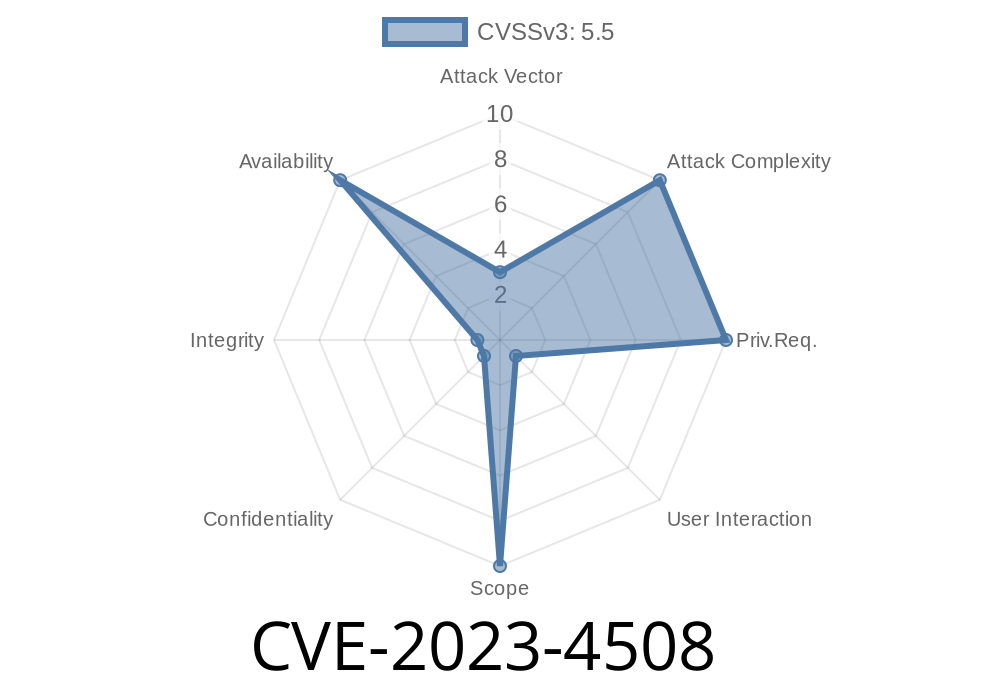
If you use Gerbv — the open-source Gerber (RS-274X) viewer — especially between versions 2.4. and 2.10., you should know about CVE-2023-4508. This vulnerability can allow a remote attacker to crash the application with a specially crafted file, making it unavailable (a Denial-of-Service, or DoS). The attacker only needs to get you to open a malicious file.
This post explains the bug in simple terms, shows code snippets demonstrating the issue, and walks you through a working exploit. At the end, you’ll find links to the original advisory and technical discussion.
What is Gerbv and the Gerber File Format?
Gerbv is a popular open-source tool for viewing and analyzing PCB designs in the Gerber RS-274X format. Engineers and designers use Gerbv to make sure their circuit boards look right before ordering them.
Gerber files are just text files that describe the shapes to draw for each layer of a circuit board. But like any tool that opens files, if there’s a bug in how those files are read, someone can craft a file that causes trouble.
What happens?
An attacker who controls the file you open in Gerbv can write a special Gerber file that triggers a crash — usually a segmentation fault — and thus takes down your Gerbv session. This may lose work or disrupt automated systems.
This is a denial-of-service (DoS) bug: the attacker cannot run code just with this, but they can make Gerbv stop working.
How does it work?
Gerbv’s parser for Gerber RS-274X files does not properly check certain numeric values or formatting in the input file. A crafted file with “unexpected” or out-of-bounds values will cause a crash during parsing.
The attacker needs to supply such a file, typically with faked coordinates or undefined macro content.
Here’s a minimal Gerber file that can crash *vulnerable* Gerbv versions
G04 Gerber file with crash payload for CVE-2023-4508*
%FSLAX24Y24*%
%ADD10C,.010*%
G54D10*
X100Y100D03*
X-2147483648YD03*
M02*
The line X-2147483648YD03* sends a *huge negative* x-coordinate.
- Some Gerbv versions don’t check for integer overflows or non-standard values and crash when converting or using this data.
Note
Some other malformed Gerber commands can also trigger the crash. This is just the simplest demonstration.
Real-World Impact
- User Impact: If you rely on Gerbv for design review or automation, an attacker (or a malicious co-worker) could send you such a file by email or through your revision system. Once opened, the crash could disrupt your workflow.
- Scripted/Automated Use: In some companies, Gerbv is used in nightly build scripts. One bad file would take down the whole process.
- Mitigations: Always update to the latest Gerbv version, and avoid opening files from untrusted sources.
Upgrade to Gerbv 2.11. or later.
Download: https://gerbv.github.io/
- Preventative: Run Gerbv in a container or as a less-privileged user, so even total crashes don’t cause wider system problems.
- Pre-screen your files: If you must use older versions, try scripts that check for out-of-range coordinate values.
References
- Main CVE entry: CVE-2023-4508 at NVD
- Original Gerbv GitHub Issue
- Security Advisory at GitHub
- Gerbv Home Page
Summary
CVE-2023-4508 is a simple but effective way to crash Gerbv with a cleverly made Gerber file, thanks to incomplete input checking in several released versions. If you work with PCB files or Gerbv in any capacity, make sure you have the fixed version — and be careful with files from unknown sources!
*If you found this write-up helpful, share it with your engineering friends or co-workers who use Gerbv. Stay safe and always keep your software up-to-date!*
Timeline
Published on: 08/24/2023 23:15:09 UTC
Last modified on: 09/30/2023 17:15:39 UTC