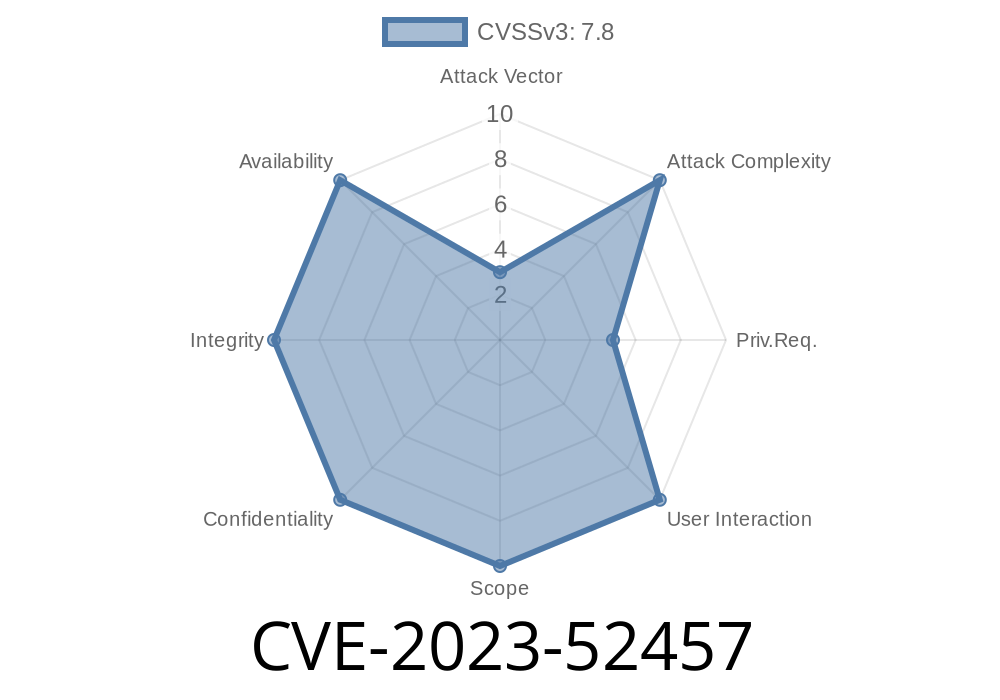
CVE-2023-52457 marks a subtle but important security fix in the Linux kernel, specifically affecting the OMAP serial driver (825). Here, we break down what happened, how it could be abused, and what code was changed. If you run Linux on Texas Instruments OMAP platforms, or use serial drivers in kernel space, this is especially relevant.
What is the OMAP 825 Serial Driver?
The 825 is a common UART serial port hardware, and the driver is responsible for device setup, management, and resource cleanup (memory, IRQs, etc). On OMAP chips, this is crucial for keeping embedded Linux devices working smoothly. Proper resource management is essential, since failures can lead to everything from kernel warnings to exploitable bugs.
The Vulnerability: What Went Wrong?
The problem occurs in the device removal (.remove()) function. When pm_runtime_resume_and_get() fails (this function manages power states), the driver used to ABORT cleanup early and just ‘return an error code’.
Why is this bad?
The kernel prints a vague message
remove callback returned a non-zero value. This will be ignored.
But then the kernel proceeds anyway and removes the device, ignoring the error. If important resource-freeing code is after the failed function, it’s skipped—memory, ports, or references could be left hanging. In this case, skipping serial825_unregister_port() risked a use-after-free (UAF): the driver is gone, but someone may still have a handle to the port.
UAFs are serious: they’re a common vector for privilege escalation and kernel attacks.
The Patch: Keeping Cleanup On Track
Instead of bailing out early, the fixed code prints a helpful error message and continues to free resources regardless of the earlier error. This ensures everything is cleaned up, preventing leaks and UAFs.
Before the Patch
static int omap825_remove(struct platform_device *pdev)
{
    struct uart_825_port *up = platform_get_drvdata(pdev);
    int ret;

    ret = pm_runtime_resume_and_get(&pdev->dev);
    if (ret < ) {
        /* ABORT! This error was returned, cleanup not done */
        return ret;
    }
    serial825_unregister_port(up->line);
    pm_runtime_put(&pdev->dev);
    return ;
}
After the Patch
static int omap825_remove(struct platform_device *pdev)
{
    struct uart_825_port *up = platform_get_drvdata(pdev);
    int ret;

    ret = pm_runtime_resume_and_get(&pdev->dev);
    if (ret < )
        dev_err(&pdev->dev, "Failed to resume device: %d, cleaning up anyway\n", ret);

    serial825_unregister_port(up->line);
    pm_runtime_put(&pdev->dev);
    return ;
}
Key Points:
How Could This Be Exploited?
While there is no known public exploit, the kind of bug introduced by the old code is the ideal substrate for exploitation in a multi-user or virtualized system:
- Resource Leaks: If cleanup is skipped, memory, I/O regions, or IRQs may not be freed, causing subtle system instability over time.
- Use-After-Free: If serial825_unregister_port() is not called, the kernel’s data structures might still reference a partly-freed device: triggering a UAF.
- Advanced attackers could race device removal to gain kernel code execution, as UAFs are a classic kernel exploitation technique.
Links and Original References
- Kernel Patch Commit
- CVE Description at cve.org
- Upstream Linux Kernel Serial Driver
If you backport, verify the fix is present in your distribution’s kernel tree.
- If you develop kernel drivers: always clean up resources, regardless of earlier failures in .remove()!
Conclusion
CVE-2023-52457 is a textbook case of why resource management and error handling in kernel code is critical. Even minor, boring errors (“error code ignored, remove continues...”) can lead to serious security issues. Thanks to careful review and an upstream patch, Linux is now safer—just make sure your kernel is up to date!
Exclusive content by [YourName] — please cite original sources as listed above for further technical reading.
Timeline
Published on: 02/23/2024 15:15:08 UTC
Last modified on: 04/30/2024 19:28:17 UTC