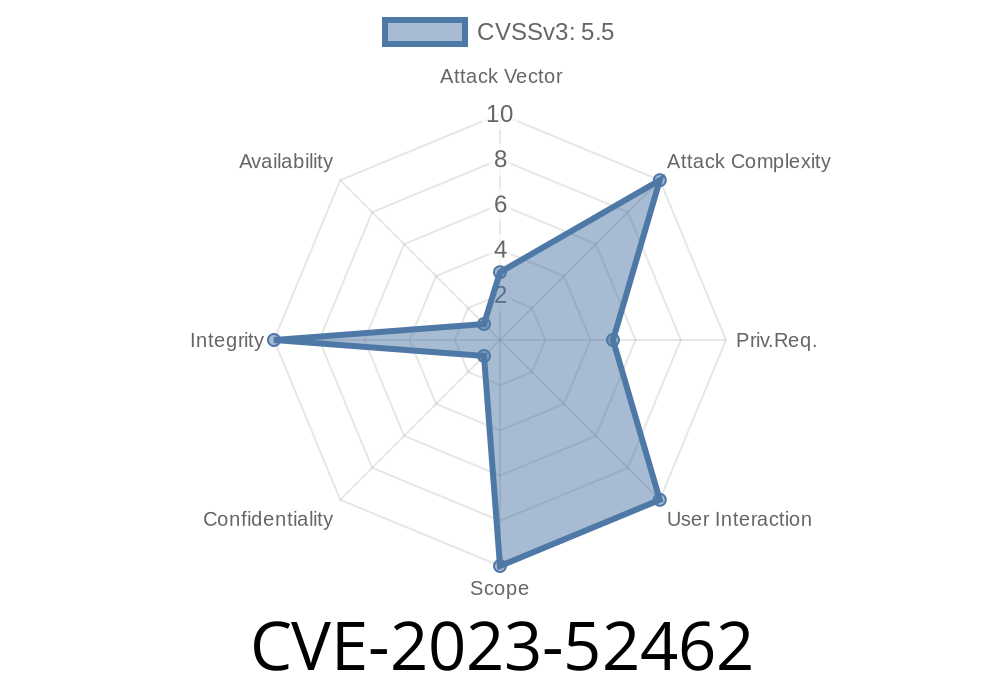
In late 2023, security researchers and Linux kernel developers fixed a subtle but serious bug in the kernel’s BPF (Berkeley Packet Filter) subsystem. Known as CVE-2023-52462, the vulnerability involved a mishandling of stack slots when BPF registers get spilled, and created a chance for attackers to corrupt memory—or even escalate privilege. Let’s break this down in plain, simple English, look at the code, and see what was done to patch it.
What Is BPF and Why Does It Matter?
The BPF system lets apps and tools load “programs” into the kernel that can filter packets, trace syscalls, or execute other low-level logic. Since these programs run almost directly inside the kernel, even a tiny bug or oversight in BPF’s security can have *catastrophic* results.
Summary of the Vulnerability
CVE-2023-52462 boils down to how the kernel tracked BPF registers when pushed (“spilled”) onto the stack. For efficiency, BPF uses byte-sized slots, and sometimes, only a part of a register (like 1, 2, or 4 bytes) gets pushed.
The logic that checked if a stack location contains a spilled register was *off by several slots*. It wrongly checked slot_type[] (bottom of the stack slot), when actually, the spilled data could be up in slot_type[7] for an 8-byte (64-bit) register.
The fix: use a dedicated is_spilled_reg() function that always checks the proper position, so future code doesn’t get this critical detail wrong.
Leak kernel addresses, or let crafted BPF programs “poke” at sensitive kernel memory.
It’s a classic example of a memory corruption primitive that makes further kernel exploits much easier, especially in containerized or privileged environments.
Here’s the essence of the vulnerable logic in the BPF kernel verifier (simplified)
// OLD BAD LOGIC: Only checks the bottom slot!
if (slot_type[] == STACK_SPILL) {
    // assume a register was spilled here
    ...
}

// CORRECT WAY: Use the helper to check the correct slot!
if (is_spilled_reg(slot_type)) {
    // accurately detects spilled register on the stack
    ...
}
The bug was in assuming the bottom-most stack slot (slot_type[]) always reflects if a register is spilled there. For partial spills, the actual spill info might be only in slot_type[7].
The fix is simple, but crucial—call the right helper so future checks always do the right thing, no matter what size the spill.
Reference Links
- Main Linux kernel commit: bpf: fix check for attempt to corrupt spilled pointer
- Mitre CVE entry (when available)
- BPF documentation
Why This Matters (And How to Stay Safe)
If you run untrusted BPF code (user containers, system tracing, custom packet filters), this bug might let a local user abuse kernel containment, break isolation, or escalate privilege. Even if you don’t, patch anyway—kernel security bugs often have surprising side effects!
How to fix
- Upgrade to at least Linux 6.6.12, or ensure your kernel has the backported patch.
- If you can’t patch quickly, consider disabling untrusted BPF program loading or restricting the CAP_BPF/related capabilities for low-trust users.
In Conclusion
CVE-2023-52462 shows how even a “small” bug—a single out-of-place array access—can lead to wide-open gates for attackers. Thanks to the Linux kernel community, it was quickly found and fixed. Make sure your systems are updated, especially if you rely on BPF for anything security sensitive.
Timeline
Published on: 02/23/2024 15:15:08 UTC
Last modified on: 04/17/2024 20:06:29 UTC