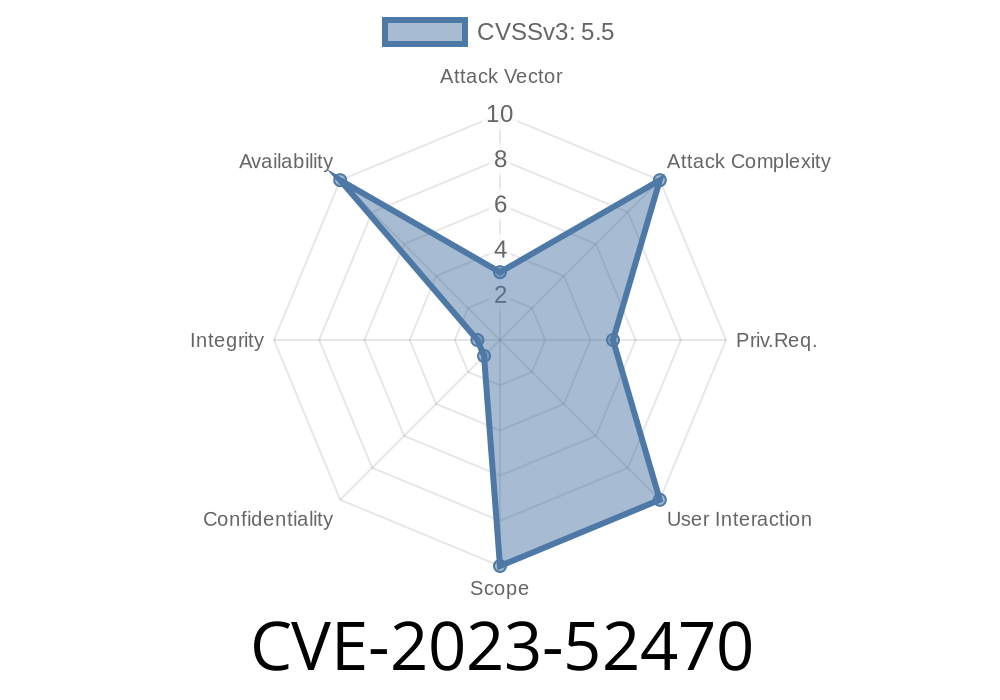
When it comes to the Linux kernel, even a small oversight can cascade into security vulnerabilities. One such oversight was recently uncovered and patched in the Radeon graphics driver code — tracked as CVE-2023-52470. In this long read, we’ll break down what went wrong, what could happen if left unpatched, and show you just how simple the fix was.
Overview: Null Pointer Dereference and Why It’s Bad
The Radeon graphics driver is open-source code for AMD graphics cards on Linux. Like much kernel code, it interacts directly with hardware and runs with the highest privileges. That means a single misstep (like using a pointer without checking it’s not NULL) can crash your system — or worse, be used for privilege escalation.
A null pointer dereference error happens when a program assumes a memory allocation worked, but it actually failed and returned NULL. If the code then tries to use that pointer, the kernel panics; on rare occasions, crafty attackers might exploit this for more nefarious purposes.
The Vulnerable Function: radeon_crtc_init()
Within the Linux kernel’s Radeon driver sits the function radeon_crtc_init(), responsible for setting up a "CRTC" (the hardware controlling video signals).
To manage work in the background, Linux uses "workqueues". Developers typically allocate these structures with alloc_workqueue(). Crucially, that function might fail (especially under tight memory). But until recently, the Radeon code *did not check* if alloc_workqueue() returned NULL — it just assumed it always succeeded.
Here’s a snippet from the vulnerable code
rdev->disp_irq_workqueue = alloc_workqueue("radeon-disp", WQ_HIGHPRI, );
queue_work(rdev->disp_irq_workqueue, &rdev->disp_irq_work);
If alloc_workqueue() fails and returns NULL, queue_work() operates on a null pointer — crashing the kernel.
Potential Exploit Scenario
While this bug is not a remote code execution vulnerability, it could be abused locally by a user who can force low memory situations, causing alloc_workqueue() to return NULL. If a malicious local user then triggers the vulnerable Radeon code path, the system could crash (denial of service). In some situations, with clever heap manipulation, an attacker could trigger undefined kernel behavior — possibly escalating privileges.
Malicious user starves system memory (using stress tools or memory-hogging programs).
2. Causes the kernel (with Radeon driver loaded) to initialize a new CRTC (e.g., plug/unplug monitors or manipulate the graphics environment).
The Fix: Add a Null Check
The fix for CVE-2023-52470 is beautifully simple. After calling alloc_workqueue(), the code now checks if the result is NULL. If it is, the function bails out instead of proceeding.
Patch snippet
rdev->disp_irq_workqueue = alloc_workqueue("radeon-disp", WQ_HIGHPRI, );
if (!rdev->disp_irq_workqueue) {
    DRM_ERROR("Failed to create irq workqueue\n");
    return -ENOMEM;
}
Key References
- CVE Notice — nvd.nist.gov
- Patch commit in kernel source
- Radeon driver code (as of mainline)
How You’re Affected, and Remediation
- Who’s impacted? Any Linux system using the open-source Radeon driver, especially those with untrusted users.
- What to do? Make sure your system is running a Linux kernel with this patch (look for updates from your distribution).
- Can I test or exploit this myself? While possible, exploiting this is hard (and risky). Simulating low-memory then hotplugging monitors might reproduce crashes on unpatched systems.
Conclusion
CVE-2023-52470 is a textbook example of how critical low-level code correctness is; a single missed null check in a crucial path could allow local users to crash your machine, or potentially do worse. Thanks to diligent kernel developers and transparent reporting, the bug was patched quickly. The fix is open, simple, and effective — but every Linux admin should make sure their systems have it.
Keep those kernels updated!
*If you want to read more kernel security stories, or learn how to dig into open-source code for your own protection, stay tuned.*
Timeline
Published on: 02/26/2024 16:27:48 UTC
Last modified on: 04/17/2024 18:46:07 UTC