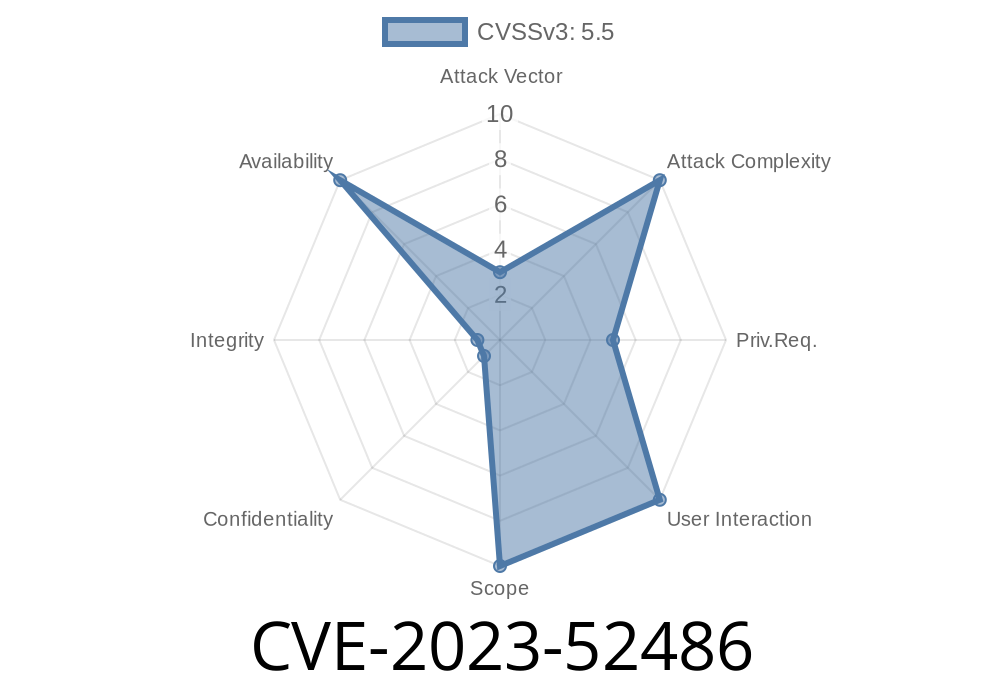
On modern Linux systems, the kernel does a huge job managing graphics—especially through something called the Direct Rendering Manager (DRM). Sometimes, even the tiniest bug in this area can cause weird crashes, memory problems, or even system instability. CVE-2023-52486 is a great example: a simple but dangerous memory handling mistake in the Linux kernel's DRM subsystem.
This bug is now fixed, but let’s break down what happened, how the exploit could work, and what you should know to protect your system. This post tries to keep things simple and clear for everyone—from Linux users to kernel developers. Links to more details are at the bottom.
1. What is CVE-2023-52486?
CVE-2023-52486 is a vulnerability found in the Linux kernel’s DRM code, specifically in the function responsible for flipping display buffers (drm_mode_page_flip_ioctl). The bug allowed the kernel to mess up the memory reference count for graphic framebuffers—leading to the system freeing up (or unreferencing) a framebuffer while it was still being used.
Here’s the problem in simple words
- The kernel tried to "unref" (release) the same framebuffer (an object representing the graphic content shown on screen) more than once by mistake.
- If that happens, the actual framebuffer data might get deleted from memory while still expected by the system or apps.
Let’s zoom in on the bug itself.
When the kernel wants to *flip* what's displayed (useful for smooth graphics or games), it first looks up the framebuffer object:
struct drm_framebuffer *fb;
fb = drm_framebuffer_lookup(dev, file, r->fb_id);
But if it runs into a deadlock, it needs to clean up before retrying. The code did this with
drm_framebuffer_unreference(fb);
But here's the catch: They *forgot* to reset the fb pointer after unreferencing it. So, on the next loop, if another error happened before getting a new framebuffer, it would *again* try to unref the same already-freed framebuffer.
This is called a *double unref*, and it can corrupt kernel memory. Imagine two people trying to throw away the same document—one throws it out, and the other tries, but the document is already gone!
After the bug was reported, the fix added one crucial line
if (fb) {
    drm_framebuffer_unreference(fb);
    fb = NULL;  // <--- THE FIX
}
By setting fb to NULL, any later code will not mistakenly use or unreference a framebuffer that’s already been cleaned up.
3. How Can This Be Exploited?
This vulnerability is *not* a simple “run this and get root” issue. But...
- Local users who can trigger GPU buffer flipping (i.e., with access to /dev/dri/card, like regular logged-in users with graphics sessions) could cause kernel memory corruption.
- Privilege escalation is theoretically possible if you chain this with other bugs, but by itself, it mainly risks denial of service (kernel crashes, lockups).
- Attackers could write programs or scripts that rapidly trigger asynchronous page flips and intentionally cause deadlocks—especially on affected hardware/chips.
Sample Exploit Pseudocode
This is how you might create an unstable situation (pseudocode—don’t run on non-test systems):
"""
CAUTION: This is for research/demo ONLY.

Requirements:
- Access to /dev/dri/card (local graphics user)
- System with vulnerable kernel (before the fix was applied)
"""

import os
import fcntl
import threading

def flip_thread():
    fd = os.open('/dev/dri/card', os.O_RDWR)
    while True:
        # Craft and send a maliciously timed page flip ioctl
        try:
            # Replace the following with actual DRM_IOCTL_MODE_PAGE_FLIP call
            fcntl.ioctl(fd, DRM_IOCTL_MODE_PAGE_FLIP, malformed_buffer)
        except Exception:
            pass

threads = []
for _ in range(10):
    t = threading.Thread(target=flip_thread)
    t.start()
    threads.append(t)
This thread bombards the GPU driver with poorly timed flip requests and can sometimes trigger the vulnerable path, especially under debug kernels or with artificial mutex contention.
Primarily impacts users of Intel DG2 graphics (and maybe others using DRM async flips).
- The bug is more likely to appear if CONFIG_DEBUG_WW_MUTEX_SLOWPATH=y is enabled (dev/debug/test builds).
5. How to Fix
Update your kernel! The fix is simple and is already merged in mainline. If you use Debian, Ubuntu, Fedora, Arch, or any maintained Linux, just ensure your system’s kernel includes this commit:
- drm: Don't unref the same fb many times by mistake due to deadlock handling
6. References and Further Reading
- [CVE-2023-52486 [MITRE/NVD Entry]](https://nvd.nist.gov/vuln/detail/CVE-2023-52486)
- Linux kernel Git commit: drm: Don't unref the same fb many times (fcec0683d1c1)
- Original bug report/thread on the Linux kernel mailing list
7. Summary
CVE-2023-52486 is a good reminder: even tiny mistakes like forgetting to reset a pointer can have big consequences in kernel code. Most users are safe if they keep their Linux kernel up-to-date. But for anyone interested in how robust graphics systems work under the hood, this bug is a great (if cautionary) lesson in the importance of good reference counting and careful error handling.
If you want to learn more about Linux kernel graphics bugs, check out the links above!
Timeline
Published on: 03/11/2024 18:15:16 UTC
Last modified on: 01/14/2025 15:01:47 UTC