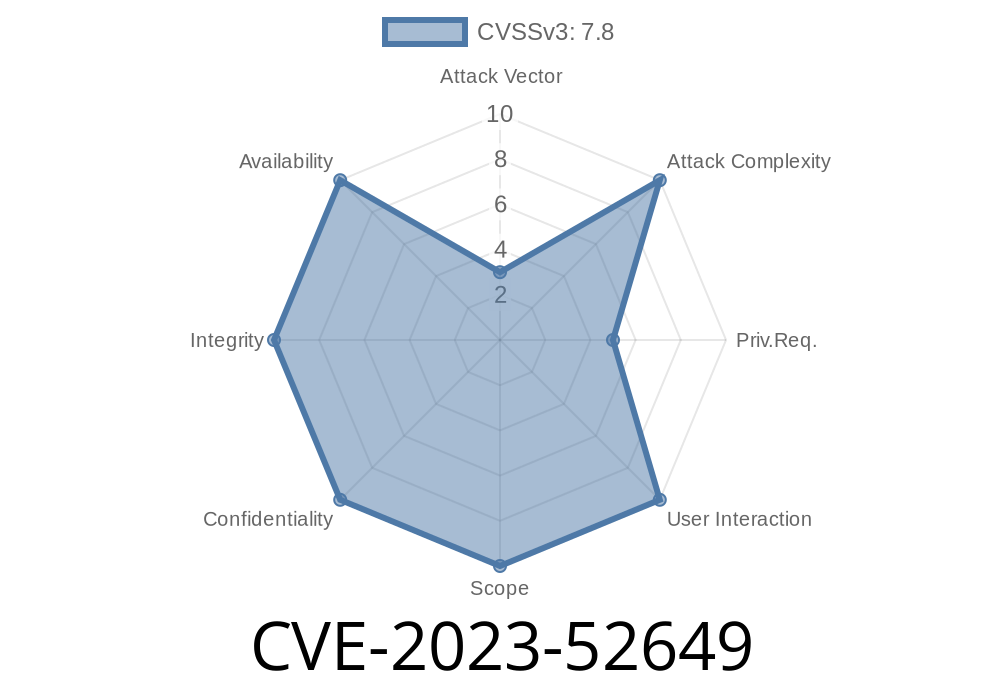
Recently, a vulnerability was discovered and fixed in the Linux kernel's Virtual Kernel Mode Setting (VKMS) driver—specifically in its DRM (Direct Rendering Manager) implementation. This flaw, identified as CVE-2023-52649, could allow code to read memory beyond the bounds of an array. That might sound technical, but in simple terms, it means a bug in the kernel could potentially be leveraged for information leaks or stability issues if not patched.
This post breaks down what happened, shows the vulnerable code, and outlines how someone might exploit (and how to fix) the issue. If you're a Linux user or kernel developer, read on to learn what you need to know.
What is VKMS and the LUT Array?
VKMS is a software-only driver in the Linux kernel for testing and running graphical components without actual hardware. It's handy for headless servers, virtual machines, and automated CI tests.
A LUT (Look-Up Table) here is just an array used for color correction and other pixel manipulations. In code, these are standard C arrays.
In this specific case, the bug was about reading a table with color data and accidentally reading *off the end* of the array—something C doesn't stop you from doing, but which is always a security risk.
The Vulnerability in Detail
Vulnerable component:
drivers/gpu/drm/vkms/vkms_composer.c in the Linux kernel
What Happened?
When converting a color value, the code would look up two values in the LUT array: a "floor" and a "ceiling" index. If the color was at the very end of the LUT array, the code didn't properly check if it was about to read *beyond* the end of the array. This is known as an "out-of-bounds read," which can result in leaking sensitive data, kernel panics, or worse.
The Vulnerable Code
Here’s a simplified C code snippet demonstrating the problem (source):
int lut_index = drm_fixp2int(lut_pos); // Get fixed-point value
int floor = lut_index;
int ceil = floor + 1;

// Bug! If floor is the last array index, 'ceil' is out-of-bounds
result = interpolate(lut[floor], lut[ceil], lut_pos);
The Fix
The maintainers patched the code so that if floor is already the last valid index, ceil is set to the same value, preventing an out-of-bounds access:
int lut_index = drm_fixp2int(lut_pos);
int floor = lut_index;
int ceil = (floor == lut_size - 1) ? floor : (floor + 1); // Fixed!

result = interpolate(lut[floor], lut[ceil], lut_pos);
Reference to the patch:
- Upstream Patch Commit
Example Exploit Condition
1. A program (privileged or not, depending on kernel config and graphics permissions) creates a framebuffer using VKMS.
It deliberately sets pixel values that will cause the color LUT index to be at its maximum value.
3. The vulnerable code tries to read lut[ceil] with ceil=lut_size, reading memory just past the color table.
4. Whatever data lives there could be used to infer kernel pointers, poison stateful checks, or just crash the kernel by accessing unmapped memory.
Minimal Trigger (Pseudocode)
// This is pseudocode and won't work unless you have full kernel module access
unsigned int index = max_lut_index; // Last element
value = lut[index + 1]; // Out-of-bounds read
In real scenarios, user space could trigger this under some configurations by playing with DRM clients and pixel formats.
Who is Affected?
- Linux kernels with the VKMS driver enabled, particularly unpatched versions from before late 2023/early 2024.
- Systems running with graphics stack test setups or in CI/CD pipelines.
Distributions
- Most end-user desktops aren’t using VKMS, but servers and virtual machines for development/testing might be. It's always best to update your kernel.
Update your Linux kernel
Make sure you’re running a version with the fix merged (v6.7-rc1 and newer; check your distro’s kernel advisory).
Check with your distro
Most distributers (Ubuntu, Debian, Fedora, etc.) have security advisories—search for 'CVE-2023-52649' for your system.
Official References & More Info
- CVE-2023-52649 at NVD
- Upstream Linux Patch Commit
- Linux Kernel DRM VKMS Subsystem
Conclusion
CVE-2023-52649 is a classic "off-by-one" bug that highlights how even simple C array mistakes can have real-world security consequences in the kernel. If you maintain infrastructure or projects use VKMS for testing, it’s critical to update your kernel or validate configurations.
Thanks for reading! Stay safe, and remember: *always check your array bounds*.
*Exclusive security analysis and code detail compiled for 2024. If you found this helpful, share or reference for responsible disclosure!*
Timeline
Published on: 05/01/2024 13:15:48 UTC
Last modified on: 12/23/2024 19:14:57 UTC