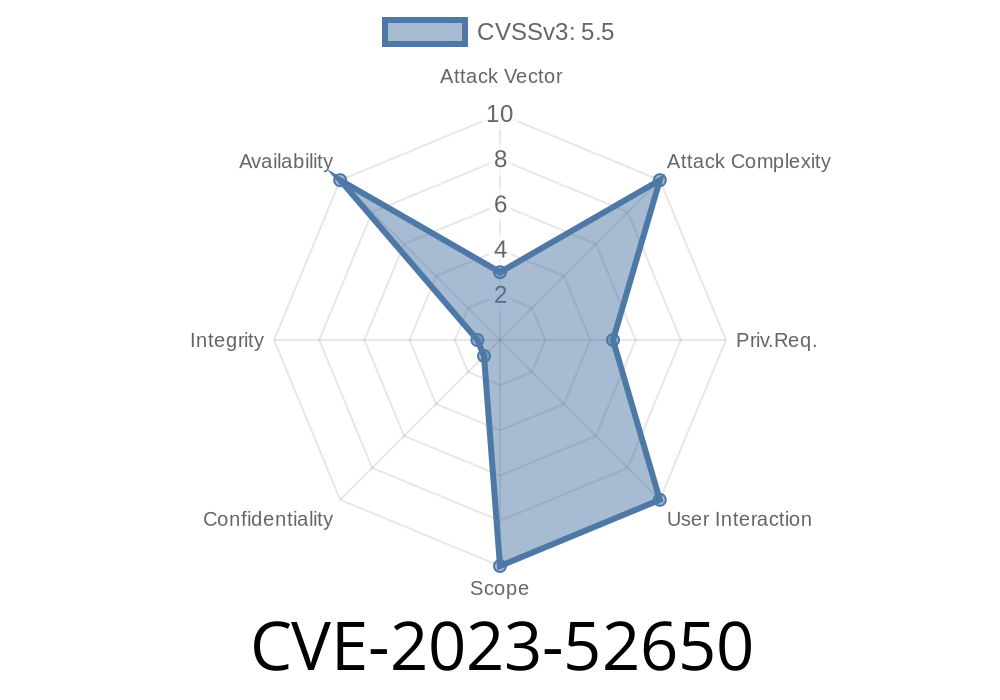
The world's favorite operating system, Linux, is known for its open-source nature and powerful kernel. But it's not immune to security flaws, especially in hardware drivers. One such vulnerability, CVE-2023-52650, was found in the Direct Rendering Manager (DRM) subsystem for NVIDIA Tegra SoCs (System on Chips). This write-up breaks down the bug, its technical details, how it could be exploited, and what you should do to stay safe.
What is CVE-2023-52650?
CVE-2023-52650 is a vulnerability in the Linux kernel, affecting the *drm/tegra/dsi* (Display Serial Interface) driver. The flaw is all about improper error handling when the kernel tries to find a device by its device tree node using of_find_device_by_node(). If that function fails and returns NULL, not handling the error could lead to a NULL pointer dereference. In the worst case, this may crash your system or, less likely, allow for further exploitation.
The Vulnerable Code
Let’s look at what went wrong in the code. Here’s a simplified version from the Linux kernel source:
struct platform_device *pdev;
pdev = of_find_device_by_node(some_node);
/* ... used pdev with no NULL check ... */
do_something_with(pdev->dev);
The problem? If of_find_device_by_node() couldn’t find the device, pdev would be NULL. The code was using pdev directly, leading to a crash.
How the Vulnerability Works
Attackers could possibly trigger this flaw by manipulating the device tree input — for example, by providing an unusual or corrupt device tree node. When kernel code fails to check if pdev is valid, dereferencing this NULL pointer can result in a kernel panic (the Linux equivalent of the "Blue Screen of Death"). While this is most likely a Denial-of-Service (DoS) vulnerability, such bugs are sometimes used in more complex exploits for privilege escalation.
Proof-of-Concept (PoC) Exploit
While an easily weaponizable exploit isn’t public (or practical) for most users, here’s a minimum proof-of-concept demonstrating the core issue:
// Pseudocode for triggering the crash
struct device_node *bad_node = get_nonexistent_node();
struct platform_device *pdev = of_find_device_by_node(bad_node);

// No check here!
pr_info("Device name: %s\n", dev_name(&pdev->dev)); // Crashes if pdev == NULL
By supplying a node that doesn’t exist, and accessing pdev->dev, the system crashes.
Note: In real life, this kind of attack would require special hardware or root privileges and is unlikely to be a remote exploit.
The Fix: How It Was Resolved
The patch is straightforward: check the return value from of_find_device_by_node() before using it. If it returns NULL, return an error instead of continuing.
Fixed Code
struct platform_device *pdev;
pdev = of_find_device_by_node(some_node);
if (!pdev)
    return -ENODEV; // Exit cleanly if device is not found

// Safe to use pdev here
do_something_with(pdev->dev);
This proper error handling prevents a NULL pointer dereference and improves kernel robustness.
Reported: Late 2023
- Patched in: Linux mainline kernel (commit link)
- Kernel Versions Affected: Any version with the buggy drivers/gpu/drm/tegra/dsi.c code before the patch
References
- NVD Entry for CVE-2023-52650
- Upstream Kernel Commit
- Relevant Patch Discussion
What Should You Do?
If you maintain or run a Linux system on NVIDIA Tegra SoCs (think Jetson developer boards and some Android devices):
Conclusion
CVE-2023-52650 is a clear example of how a small oversight — not checking for a NULL return value — can lead to kernel crashes, or worse. While unlikely to allow remote attacks, it could deny service by crashing affected systems, especially in embedded scenarios where DSI is actively used.
Takeaway: Always check your return values, and keep your Linux systems patched!
Timeline
Published on: 05/01/2024 13:15:48 UTC
Last modified on: 12/23/2024 14:09:30 UTC