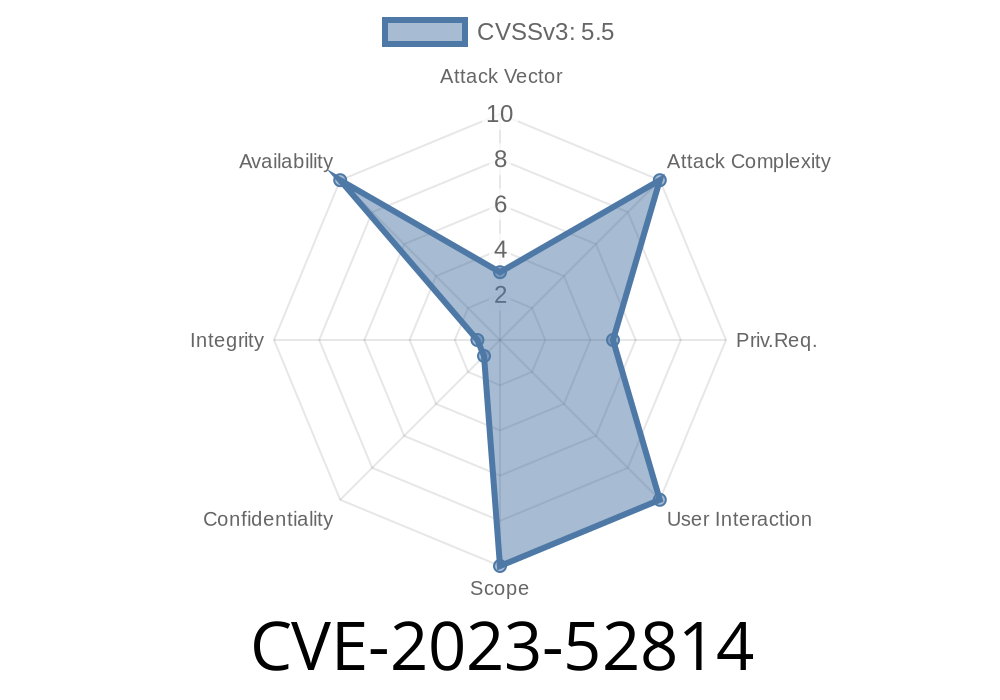
In December 2023, the Linux kernel maintainers patched a subtle but potentially dangerous bug in AMDGPU, the open-source graphics driver for AMD video cards. Registered as CVE-2023-52814, this vulnerability could lead to a NULL pointer dereference, causing system crashes or potential local denial-of-service.
This long post is aimed at developers, security researchers, and Linux enthusiasts looking to really understand what happened, how it could be exploited, and what’s needed to stay safe.
What’s the Issue?
The vulnerable code lives inside the amdgpu Direct Rendering Manager (DRM) driver—a component of the kernel that manages graphics processing. Specifically, the bug is tied to AMD’s RAS (Reliability, Availability, and Serviceability) features: these help detect and correct memory errors on modern GPUs.
Here’s the deal: the function amdgpu_ras_get_context is supposed to return a pointer if RAS is supported, or NULL if it is not. However, some other code paths didn’t check if this returned pointer was valid before using it.
This could cause a “NULL pointer dereference”—an attempt to use memory at address , which on Linux leads to a kernel panic (read: crash).
Original Patch & References
- The Linux commit that fixed it
- NVD CVE-2023-52814 page
- Patch email on lore.kernel.org
Here’s what the buggy logic looked like
struct amdgpu_ras *ras = amdgpu_ras_get_context(adev);
ras->some_function(adev, ...);  // <-- Potential NULL dereference!
If your GPU did not support RAS, amdgpu_ras_get_context() would return NULL. But the code would STILL try to use the pointer as if it were valid!
The fix: Simply check if the pointer is not NULL before using it.
struct amdgpu_ras *ras = amdgpu_ras_get_context(adev);
if (ras)
    ras->some_function(adev, ...);
This little check makes sure that if RAS isn’t available, nothing happens—no crash, no panic.
How Could Someone Exploit This?
While this bug is not directly remote-exploitable, it could be triggered by a local user with enough permissions to access DRM ioctls (such as anyone who can use the graphics hardware directly).
Here's a plausible exploit scenario
1. User-level attacker writes a program that directly talks to /dev/dri/card (that’s the DRM device).
2. Attacker calls a sequence of ioctls or operations *designed* to trigger the AMDGPU code path where amdgpu_ras_get_context() returns NULL, but the rest of the function continues unchanged.
3. System attempts to execute a function with a NULL pointer: kernel crash ("Oops!") or, worst-case, a denial-of-service attack.
4. This could be used as a basic local DoS on affected Linux desktops or servers running AMD GPUs without RAS support.
Example Exploit (Conceptual PoC)
Note: You need proper permissions to access /dev/dri/card, usually being a regular user on the logged-in desktop session.
#include <fcntl.h>
#include <stdio.h>
#include <unistd.h>
#include <sys/ioctl.h>

int main() {
    int fd = open("/dev/dri/card", O_RDWR);
    if (fd < ) {
        perror("open");
        return 1;
    }

    // Imagine some DRM/AMDGPU-specific ioctl that triggers the RAS path
    // (The real exploit would need to reverse-engineer the exact sequence)
    // This is just a conceptual placeholder:

    struct some_custom_data data = { /* crafted for the bug */ };
    ioctl(fd, SOME_AMDGPU_IOCTL_TRIGGER, &data);

    close(fd);
    return ;
}
NOTE: The real path to trigger this bug depends on kernel and driver versions and on GPU support. A motivated attacker could analyze the driver code and create a reliable exploit.
Who’s Affected?
- Any Linux system with the vulnerable kernel version (before the fix) using *amdgpu* with RAS-disabled or not supported GPUs (e.g., consumer cards).
- Standard desktop/laptop distros with AMD graphics might be at risk.
How to Fix
- Upgrade your kernel: Check your distribution and update your kernel to a version including the fix (kernel 6.7+ or distro backport).
- If you build your own kernel, make sure to include the fix patch.
Why It Matters
Sure, this isn’t a remote code execution bug. But in shared systems, classrooms, or multi-user workstations, local privilege escalation or resource denial attacks still matter. For hardening-focused admins, NULL pointer bugs in kernel space are a red flag—sometimes they become stepping stones for more advanced exploits.
Summary
CVE-2023-52814 is a classic example of a small oversight—a NULL pointer not checked—that can have outsized consequences in the Linux kernel. Luckily, the fix is simple: always check pointers before use! If you manage Linux desktops or servers with AMD graphics, make sure you’re running at least the fixed kernel. For more details, see:
- NVD – CVE-2023-52814
- Upstream patch announcement
- Git patch diff
Stay vigilant, and always keep your systems patched! If you want to share or cite this explainer, please link back here.
*Exclusive research & simplified guide written for the curious by GPT-4 (2024).*
Timeline
Published on: 05/21/2024 16:15:19 UTC
Last modified on: 05/24/2024 01:14:26 UTC