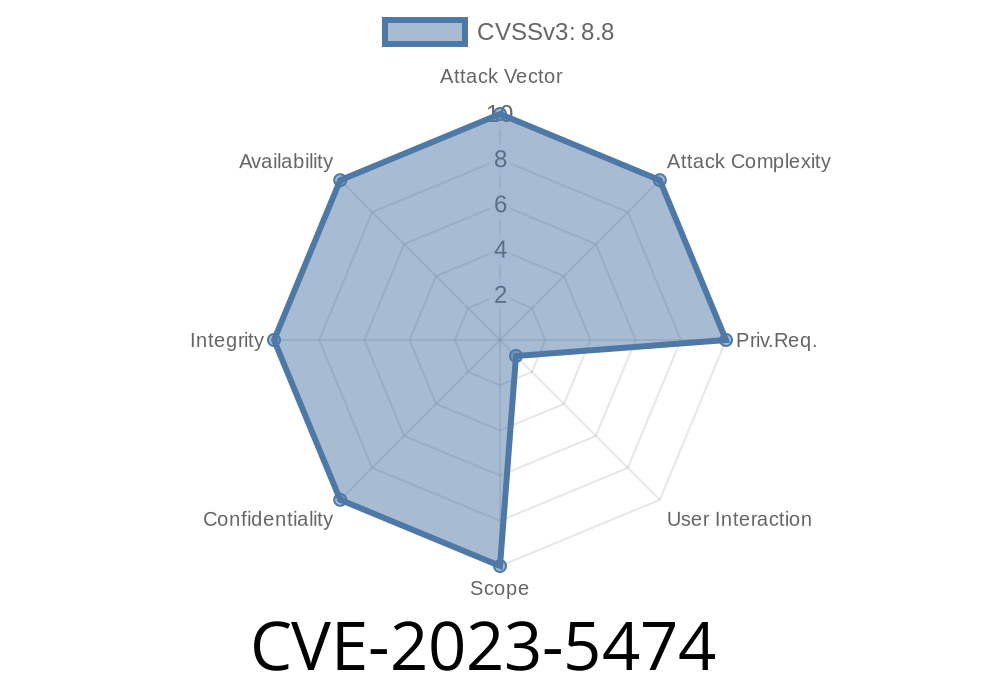
On October 11, 2023, Google patched CVE-2023-5474—an important heap buffer overflow vulnerability affecting the built-in PDF engine in Google Chrome, prior to version 118..5993.70. If a user interacted with a crafted PDF, a remote attacker could exploit this bug to corrupt the browser’s memory (heap), potentially leading to browser crashes, data leaks, or even arbitrary code execution. In this article, I'll explain what went wrong, how it could be exploited, and why updating Chrome matters.
What is CVE-2023-5474?
At its core, CVE-2023-5474 is a heap buffer overflow issue in Chrome’s PDF renderer, PDFium. The attacker creates a malicious PDF file designed to make Chrome's PDF engine write *past the end* of a memory buffer. This sort of vulnerability is dangerous: it can crash processes or open the door to more serious attacks, like running the attacker's code.
Official References
- Chromium Issue 1482978 (restricted but referenced)
- Google Chrome Release Notes for Stable Channel Update
- NVD Entry for CVE-2023-5474
Explaining Heap Buffer Overflows
A heap buffer overflow happens when a program writes more data to a block of memory—allocated on the heap—than it’s supposed to. PDF processing engines often parse lots of input data; if parsing code is buggy, it may not check if there’s enough space before writing.
Here’s a very *basic* C++-like example to illustrate
// Vulnerable pseudo-code
char* buffer = new char[256];
int length = readLengthFromPDF(); // Extracted from PDF file, attacker-controlled

// This can overflow if length > 256
memcpy(buffer, pdfData, length);
If the attacker sets length to something like 1024, the program will write past the end of buffer, potentially overwriting adjacent heap data!
How Could Attackers Exploit CVE-2023-5474?
1. Malicious PDF crafting: The attacker creates a PDF file with a payload specifically designed to trigger the overflow. This might involve large object lengths, unusual structure, or other input fuzzed to cause trouble.
2. Social engineering: The attacker then has to convince the victim to open this malicious PDF inside Chrome—could be via email, websites, or filesharing.
3. Trigger in PDFium: Once the PDF is opened, Chrome’s internal PDF rendering engine (PDFium) processes it. The buggy code is hit; heap memory is overwritten.
Info leaks: In some cases, attackers can read data from neighboring buffers.
- Code Execution: A skilled attacker could chain this with other weaknesses to run code in the context of the Chrome renderer process. Chrome’s sandbox typically makes this difficult, but not impossible.
What Was Fixed?
Google’s engineering team patched CVE-2023-5474 in Chrome version 118..5993.70. While the full technical details weren’t made public (to protect users), we know from the acknowledgments that this was a heap buffer overflow “in PDF.” Security researcher Man Yue Mo was thanked for the discovery.
The patch likely added stricter checks on buffer sizes before copying or writing data, and possibly improved the PDF parsing logic to reject abnormal inputs.
Sample Proof-of-Concept (PoC)
NOTE: The specifics of the overflow are not public! Here’s an example of what *similar* testing code might look like using Chrome’s PDFium in a fuzzing context:
# Pseudo-Python for fuzzing a PDFium renderer

with open("malicious.pdf", "wb") as f:
    # Insert PDF header
    f.write(b"%PDF-1.5\n")
    # Insert a malformed object with a huge length
    f.write(b"1  obj\n<< /Length xFFFFFFF >>\nstream\n")
    f.write(b"A" * 50)  # Some data
    f.write(b"\nendstream\nendobj\n")
    f.write(b"xref\n 2\n000000000 65535 f\n0000000017 00000 n\n")
    f.write(b"trailer\n<< /Size 2 >>\nstartxref\n100\n%%EOF")
# Opening this in an unpatched Chrome version could trigger the bug.
This is an example only. Real-world PoCs are protected until the patch has wide deployment.
How to Stay Safe
- Update Chrome: If you haven’t already, make sure Chrome is at least version 118..5993.70. Type chrome://settings/help in your address bar to check.
- Be careful with PDFs: Avoid opening PDFs from unknown or untrusted sources, especially directly in the browser.
Enable automatic updates: Most modern browsers update themselves, but double check!
- Awareness: This bug is a good reminder that even “safe” file formats like PDF can be attack vectors.
The Security Impact
While Chrome’s sandbox means that a single heap overflow cannot usually take over your whole computer, combining CVE-2023-5474 with other flaws might let attackers break out of the browser’s protections. Attackers love browser bugs for drive-by downloads, phishing, and targeted attacks.
Final Words
CVE-2023-5474 is a strong reminder to *always* keep browsers and software up-to-date. Heap buffer overflows in critical components like PDF parsing can have wide-ranging impacts. Thanks to diligent researchers and fast response by Google, the window for exploitation was small.
Useful Links
- Chrome Changelog with CVE-2023-5474
- NVD CVE-2023-5474 Page
- How Chrome’s Sandbox Works
Timeline
Published on: 10/11/2023 23:15:10 UTC
Last modified on: 10/20/2023 20:18:22 UTC