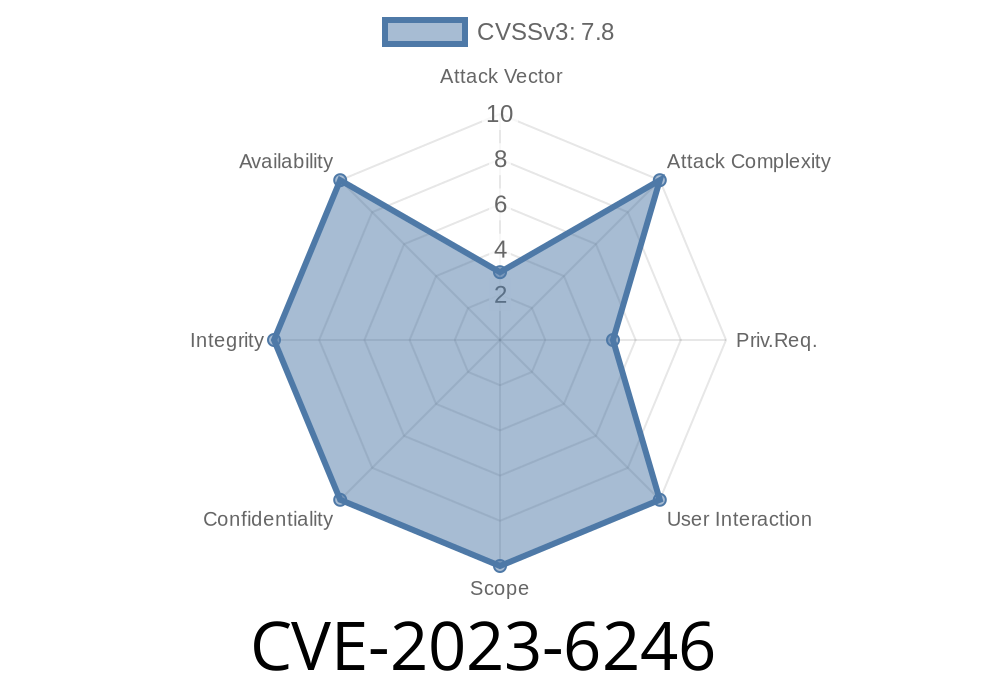
In January 2024, a critical vulnerability—CVE-2023-6246—was disclosed in one of the most fundamental parts of most Linux systems: the GNU C Library (glibc). This bug introduces a potentially severe security issue on millions of Linux installations, allowing local attackers to gain elevated privileges by exploiting a heap-based buffer overflow.
This post explains, in simple language, what CVE-2023-6246 is, how you might exploit it, and includes reference material and code snippets for a deeper understanding.
What is the Vulnerability?
CVE-2023-6246 is a heap-based buffer overflow found in the __vsyslog_internal function in the glibc library (version 2.36 and later). This function—used deep inside glibc—handles all the work for the familiar syslog and vsyslog functions, which applications use to write log messages.
The Bug
The vulnerability happens if a program calls syslog() or vsyslog() without calling openlog() first, or calls openlog() with a NULL ident. In that case, glibc tries to use the program’s own name as an identifier in logs. If that program name (which glibc gets from argv[]) is longer than 1024 bytes, it gets copied into a heap buffer without the right bounds checking. This can overflow the heap buffer, corrupt program memory, crash the application, or even allow a carefully crafted exploit to run code as the program's owner—possibly root.
Why Is It Dangerous?
Many setuid-root binaries (programs that run as root on behalf of regular users, such as sudo, passwd, etc.) use syslog, and some do not call openlog() themselves (they rely on the default). That means if an attacker can influence the argument vector (argv[]) to these programs, and make it over 1024 bytes, they can cause the overflow.
Let's look at a simplified version of the vulnerable code inside glibc
// Simplified illustration of the bug
void __vsyslog_internal(...) {
    char buf[1024]; // heap allocation in real source

    if (ident == NULL) {
        ident = program_invocation_short_name; // basically argv[]
    }
    snprintf(buf, sizeof(buf), "%s: %s", ident, message);
    // If ident is too big, snprintf will overflow buf!
}
The real source allocates buf on the heap with a fixed size and then tries to format the log message into it. If ident (here, argv[]) is too large, the buffer overflows.
Proof of Concept
Suppose there is a setuid-root binary called /usr/bin/vulnerable-syslogger that uses syslog calls but does not call openlog() or passes NULL to it.
Make a very long file name (more than 1024 bytes).
2. Create a symlink or hardlink pointing to /usr/bin/vulnerable-syslogger, with that long name.
Example PoC
# Build a 105-byte-long name
LONGNAME=$(python3 -c 'print("A" * 105)')
ln /usr/bin/vulnerable-syslogger "./$LONGNAME"
./$LONGNAME  # This will start the program with argv[] as your long name
If the program uses syslog, the heap buffer overflow occurs and may allow for code execution.
Real-World Exploit
You would need to craft a payload that, when copied into the heap, overwrites important memory structures (like function pointers, chunk metadata, etc). This is not trivial, but modern exploit techniques (especially on systems missing advanced hardening) can make it possible to hijack control flow, run shellcode, or escalate privileges.
Note: This bug is exploitable locally only (no remote attack), and the system must be missing mitigations like ASLR, heap hardening, etc.
Red Hat, Debian, Ubuntu, and other distributions have already shipped updates. See
- Red Hat Security Advisory
- Debian Security Advisory
- Ubuntu Security Advisory
- Original glibc patch
References and Further Reading
- CVE-2023-6246 NVD Entry
- Qualys Security Advisory: CVE-2023-6246
- Upstream glibc patch
- Red Hat glibc update guidance
- syslog(3) man page
Conclusion
CVE-2023-6246 serves as a reminder that even the most trusted and foundational system libraries can have critical flaws. Local users on affected systems can potentially escalate their privileges via this heap overflow bug, especially on binaries that use syslog improperly. If you’re a sysadmin or developer, update your glibc ASAP and audit your code to ensure openlog() is used properly and not with NULL ident.
If you want to see more code, a complete working exploit, or vulnerability deep dives, let me know in the comments! Stay secure.
Timeline
Published on: 01/31/2024 14:15:48 UTC
Last modified on: 02/02/2024 04:15:08 UTC