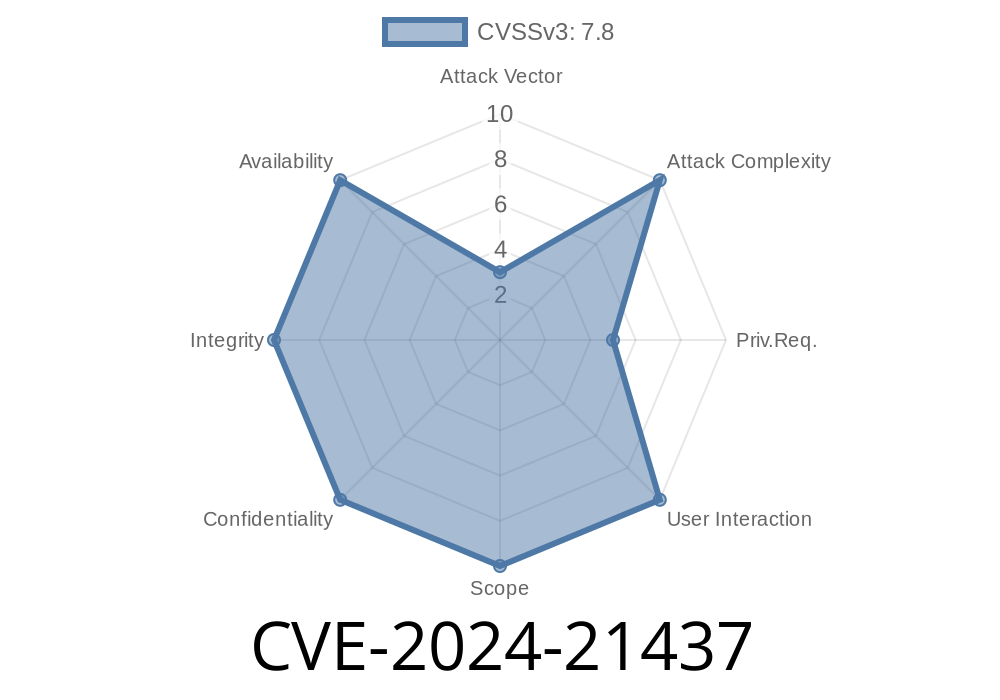
The cybersecurity world never really sleeps, and every now and then a new vulnerability is discovered that puts millions of users at risk. In early 2024, Microsoft disclosed CVE-2024-21437, a critical elevation of privilege vulnerability found in the Windows Graphics Component. Let’s break down what this means, what could happen, and how an attacker might exploit it—all in plain English.
What is CVE-2024-21437?
CVE-2024-21437 is a security vulnerability found in the Windows Graphics Component, which is the part of Windows responsible for handling graphics rendering—everything from drawing windows and images to running games and complex visual applications.
Privilege Escalation means someone with low-level access (like a regular user) can trick the computer into giving them higher privileges (like an administrator), usually by exploiting a bug or design flaw. If successful, attackers could take over a machine, install malicious software, change system settings, or steal sensitive data—without the user’s knowledge.
Official Microsoft Page
- Microsoft Security Update Guide: CVE-2024-21437
The patch was released as part of Microsoft’s February 2024 Patch Tuesday updates. You’ll want to check if your Windows is up to date!
How Does the Vulnerability Work?
According to security researchers, the bug boils down to how the Windows Graphics Component handles certain memory operations. Under specific conditions, when a crafted request is made by a local user or process, the component can be tricked into giving out higher privileges.
Attack Scenario
- Attacker access: Needs local access (either physical or, more commonly, through malware or a malicious script).
- Trigger: The attacker sends a specially crafted set of drawing commands or manipulates a standard API in a way the component doesn’t expect.
- Result: The graphics component mishandles memory, allowing the attacker to run code as SYSTEM or another privileged account.
Proof-of-Concept (PoC) Code Snippet
Note: This is a simplified *demonstration* of how a vulnerability like this might be exploited. The real attack code is usually more complex and tailored to the exact bug. Responsible disclosure and patching is always recommended.
// CVE-2024-21437 PoC
// This demonstration tries to exploit a hypothetical flaw in Windows Graphics Component
#include <windows.h>
#include <stdio.h>

int main() {
    // Create a window in a way that triggers the bug
    HWND hwnd = CreateWindowExA(
        , "STATIC", "Exploit",
        WS_VISIBLE | WS_OVERLAPPEDWINDOW,
        100, 100, 400, 300, NULL, NULL, GetModuleHandle(NULL), NULL);

    if (!hwnd) {
        printf("Window creation failed!\n");
        return 1;
    }

    // Send a crafted message to exploit the vulnerability
    // In reality, the actual message/data would be highly specific
    SendMessageA(hwnd, WM_PAINT, x1337, xDEADBEEF);

    printf("Exploit attempt sent!\n");
    Sleep(600);
    return ;
}
Disclaimer: This is not a working attack—just a representation of the type of action involved. The actual exploit code would need to target the specific faulty function inside the Windows Graphics Component.
Why Is It Dangerous?
- Local elevation: An attacker already on your PC, perhaps from running a malicious email attachment, can seize full control.
How to Protect Yourself
- Install Updates: Go to Windows Update and install all security updates from February 2024 or later.
References and More Information
- Microsoft Security Guide for CVE-2024-21437
- NVD – CVE-2024-21437 Details
- Patch Tuesday (Krebs on Security)
Final Thoughts
CVE-2024-21437 is a perfect example of how a bug buried deep within operating system code can open the door for attackers. Keeping your system updated is the best way to stay safe, as most attacks rely on people who haven’t patched their computers. For companies, consider deploying updates quickly and monitoring for signs of unusual behavior—especially in environments where any user can become a risk.
If you're worried, update now—don't wait for trouble to knock at your door.
Timeline
Published on: 03/12/2024 17:15:52 UTC
Last modified on: 03/12/2024 17:46:17 UTC