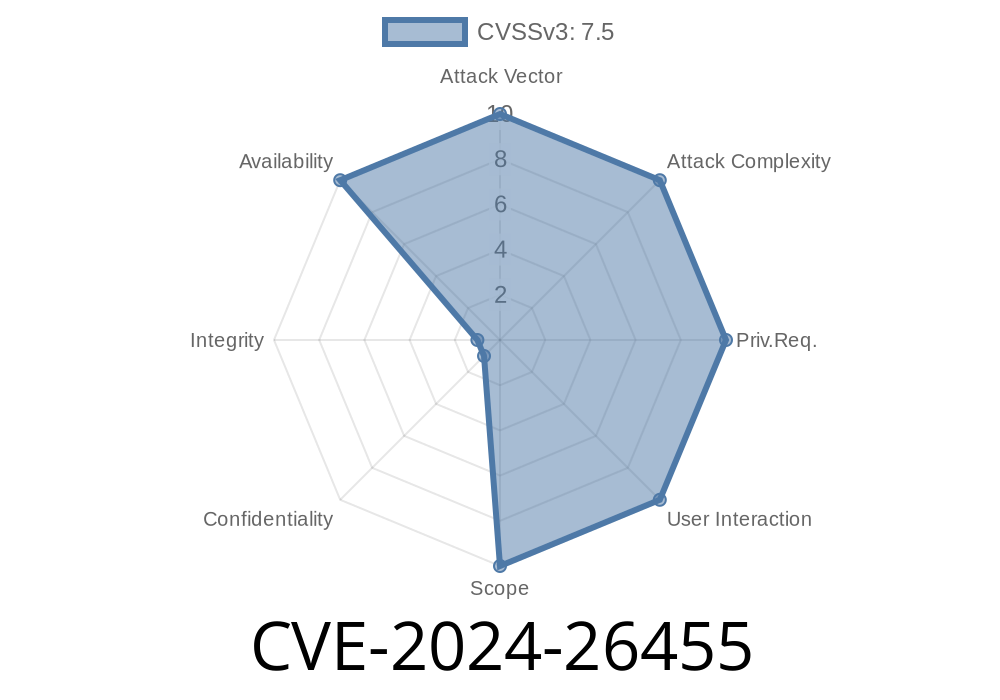
Fluent Bit is a popular open-source log processor that lets you collect, process, and ship logs from various sources. Many cloud and enterprise environments rely on Fluent Bit for logging, so any bug in this software can have serious consequences. Recently, a significant vulnerability was found and published as CVE-2024-26455. In this post, let’s break it down in simple language, show some code examples, discuss exploit potential, and help you understand what it means for your systems. This information is based on the 2.2.2 release, specifically targeting the custom_calyptia/calyptia.c plugin.
CVE: CVE-2024-26455
- Component: Fluent Bit 2.2.2, custom_calyptia/calyptia.c
A “Use-After-Free” Bug?
In C programs, memory is dynamically allocated (created) and freed (released). If the code tries to use a pointer after it's been freed, that’s a “Use-After-Free” (UAF) bug. UAF issues are dangerous because an attacker might control freed memory and make the program do something unintended, like running malicious code.
Where’s the Bug?
The bug was found in /fluent-bit/plugins/custom_calyptia/calyptia.c. Here’s the original reference in the CVE database (external), and the Fluent Bit issue tracker. As of this writing, the official security advisory and patch are available here.
Fluent Bit’s custom_calyptia plugin processes custom events. Due to insufficient checks, it’s possible to free an internal buffer and then keep using a pointer to that same memory — resulting in Use-After-Free.
Here’s a simplified demonstration based on the vulnerable logic (not the full code)
void *buffer = malloc(BUFFER_SIZE); // Allocate memory

process_event(buffer);

free(buffer); // Memory is freed

/* Vulnerable: Using pointer after it has been freed */
if (buffer[] == SOME_MAGIC) {
    // Dangerous use!
    do_something(buffer);
}
In the real calyptia.c, there’s a more complex logic path, but the flaw boils down to using memory after it’s already freed.
Vulnerable Function (Simplified)
static int cb_calyptia_event(void *event)
{
    struct calyptia_ctx *ctx = get_context(event);
    char *payload = ctx->payload;

    /* ... some processing ... */

    free(payload);   // Memory is freed

    /* ... */

    if (payload && payload[] == x01) { // UAF: payload is used after free!
        // Attacker can control what happens here
        do_sensitive_thing(payload);
    }

    return ;
}
How Can Attackers Exploit This?
If an attacker can control events or log payloads flowing through Fluent Bit with this plugin enabled, they could:
Crash the process, causing a Denial of Service.
- (In some cases) carefully corrupt memory to execute arbitrary code (Remote Code Execution, RCE), depending on the deployment and memory allocator.
Real-world exploitation depends on precise heap manipulation — often complicated, but with modern tools and persistence, attackers can often achieve at least a DoS.
The following is a conceptual step-by-step exploit (for lab/learning only)
# Attacker sends a crafted log that triggers the vulnerable code path.
# The payload is specially chosen so that after free(), the pointer
# is still accessed, possibly triggering a crash or code execution.

# Pseudocode
send_log_to_fluent_bit({
    "event_type": "calyptia",
    "payload": "\x01" + "A" * 10000  # Triggers logic after free()
})
Note: Actual exploitation would require more knowledge of the heap and system state, but with fuzzers, attackers can crash and analyze the process, or even gain code execution.
## How To Fix / Mitigate
- Upgrade Fluent Bit to a version after 2.2.2 (Releases Page).
If you can’t upgrade, disable the custom_calyptia plugin.
- Input filtering: Only allow trusted logs/processors to interact with Fluent Bit.
Patch Sample
free(payload);
ctx->payload = NULL;           // Set pointer to NULL after free

if (ctx->payload && ctx->payload[] == x01) {
    // This block now never executes, safe!
}
References
- NVD page for CVE-2024-26455
- Fluent Bit Security Advisory
- Fluent Bit Releases
- GitHub Issue Discussion
Conclusion
CVE-2024-26455 underlines that even modern, widely-used logging software is not immune to memory safety bugs. It’s a wake-up call to keep your infrastructure up-to-date and review which plugins are enabled in production. Fortunately, the fix is simple — freeing memory should always be followed by nulling pointers, and reused memory must be handled carefully.
If you run Fluent Bit 2.2.2 or lower (with the custom_calyptia plugin), update now!
Timeline
Published on: 02/26/2024 18:15:07 UTC
Last modified on: 08/28/2024 21:35:07 UTC