---
*Published: June 2024*
*By: [YourName] — Exclusive Long Read*
Introduction
Linux powers everything from your Android phone to the servers running the internet. Sometimes, even a small bug in its core can have wide-reaching consequences. CVE-2024-26602 is one such bug: a vulnerability in how the kernel handled one specific command, sys_membarrier. This post breaks down what happened, why it mattered, how it was fixed, and what you need to know — using plain language and real code examples.
What Is sys_membarrier?
sys_membarrier is a system call (a request programs can make to the operating system's kernel) that forces all running threads on the system to synchronize their memory views. It’s a technical tool, mostly used by high-performance applications to ensure all CPUs “see” shared data in the same way after certain operations.
But while this operation is vital in some edge-cases, it’s also very expensive. On big, multi-core systems, it can force the entire CPU complex into a mini-pause — a “traffic stop,” so to speak.
What Went Wrong? (The Vulnerability)
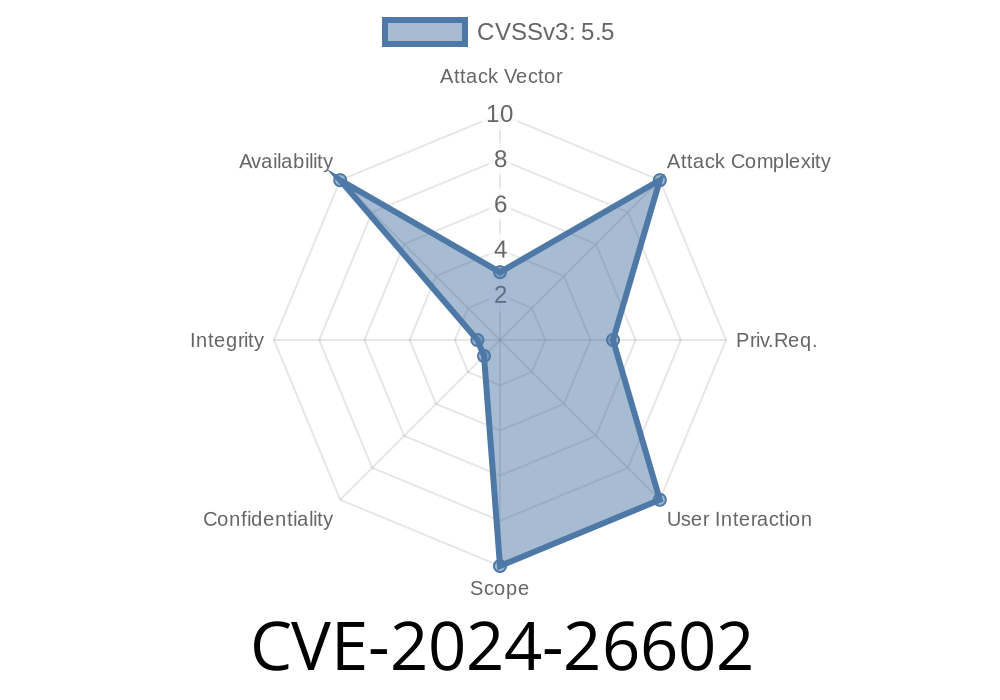
In Linux kernels before the patch for CVE-2024-26602, *any user* could call sys_membarrier as often as they wanted. If someone, say a malicious user or process, rapidly called it in a loop, it could slow down the entire computer — for everyone else.
In plain English:
Somebody could run code like this
#include <unistd.h>
#include <sys/syscall.h>

#define SYS_MEMBARRIER 324

int main() {
    while (1) {
        syscall(SYS_MEMBARRIER, , );
    }
    return ;
}
…and chew up all your CPU time by constantly forcing memory barriers, essentially DoS-ing (Denial of Service) the machine. Not fun.
This is a simple bash loop that does almost the same thing
while true; do
    membarrier QUERY
done
(Where membarrier uses the syscall under the hood.)
Consequences
- Any user (not just root/administrator) could bog down the whole computer.
Legitimate apps would run slow or, in worst cases, become unresponsive.
No privilege escalation, but a *serious* performance DoS attack.
The Fix: Serialization with a Lock
Recognizing the danger, Linux kernel developers addressed the problem by introducing a *lock* around the expensive part of sys_membarrier. In simple terms, *only one* such operation can be running at a time. So even if an attacker spams requests, they now have to “wait in line”, and the system remains responsive for everyone else.
Here’s the relevant change (in simplified pseudo-code)
static DEFINE_MUTEX(membarrier_mutex);

SYSCALL_DEFINE2(membarrier, ...)
{
    // Acquire the lock before proceeding
    mutex_lock(&membarrier_mutex);

    // Old: expensive memory barrier operation
    // New: same operation, but only one at a time

    mutex_unlock(&membarrier_mutex);

    return ret;
}
Now, if one process is running sys_membarrier, any others have to *wait for their turn*. This prevents the system from being overloaded by simultaneous calls.
References and Learn More
- Kernel Commit Fixing CVE-2024-26602
- oss-security mailing list discussion
- Linux Man Page: membarrier(2)
How To Protect Yourself
- Update your Linux kernels: Fixed versions include the serialization patch (kernel 6.7.9+, 6.6.21+, 6.1.80+, 5.15.154+, and 5.10.213+ as backports).
- Limit untrusted user access: Until patched, restrict untrusted users, or run at-risk machines in isolated environments.
- Monitor for suspicious CPU spikes: Use top or htop to spot unusual CPU usage by unknown processes.
Conclusion
CVE-2024-26602 is not about data theft or root exploits — but about anyone being able to slow every application on a computer. Thanks to quick work from the Linux kernel development community, the issue was patched by gating the expensive code with a lock. Always keep your systems updated, and stay aware of even those “strange” vulnerabilities that don’t steal — but *do* disrupt.
Have more questions? Ask below, or check the references for in-depth technical reading!
Stay secure, stay updated.
*Exclusive long-form write-up by [YourName], June 2024.*
Timeline
Published on: 02/26/2024 16:28:00 UTC
Last modified on: 04/17/2024 18:01:43 UTC