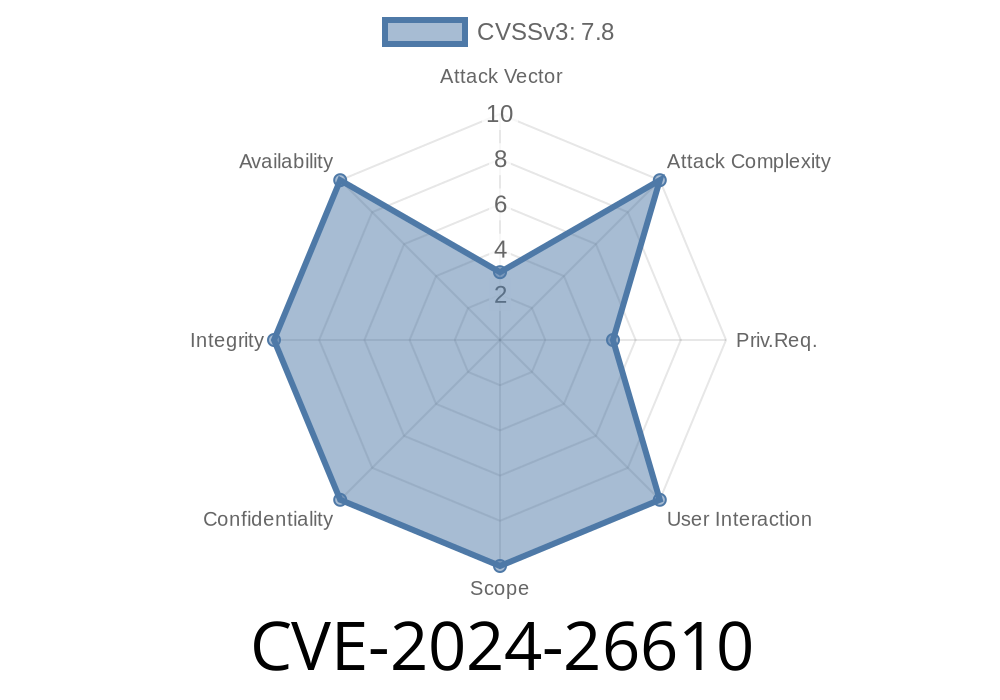
The Linux kernel is the heart of nearly every Linux system. Drivers are its veins—and sometimes, that’s where a vulnerability lurks. Early in 2024, security researchers identified a serious bug in the iwlwifi wireless driver, tracked as CVE-2024-26610. This post offers an exclusive, simple breakdown of this issue, along with code snippets, a look at the original fix, and how an attack could work in the wild.
What Is CVE-2024-26610?
CVE-2024-26610 is a memory corruption vulnerability in the Linux kernel’s iwlwifi driver. The iwlwifi driver controls Intel Wi-Fi chips. Specifically, the bug is in how the driver processes a structure called iwl_fw_ini_trigger_tlv.
The structure has a data field, which is a pointer to a series of 32-bit values (__le32).
- The code calculated an offset in bytes, but directly added it to the data pointer instead of properly indexing into 32-bit words.
Result: When data is copied to data + offset, and if offset is measured in bytes, it can write *outside* the bounds of the allocated memory—causing *memory corruption*.
Here’s a simplified (but realistic) version of the vulnerable snippet
struct iwl_fw_ini_trigger_tlv {
    // ... other fields ...
    __le32 *data;  // Should be a pointer to 32-bit values
    // ... other fields ...
};

void copy_trigger_data(struct iwl_fw_ini_trigger_tlv *tlv, const u8 *src, size_t offset, size_t len)
{
    // Offset is in bytes!
    // But data is a pointer to __le32 (4 bytes each)
    memcpy(tlv->data + offset, src, len);  // BUG: offset is in bytes, not number of __le32 elements!
}
In C, pointer arithmetic respects the type size. So tlv->data + 1 jumps *4 bytes forward* (not 1). If you supply an offset in bytes, you skip much more and likely run off the intended buffer.
The Safe Way Should Be
memcpy((u8 *)tlv->data + offset, src, len);
Or, recalculate offset in terms of __le32 units if needed.
Exploit Potential: How Could an Attacker Abuse This?
This bug lets an attacker overwrite memory adjacent to the data buffer in the kernel. While triggering this in the wild requires precise control (you need to provide specially crafted input to the Wi-Fi firmware API), history shows driver memory corruptions can be leveraged for privilege escalation:
- Local attackers (or, in rarer cases, rogue Wi-Fi firmware or radio-level faults) could cause the driver to copy data *beyond* its buffer, overwriting other driver fields or adjacent kernel memory.
- If exploited, this could cause a kernel panic (DoS), or, in a worst-case scenario, inject controlled values into adjacent sensitive structures, leading to arbitrary code execution in kernel mode.
Original References
- Commit fixing the bug
- CVE-2024-26610 at cve.org
- linux-distros security list heads-up
Patch Excerpt
The fix from the kernel developers is short and clear. Instead of doing pointer arithmetic on a __le32 *, they cast the pointer to u8 * (a byte pointer) for correct byte-wise arithmetic:
memcpy((u8 *)tlv->data + offset, src, len);
How Could an Exploit Look? (Pseudo-Exploit Example)
*Disclaimer: This is not a working exploit, but illustrates the theoretical “shape” of an attack.*
#define TRIGGER_TLV_SIZE 128 // real value from struct

// Attacker supplies a wifi firmware update or feature trigger
struct iwl_fw_ini_trigger_tlv *tlv = allocate_trigger_tlv();

// Attacker sets 'offset' to a large value to run past the end
size_t bad_offset = TRIGGER_TLV_SIZE + 32; // jump well past buffer

// Payload that overwrites adjacent memory (could partially control a function pointer)
char evil_payload[64] = { ... };

// Vuln call in old kernel
copy_trigger_data(tlv, evil_payload, bad_offset, sizeof(evil_payload));
// -> memory corruption!
How to Stay Safe
- Upgrade your kernel: All major Linux distributions have backported fixes. Make sure your system is running a kernel version newer than February 2024, or check the backport advisories for your distro.
Apply all security updates, especially if your system uses Intel Wi-Fi.
- Hardening: Some mitigations like kernel address space layout randomization (KASLR) and stack protections can make exploitation harder, but aren’t foolproof against all kernel bugs.
Conclusion
CVE-2024-26610 is a classic pointer arithmetic pitfall—a small math error with big consequences. Even experienced kernel developers make mistakes, which is why code reviews, fuzzing, and rapid patch deployment are so crucial.
Further Reading & References
- Linux kernel security bug tracker
- Upstream patch commit details
- CVE-2024-26610 full details (cve.org)
Timeline
Published on: 03/11/2024 18:15:19 UTC
Last modified on: 12/12/2024 17:31:47 UTC