Published: June 2024
Author: [Your Name]
The Linux kernel is the beating heart of millions of systems ranging from smartphones to supercomputers. Security in its various subsystems remains critical. One vulnerability recently addressed is CVE-2024-26814, impacting the vfio/fsl-mc (Freescale Management Complex) driver’s interrupt handling. This writeup breaks down what happened, why it mattered, and how it was resolved, using plain English and practical insights.
What’s the Problem?
Within the Linux kernel, *VFIO* (Virtual Function I/O) enables secure, user-friendly device access for virtual machines and applications. The vfio/fsl-mc driver lets user-space applications handle Freescale (now NXP) multi-core management complex devices.
A subtle bug was lurking in how this driver dealt with interrupt events
- The vfio_fsl_mc_irq object has a member called trigger, which points to an eventfd_ctx structure.
- This trigger can be NULL at first, and it can be set to NULL if the user disables event triggering (by setting the trigger eventfd to -1).
- The interrupt handler is supposed to only access trigger when it's guaranteed to be valid – that is, between request_irq() and free_irq().
- However, testing (with loopback and ioctl handlers) could call the interrupt function even if trigger is NULL, leading to unsafe behavior.
This creates a small window where the kernel could try to use a NULL pointer, leading to possible *use-after-free* or *NULL pointer dereference* bugs—both classic sources of crashes or escalations.
The Patch: Making It Safe
To fix CVE-2024-26814, Linux developers added a simple-but-important check:
Don’t call the handler if trigger is NULL.
Here’s the essential patch as seen upstream:
// vfio_fsl_mc.c - Fixed code snippet

static void vfio_fsl_mc_irq_handler(struct vfio_fsl_mc_irq *irq)
{
    struct eventfd_ctx *trigger;

    // Protect access with igate (spinlock)
    spin_lock(&irq->igate);
    trigger = irq->trigger;
    spin_unlock(&irq->igate);

    // Block calling handler if trigger is not set
    if (!trigger)
        return;

    eventfd_signal(trigger, 1);
}
Only if trigger is valid does it go ahead and notify the user.
Result: No more unsafe calls into NULL pointers!
Technical Details: Why Was This Buggy?
Originally, the handler could be invoked even if trigger was NULL. Since only the handler itself guarantees trigger validity in the active setup, this exposed the kernel to bad memory access. The normal device interrupt path is safe, but test or ioctl-triggered paths weren’t.
Other drivers (like vfio-pci or vfio-platform) need more complicated fixes, since they use features like *irqfds* and *masking*. However, vfio-fsl-mc doesn’t—so the fix is straightforward.
Who’s Impacted?
- Affected Kernel Versions: Mainline Linux before 6.6.30, 6.7.x before 6.7.8, and 6.8.x before 6.8.7.
- Devices: NXP/Freescale SoCs using MC devices and vfio-fsl-mc.
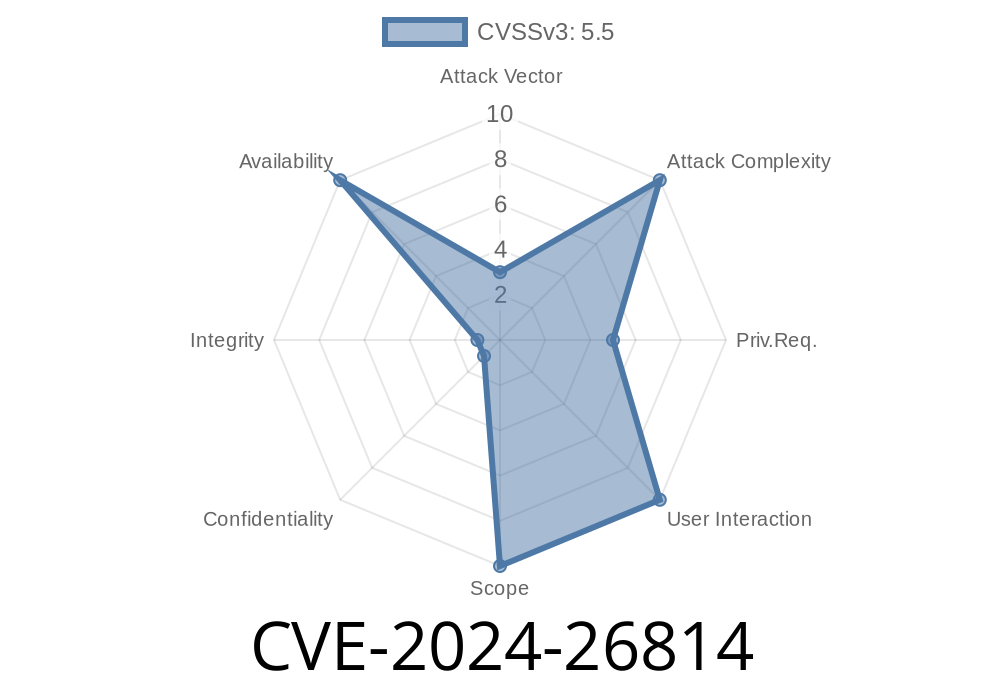
- Attack Complexity: Low, if a local user can mess with trigger eventfd (possible if using VFIO in VMs/containers).
Exploitation would require a user with sufficient permissions to manipulate vfio-fsl-mc device triggers, *but* could lead to system instability or potential privilege escalation.
Exploitation: What Could Go Wrong?
Suppose a malicious user or buggy program rapidly changes or disables the event trigger (via /dev/vfio/* IOCTL calls) while another process tries to trigger an interrupt. If the interrupt handler accesses trigger while it’s NULL, kernel panic or misbehavior can result.
Example Exploit Pseudocode
// WARNING: For educational/pentesting on non-production only!
int fd = open("/dev/vfio/xxx", O_RDWR);
// (Set up trigger, then disable it rapidly)
ioctl(fd, VFIO_DEVICE_SET_IRQS, disable_trigger_command);
// Simultaneously, another process triggers the interrupt
ioctl(fd, VFIO_DEVICE_TRIGGER_IRQ, manual_trigger_command);
// If not patched, may cause NULL dereference in kernel!
Patch your kernel! Make sure you’re on Linux 6.6.30+, 6.7.8+, or 6.8.7+ (or later).
- Restrict access to /dev/vfio/* to only trusted users or services.
- Monitor dmesg/syslog for suspicious kernel crashes related to vfio or fsl-mc.
References
- Upstream Linux Kernel Commit: vfio/fsl-mc: Block calling interrupt handler without trigger
- CVE-2024-26814 – NVD Entry
- Linux Kernel Documentation: VFIO
Conclusion
While CVE-2024-26814 may seem like a small bug, it highlights how careful kernel programming has to be—especially with low-level concurrency and event management. Thanks to the kernel community’s vigilance, these kinds of vulnerabilities get nipped in the bud quickly. Still, as always: stay patched and stay vigilant.
*For questions or further info, feel free to leave a comment below or check out the official patch log.*
Timeline
Published on: 04/05/2024 09:15:09 UTC
Last modified on: 03/27/2025 21:36:57 UTC