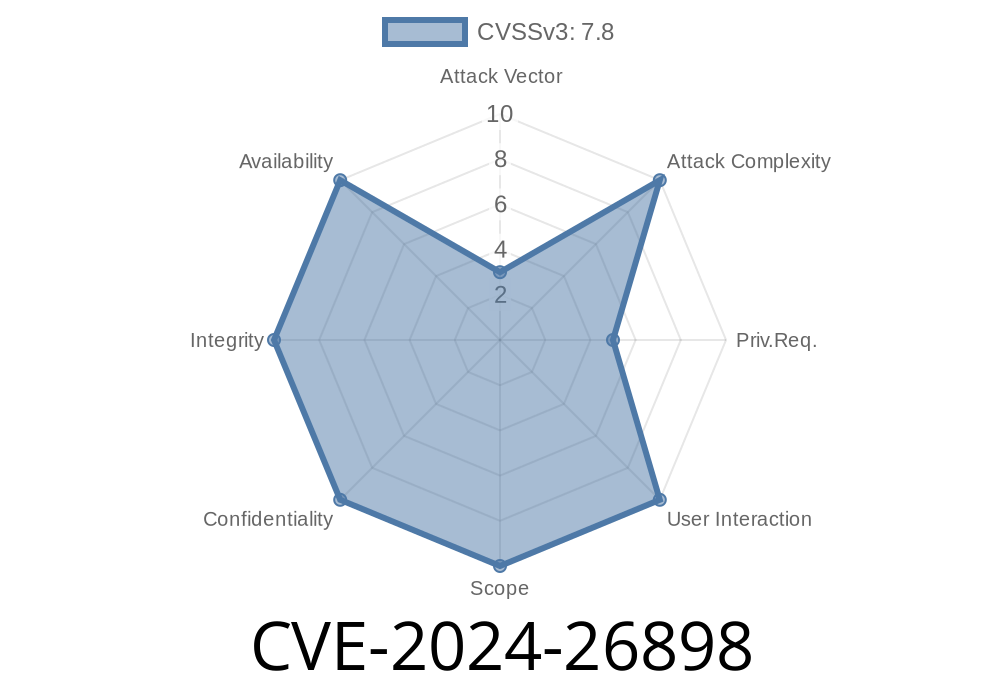
A new critical security update has landed in the Linux Kernel, focusing on the ATA over Ethernet (AoE) driver. The vulnerability, now tracked as CVE-2024-26898, addresses a dangerous use-after-free bug that could let an attacker crash the system or potentially run malicious code. If you use Linux systems with AoE (used in some storage setups), understanding this issue and patch is essential.
In this post, we’ll break the problem down in plain language, show you how the bug works, and highlight the simple but effective code patch. We’ll also share resources for further reading, and demonstrate why quick patching is a must.
What Is AoE?
ATA over Ethernet (AoE) lets computers talk to storage devices over a local network. It’s a lightweight protocol, popular with some Linux admins for building cheap SANs (Storage Area Networks).
Where’s the Bug?
The broken part lies in the Linux kernel’s AoE driver, in a function named aoecmd_cfg_pkts(). This function creates network packets and schedules their transmission. It keeps a reference to the *network device* (struct net_device) that's used to send these packets.
The Dangerous Bug
In simple terms:
But another kernel thread (the tx() function) might still be using the device to send a packet,
- This results in the *network device memory being freed while still in use*—a classic use-after-free bug.
- Attackers can exploit these timing bugs to crash the system (*denial of service*) or, in some cases, execute arbitrary code.
Vulnerable Code
// BAD: Reference dropped too early!
int aoecmd_cfg_pkts(...) {
    ...
    dev_put(ifp);
    // But "ifp" will be used later in another thread!
    ...
}
Patched Code Snippet
// Good: Don’t release "ifp" until it’s really unused
int aoecmd_cfg_pkts(...) {
    ...
    // Remove dev_put(ifp) here
    ...
}
// Later, after transmission is definitely complete:
void tx(...) {
    ...
    dev_queue_xmit(skb);
    dev_put(ifp); // Safe to release now!
    ...
}
Reference:
- Linux Kernel Patch Commit
- CVE Detail Page - CVE-2024-26898
- Original Patch Discussion
Is This Exploitable?
- Yes, potentially – a local or privileged attacker could trigger this bug by intentionally causing AoE packets to be queued and racing for memory reuse.
Most likely: Kernel panic or system crash.
- In theory: If an attacker could carefully craft memory reuse, code execution is possible (though tricky).
Simplified Exploit Flow
1. Open multiple AoE connections rapidly.
2. Trigger lots of packet transmissions via aoecmd_cfg_pkts().
3. Force network device removal/reuse (e.g. hotplug/unplug or module unload).
4. Try to access the previously-freed device memory through the global tx queue.
5. System likely crashes (DoS), or rare code execution if lucky.
Example (Hypothetical) Exploit
// This is illustrative - requires root/admin and technical skill
// Not an off-the-shelf exploit!
system("echo remove > /sys/class/net/ethX/device/uevent"); // Remove net device at the right moment
// Or write clever race in a kernel module to exploit the timing.
Note: The exploit surface is mostly relevant to server environments using AoE.
AoE users: Check for patched kernels or backport the fix manually if needed.
- If you don’t use AoE, keep your kernel updated anyway—lots of systems ship with built-in AoE support.
Conclusion
CVE-2024-26898 is a classic example of how small mistakes in reference counting can have big security consequences in complex kernel code. The fix is simple—release a resource *only after it’s really not needed*—but catching such bugs is hard.
Don’t play with fire: Patch promptly to keep your systems stable and safe.
References & Further Reading
- Linux Kernel Commit: Fix use-after-free in AoE driver
- nvd.nist.gov - CVE-2024-26898
- aoe: fix the potential use-after-free problem in aoecmd_cfg_pkts
- Linux AoE documentation
- CWE-416: Use After Free
Timeline
Published on: 04/17/2024 11:15:10 UTC
Last modified on: 07/22/2024 14:55:25 UTC