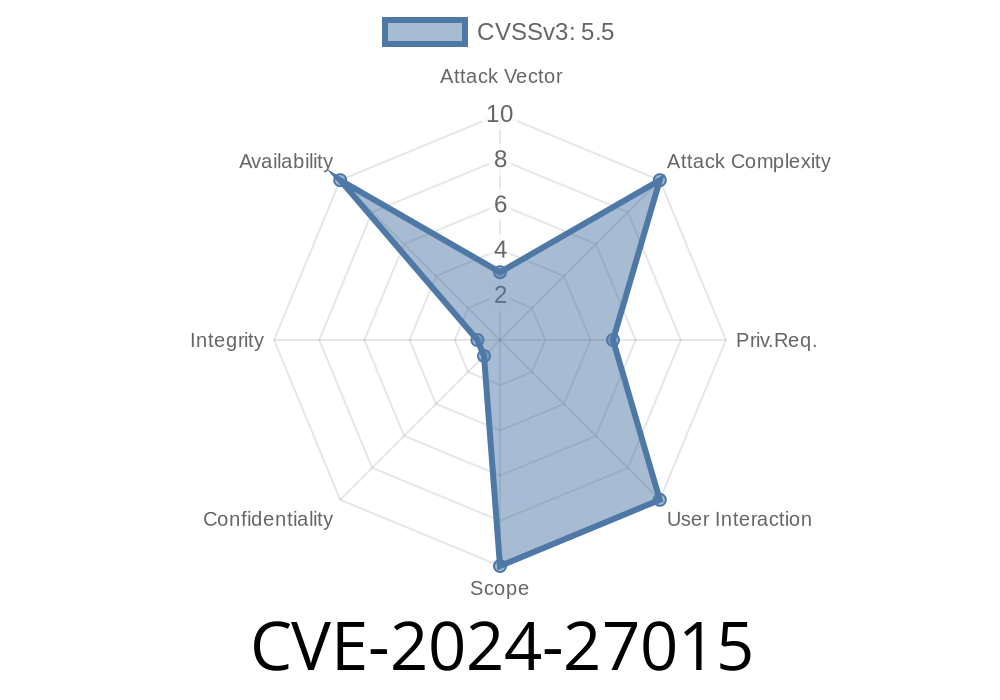
The Linux kernel is the backbone of countless servers, routers, and personal devices. Its network stack is fast and mighty, but sometimes even little bugs can trip up performance or, in the worst cases, open the door to vulnerabilities. In this post, we’ll dig into CVE-2024-27015—a recently patched bug in the kernel’s handling of netfilter flowtables and PPPoE packets. We’ll break down how a misplaced header led to mismatched packet lookups, talk about the security and performance impact, and show how the fix works.
What is CVE-2024-27015?
This CVE relates to a bug in how the Linux kernel’s netfilter framework processes PPPoE (Point-to-Point Protocol over Ethernet) packets using flowtables. Flowtables are a fast packet-forwarding feature—you can think of them as shortcuts for moving data through your network stack.
But the bug meant that some PPPoE traffic bypassed these shortcuts, causing unexpected and potentially problematic routing behavior.
In plain English:
PPPoE packets weren't being recognized correctly by the flowtable, so they got stuck taking the slower, old way around inside the kernel.
Understanding the Problem: The Flowtable and PPPoE
Let’s say your router is forwarding internet traffic using netfilter’s flowtable. For most packets, this is slick and fast. But with PPPoE traffic—common in DSL setups—the netfilter code expects the PPPoE header to start at the same offset as a TCP/IP header. Unfortunately, PPPoE adds an extra layer, and the existing code wasn’t looking in the right spot.
So when a PPPoE packet came along, the flowtable lookup failed, falling back to "classical forwarding": a slower, more resource-intensive code path.
Code Example: The Broken Tuple Extraction (nf_flow_tuple_ipv4)
struct pppoehdr *ph;
...
ph = (struct pppoehdr *)skb_network_header(skb);
if (ph->code == ... && ph->session_id == ...) {
    /* Expecting pppoe header here, but position is off */
}
*Here, skb_network_header(skb) gives the wrong offset for PPPoE packets.*
Performance Loss.
PPPoE packets weren’t benefiting from the speed gains of flowtable. If your router or gateway forwards a lot of PPPoE traffic, you’re wasting CPU cycles.
2. Security/Policy Bypass?
There isn’t a direct exploit for remote code execution or privilege escalation, but the bypass of flowtables might result in unexpected firewall or NAT behavior. In some setups, this could mean traffic doesn’t get filtered the way you expect.
Confusing Debugging.
If you’re debugging why PPPoE packets aren’t fast-forwarded or why some firewall rules seem off, this bug is a silent troublemaker.
The Fix
The kernel developers corrected the offset logic, ensuring that flowtable lookups now account for the PPPoE header. The fix moves the search to the proper spot in the memory buffer.
Here’s How the Patch Looks (link to commit):
+ if (skb->protocol == htons(ETH_P_PPP_SES)) {
+     if (!pskb_may_pull(skb, sizeof(struct pppoe_hdr)))
+         return -EINVAL;
+     skb_set_network_header(skb, skb_network_offset(skb) + sizeof(struct pppoe_hdr));
+ }
*This extra check advances the network header pointer, so the kernel can correctly match PPPoE packets.*
How To Exploit or Demonstrate the Bug
This isn't a traditional "exploit," since it mainly affects routing and filtering performance rather than causing buffer overflows or crashes. However, to reproduce or demonstrate the bug:
Setup:
Configure a Linux router/gateway with netfilter flowtable enabled.
pppoe packets bypass flowtable; use conntrack and iptables logging to confirm.
Example:
# On your router
echo 1 > /proc/sys/net/netfilter/nf_flowtable_enable

# Use tcpdump to watch PPPoE packets:
tcpdump ether proto x8864

# Watch kernel logs or use perf/tracepoints to spot fallback routing.
CVE entry:
Upstream kernel commit:
netfilter: flowtable: fix pppoe tuple lookup
Netfilter Flowtable documentation:
What Should You Do?
If you run a Linux kernel and route PPPoE traffic (e.g., DSL ISPs, certain enterprise or home routers), you should:
Upgrade your kernel to a version including this fix (post-Feb 2024).
- Check your router’s forwarding performance—if you saw mysterious PPPoE slowdowns, this could be why.
- Audit firewall/NAT rules for any PPPoE-specific quirks.
Summary
CVE-2024-27015 is a good reminder that even subtle code assumptions—like where a header starts—can trip up robust software like the Linux kernel. This bug didn’t let hackers take over your machine, but it did break routing optimizations for anyone using PPPoE. The fix is simple but crucial for performance and correct traffic filtering. Always keep your kernel up to date!
*Have you noticed weird PPPoE behavior? Let us know in the comments or reach out on GitHub!*
Timeline
Published on: 05/01/2024 06:15:20 UTC
Last modified on: 06/14/2024 18:55:59 UTC