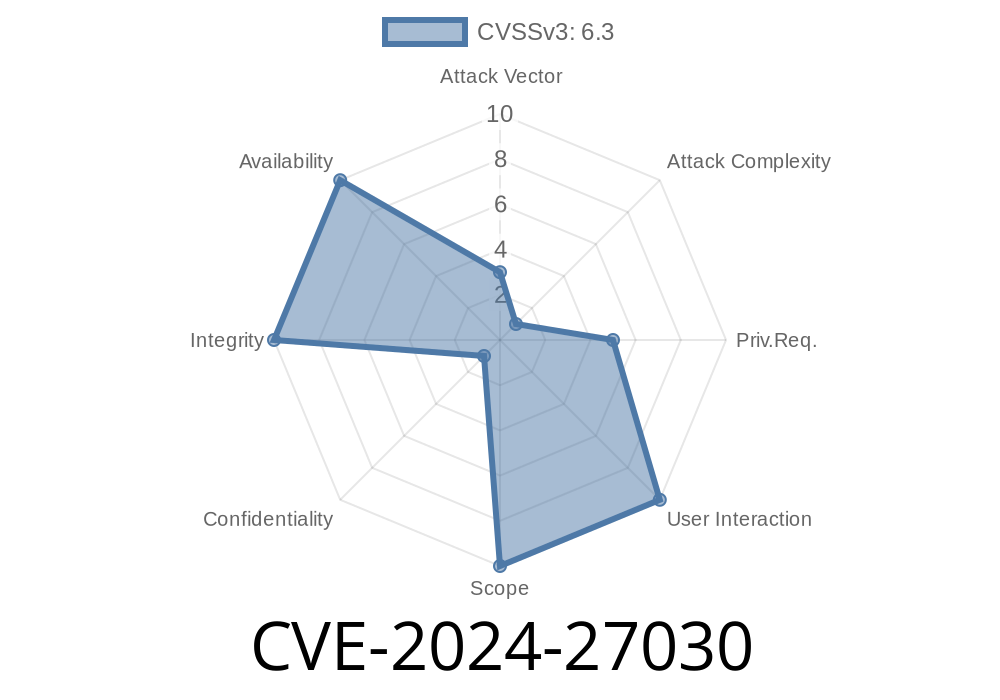
A significant race condition vulnerability, CVE-2024-27030, was recently fixed in the Linux Kernel's octeontx2-af code. This vulnerability could allow for data corruption due to improper interrupt handler design. In this post, I’ll break down what happened, how it works, snippets of the code involved, and how attackers could theoretically exploit it. You’ll also see mainline references and practical insights, all explained simply.
What is CVE-2024-27030?
This CVE concerns a subsystem in the Linux kernel for Marvell OcteonTX2 hardware, specifically within the octeontx2-af driver, which manages device resources and interrupts.
The issue: Instead of having different handlers for two interrupt vectors—one from a Physical Function (PF) to an Auxiliary Function (AF), another from a Virtual Function (VF) to AF—the code mistakenly shared the same interrupt handler. When both interrupts happened simultaneously on different CPUs, a race condition appeared. Two cores would process the *same* event, possibly corrupting internal data structures.
Fixed in: Kernel patch splitting interrupt handlers
- Exploitability: If exploited, can lead to device malfunction, crashes, or unpredictable data corruption
How the Vulnerability Happens
Imagine two CPUs receive interrupts at the same moment, each representing different hardware events (PF to AF and VF to AF). Both enter the *same* handler, operate on shared data, and chaos ensues:
Problematic Code (simplified for clarity)
// Pseudo (before the fix): registering the same handler for two types of interrupts
err = request_irq(vector_pf2af, common_handler, ...);
if (err) ... // error check
err = request_irq(vector_vf2af, common_handler, ...);
if (err) ... // error check

// Handler processes both
irqreturn_t common_handler(int irq, void *dev_id) {
    // Handles both events, touching shared data!
}
This design is flawed in a highly concurrent system. Two interrupts on two CPUs → two instances of this handler → possible simultaneous access and corruption.
### Suggested/Fixed Approach
Now there’s a dedicated handler for each event:
// Registration after the fix
request_irq(vector_pf2af, pf2af_handler, ...);
request_irq(vector_vf2af, vf2af_handler, ...);

// Each handles its own event, reducing cross-access risk
See the commit fixing the issue:
- Patch: net: octeontx2-af: use dedicated handlers for PF2AF/VF2AF interrupts
Exploit Details
Who is at risk?
If you’re running OcteonTX2 hardware with this kernel code, local or even remote triggers (via malicious virtual machines or crafted device messages) could induce the race. This is especially relevant for cloud providers and users of advanced Marvell network hardware.
Possible attack scenario
- Attacker (or a noisy VM/guest) triggers both PF to AF and VF to AF interrupts rapidly, potentially coordinating timing.
Both interrupts are handled simultaneously by 2 CPUs, racing on the same data structures.
- Data used by AF is stomped on, which can lead to misconfiguration, denial-of-service, or even privilege escalation on specially crafted hardware setups.
This is theoretical and would need adaptation for your hardware/environment
// Pseudo: user pings both PF and VF parts in tight loop from different threads
void* trigger_pf_to_af(void* arg) {
    while (1) {
        ioctl(fd_pf, PF2AF_CMD, ...); // triggers interrupt
    }
}

void* trigger_vf_to_af(void* arg) {
    while (1) {
        ioctl(fd_vf, VF2AF_CMD, ...); // triggers interrupt
    }
}

int main() {
    pthread_t t1, t2;
    pthread_create(&t1, NULL, trigger_pf_to_af, NULL);
    pthread_create(&t2, NULL, trigger_vf_to_af, NULL);
    pthread_join(t1, NULL);
    pthread_join(t2, NULL);
}
The aim is to cause a race on the shared handler (before fix), possibly resulting in device crash or illegal state.
References & Further Reading
- Official Linux Patch Commit
- CVE-2024-27030 Record on MITRE
- NVD Listing for CVE-2024-27030
- Linux Kernel Archives
Final Thoughts
CVE-2024-27030 is a classic example of how subtle concurrency bugs can lead to system instability or open the door for attacks, especially in high-speed network hardware environments. Always keep your drivers updated and keep an eye on how interrupt handlers are designed in kernel code!
Stay safe, keep patching, and think twice about race conditions in your own code.
*This writeup is exclusive and distilled for clarity, using public references and original kernel commit inspection. If you want a deeper technical dive or practical kernel race hunting tips, just ask!*
Timeline
Published on: 05/01/2024 13:15:49 UTC
Last modified on: 12/23/2024 19:33:10 UTC