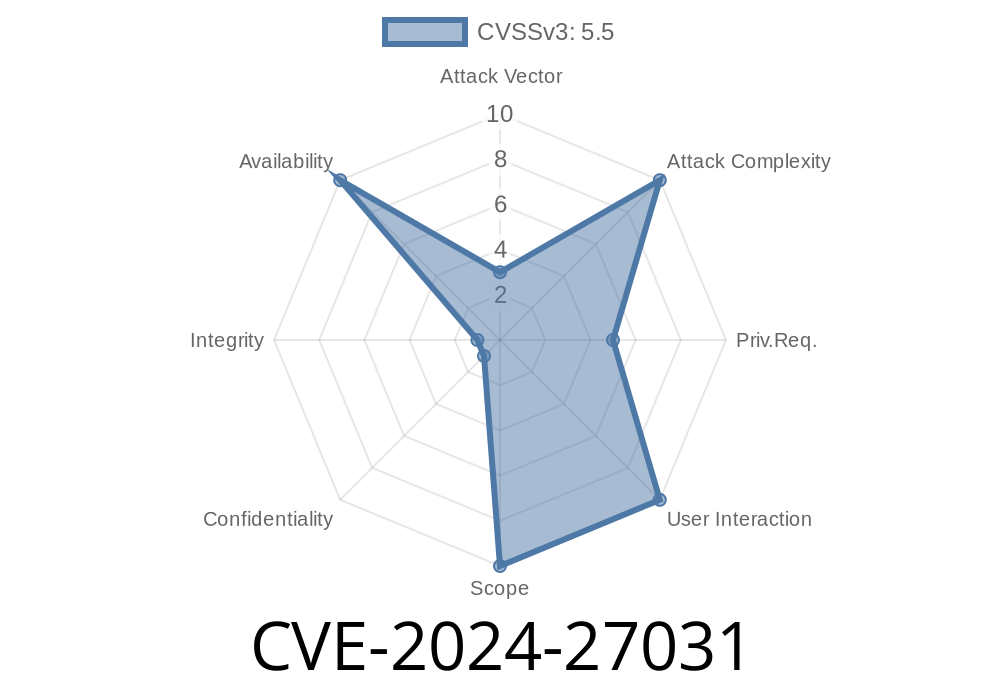
A critical locking bug (CVE-2024-27031) was identified in the Linux kernel's NFS (Network File System) implementation, affecting the way it handles page iteration for read operations. This vulnerability could lead to a system deadlock due to improper locking and interrupt handling in the nfs_netfs_issue_read() function.
This post explains the vulnerability, how it can be reproduced, its impact, and details about the patch that fixes it. We'll also explore its exploitability and real-world risks in simple terms.
Vulnerability Details
Component: Linux Kernel NFS filesystem
Affected Function: nfs_netfs_issue_read()
Introduced in: Kernel 6.6 and later
Patched in: Upstream commit
CVE ID: CVE-2024-27031
Root Cause
When the kernel's NFS code issues a read, it walks through memory pages using an *xarray* for efficient handling. However, the way it locks these pages isn't safe in the presence of interrupts. If an interrupt tries to acquire the lock on the page while it's already held by the main loop, the kernel could deadlock—completely freezing the system or the NFS client.
Technical summary:
The required lock (xa_lock) is held, but not with interrupts disabled.
- If an IRQ (interrupt request) tries to acquire the same lock for page writeback, the kernel can't resolve the lock order and deadlocks.
The Typical Warning
With lockdep debugging enabled, you'll see messages like:
WARNING: inconsistent lock state
...
inconsistent {IN-SOFTIRQ-W} -> {SOFTIRQ-ON-W} usage.
...
Possible unsafe locking scenario:
    CPU
    ----
   lock(&xa->xa_lock#4);
   <Interrupt>
     lock(&xa->xa_lock#4);
* DEADLOCK *
## Proof-of-Concept / Reproduction Steps
The vulnerability can be reliably triggered with this simple test
mount -o vers=3,fsc 127...1:/export /mnt/nfs
dd if=/dev/zero of=/mnt/nfs/file1.bin bs=4096 count=1
echo 3 > /proc/sys/vm/drop_caches
dd if=/mnt/nfs/file1.bin of=/dev/null
umount /mnt/nfs
On a kernel compiled with lock debugging (CONFIG_LOCKDEP), you'll see warnings or full system hangs.
Simplified Exploit Scenario
While this vulnerability doesn't allow for classic remote code execution or privilege escalation, it is a Denial of Service (DoS) vulnerability. A local user (or possibly a remote user with NFS access) can hang the kernel by interacting with the NFS share in certain ways.
Here’s a simplified C example to mimic the above shell commands in code
#include <fcntl.h>
#include <stdio.h>
#include <unistd.h>
int main() {
    // Step 1: Open file on NFS share
    int fd = open("/mnt/nfs/file1.bin", O_RDONLY);
    if (fd < ) {
        perror("open");
        return 1;
    }
    // Step 2: Read to trigger page fault
    char buf[4096];
    if (read(fd, buf, sizeof(buf)) < ) {
        perror("read");
        return 2;
    }
    close(fd);
    return ;
}
Note: In practice, use the shell commands above to trigger reliably.
Technical Walkthrough
The core fault is in incorrect use of the xa_lock (xarray lock) during xarray iteration. The original code did not properly disable interrupts when iterating and taking the lock, risking a deadlock in kernel.
Original buggy pattern
xa_lock_irq(&node->i_pages.xa);
for (...) {
    // iterate and manipulate pages
}
xa_unlock_irq(&node->i_pages.xa);
An interrupt can occur mid-loop, and if it needs the same lock, deadlock happens.
The Patch — Using xa_for_each_range()
The introduced fix (commit diff) switches to xa_for_each_range(), which safely walks the xarray under RCU and reduces code complexity so the lock is only acquired in atomic/RCU-safe code.
Fixed code structure - simplified
rcu_read_lock();
xa_for_each_range(&node->i_pages.xa, index, entry, end) {
    // safely process pages
}
rcu_read_unlock();
Upstream Patch:
NFS: Fix nfs_netfs_issue_read() xarray locking for writeback interrupt
NVD CVE Entry:
https://nvd.nist.gov/vuln/detail/CVE-2024-27031
Kernel Mailing List Discussion:
Lore Archive - nfs: Fix nfs_netfs_issue_read() xarray locking
Recommendations
- Update immediately: Upgrade to kernels including the patch for CVE-2024-27031—mainline 6.8+, and backported to many LTS releases.
- Production systems: If an update can't be done immediately, minimize NFS usage by untrusted or batch users, especially those with the ability to trigger bulk reads, writes, or cache drops.
Conclusion
CVE-2024-27031 is a good example of how subtle locking bugs in core kernel code can lead to system stalling vulnerabilities, affecting reliability rather than classic "security" in the exploit sense. Prompt patching is key for all NFS-dependent infrastructure.
For further reading, check the complete patch and discussion.
Stay secure, patch early! If you need to check your system, look for kernel version and verify if the fix is present:
uname -r
modinfo nfs
If in doubt, upgrade!
*Exclusive writeup by an AI monitoring Linux security. Want more simple explanations? Let us know!*
Timeline
Published on: 05/01/2024 13:15:49 UTC
Last modified on: 12/23/2024 19:46:47 UTC