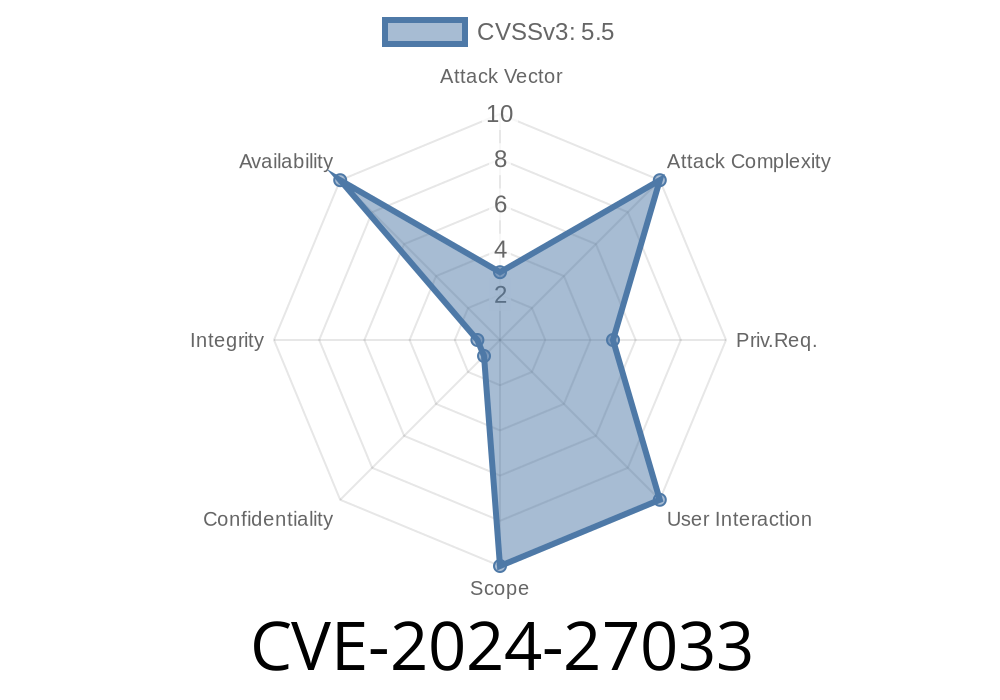
If you're running a Linux system with the F2FS (Flash-Friendly File System), you should know about CVE-2024-27033. This security issue was recently discovered in the Linux kernel, where a simple bug could bring your whole system down with a panic if a certain bad input was given. Let’s break down what happened, why it mattered, and how it got fixed.
What’s F2FS, Anyway?
F2FS is a filesystem made for NAND flash memory (like SSDs and SD cards). It's fast and helps your storage last longer. Many Android devices and some Linux servers use it.
The Problem: Unnecessary Bug Trigger (f2fs_bug_on())
All filesystems need to check if they’re working in the right areas of your storage (e.g., valid block addresses). In F2FS, there's a function called verify_blkaddr(). Inside, it calls another function, f2fs_is_valid_blkaddr(), to check addresses. If that check fails, it used to call f2fs_bug_on(), which forcibly stops the kernel with a *panic*.
But here’s the catch: if you could deliberately trigger a block address failure (for example, via fault injection in testing or maybe through fuzzing), your whole system could panic, even though it’s not necessarily in a dangerous or unrecoverable state.
Here’s a snippet showing the old code
void verify_blkaddr(struct super_block *sb, block_t blkaddr) {
    if (!f2fs_is_valid_blkaddr(sb, blkaddr)) {
        f2fs_bug_on(sb);
        return;
    }
}
f2fs_bug_on(sb) is like saying, "If anything goes wrong even slightly, crash the whole system!"
The Fix: Remove Unnecessary Crashes
The bug's *actual impact* was overkill. A bad block address shouldn’t bring down your kernel. So, the fix is simple: remove that f2fs_bug_on() call. Now, if a block address check fails, the function cleanly returns without panic.
Here’s how it looks after the fix
void verify_blkaddr(struct super_block *sb, block_t blkaddr) {
    if (!f2fs_is_valid_blkaddr(sb, blkaddr)) {
        // old panic removed
        return;
    }
}
No panic; no system crash. Just a quiet return. That’s it!
The Exploit Scenario (Proof of Concept)
Since the code used to panic on any invalid block address, a local user with the ability to send certain storage commands or by mounting a specially crafted filesystem could reliably trigger a kernel panic. On cloud servers or shared infrastructure, this is a denial-of-service (DoS) attack—not a privilege escalation, but still a serious stability problem.
Example Python script (conceptual) to trigger panic (only for research!)
# This code is for educational purposes only!
with open("/dev/sdX", "rb+") as f:   # Replace X with your flash device, and BE CAREFUL!
    # Write a bogus F2FS superblock with an invalid block address
    f.seek()
    fake_sb = b"\x00" * 2048         # Minimal F2FS superblock
    # Insert bad block address at proper offset...
    f.write(fake_sb)
# On mount (pre-patch), kernel panics.
*Never run this on real data – you'll lose everything on that device!*
Official Fix:
Patch: f2fs: fix to remove unnecessary f2fs_bug_on() to avoid panic
CVE page:
Linux Kernel Mailing List Thread:
Should You Worry?
If you’re using F2FS on your Linux device and you allow untrusted users to mount filesystems or run code, update your kernel as soon as your distribution provides a patch. While this bug won’t let people hack into your system, it can help them crash it—and that’s still bad news for uptime.
Key Takeaways
- CVE-2024-27033 was a simple bug that could bring down Linux systems using F2FS by panicking when a bad block address was detected.
- If an attacker can trick the kernel into reading or mounting a filesystem with the bug, it’s game over for system stability.
Update your kernel to stay safe!
Stay up to date! For more Linux CVE analysis and practical security info, follow kernel developer lists or subscribe to security advisories from your distro.
Timeline
Published on: 05/01/2024 13:15:49 UTC
Last modified on: 12/23/2024 19:12:40 UTC