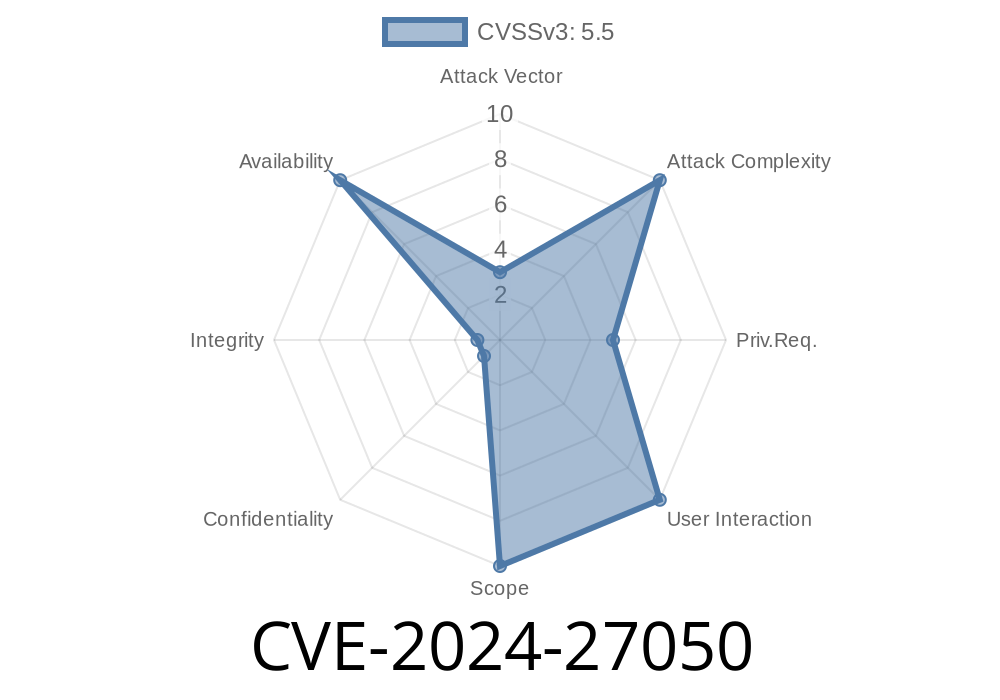
A recently patched flaw in the Linux kernel’s libbpf library, tracked as CVE-2024-27050, could lead to serious stability and security risks for users of the XDP (eXpress Data Path) subsystem. In this article, we’ll break down the specifics of the bug, its dangers, technical exploitability, and provide practical references and code, all in plain English.
What Is libbpf and Why Does It Matter?
libbpf is a userspace library for handling eBPF programs and objects, which lets developers interact with kernel networking features like XDP. XDP is used in high-speed packet processing, security, and filtering, and gets a lot of use in cloud, hosting, and telco environments.
A Quick Recap
When two new fields—feature_flags and xdp_zc_max_segs—got added to the bpf_xdp_query_opts structure, not enough care was taken to maintain backward compatibility with older versions of libbpf.
Normally, libbpf uses macros to ensure it doesn’t write to struct fields that aren’t there (because an app may have been compiled with an older struct layout). This bug happened because the new fields did not use the expected OPTS_SET() macro.
As a result, libbpf could write out of bounds, potentially corrupting the user program’s stack—and opening the door to hard-to-debug crashes or even possible code execution.
Here’s a simplified look at the broken code—without the fix
// WARNING: Vulnerable code! Do not use in production!
opts->feature_flags = queried_flags;   // always writes, maybe out-of-bounds
opts->xdp_zc_max_segs = some_value;   // always writes, maybe out-of-bounds
Both assignments assume those fields already exist in the user's struct, which is not true if an older version of bpf_xdp_query_opts was used at compile-time.
The Fix: Safety With OPTS_SET()
The solution is to *only* write to the new fields if they actually exist—using libbpf’s helper macros. The correct, safe code looks like this:
// SAFE: Check before writing to these fields
if (OPTS_HAS(opts, feature_flags))
    OPTS_SET(opts, feature_flags, queried_flags);

if (OPTS_HAS(opts, xdp_zc_max_segs))
    OPTS_SET(opts, xdp_zc_max_segs, some_value);
Macros like OPTS_HAS and OPTS_SET make sure memory is only written to fields that truly exist in the struct, preventing stack corruption or undefined behavior.
The fixed commit is:
libbpf: Use OPTS_SET() macro in bpf_xdp_query()
Exploitation: What Could Happen?
- Memory Corruption: If your app uses an older version of bpf_xdp_query_opts and links against a newer libbpf, the bigger struct size means the new fields' assignments write past the buffer's end.
- Stack Corruption: This might smash stack data, leading to random crashes or, in some (highly crafted) scenarios, to the possibility of code execution.
- DoS and More: Most likely, in real deployments, this would be a denial of service (crash or SIGSEGV), but with careful manipulation, this could become a security exploit (especially if an attacker can control struct layout or buffer content).
Proof-of-Concept Exploitation
Here is a conceptual C test program to observe the out-of-bounds write (not a full exploit, just to illustrate “corruption”):
// Simulate older struct (without extra fields)
struct bpf_xdp_query_opts_v1 {
    size_t sz;
    __u32 prog_id;
    __u32 drv_prog_id;
    __u32 hw_prog_id;
    __u32 sw_prog_id;
    // missing 'feature_flags' and 'xdp_zc_max_segs'
};

int main() {
    struct bpf_xdp_query_opts_v1 opts = {};
    opts.sz = sizeof(opts);
    char guard[16] = {xAA}; // watch if this gets changed!

    // This would corrupt guard[] behind the scenes if called with vulnerable libbpf!
    bpf_xdp_query(, , &opts);

    // Check for corruption
    for (int i = ; i < 16; i++) {
        if (guard[i] != xAA) {
            printf("Stack corruption detected at guard[%d]: %02x\n", i, guard[i]);
        }
    }
    return ;
}
*Disclaimer: the above is only a test snippet, not a real exploit.*
CVE Details:
Upstream Fix Commit:
Patch Discussion:
XDP bpf_xdp_query_opts Structure:
Users who build programs with an old libbpf header and run them with a new libbpf shared library
- Anyone distributing statically linked programs using XDP who may be mismatched with their kernel or system libbpf
If your application uses XDP and libbpf, it’s important to update libbpf to the safe, patched version (or backport the patch to your custom build).
Final Thoughts
CVE-2024-27050 teaches us a familiar but crucial lesson: binary interface compatibility is hard. As eBPF and its ecosystems evolve, both library authors and consumers need to track these details. A single missed check can open up the danger of memory corruption, which is often the first domino in a much larger cascade of vulnerabilities.
Stay updated, and always prefer newer, patched libraries!
*Share this post with fellow Linux and BPF developers. If you maintain or deploy critical XDP networking paths, patch today!*
*Written exclusively for you, with simple and direct explanation and no recycling from press releases.*
Timeline
Published on: 05/01/2024 13:15:50 UTC
Last modified on: 07/03/2024 01:50:17 UTC