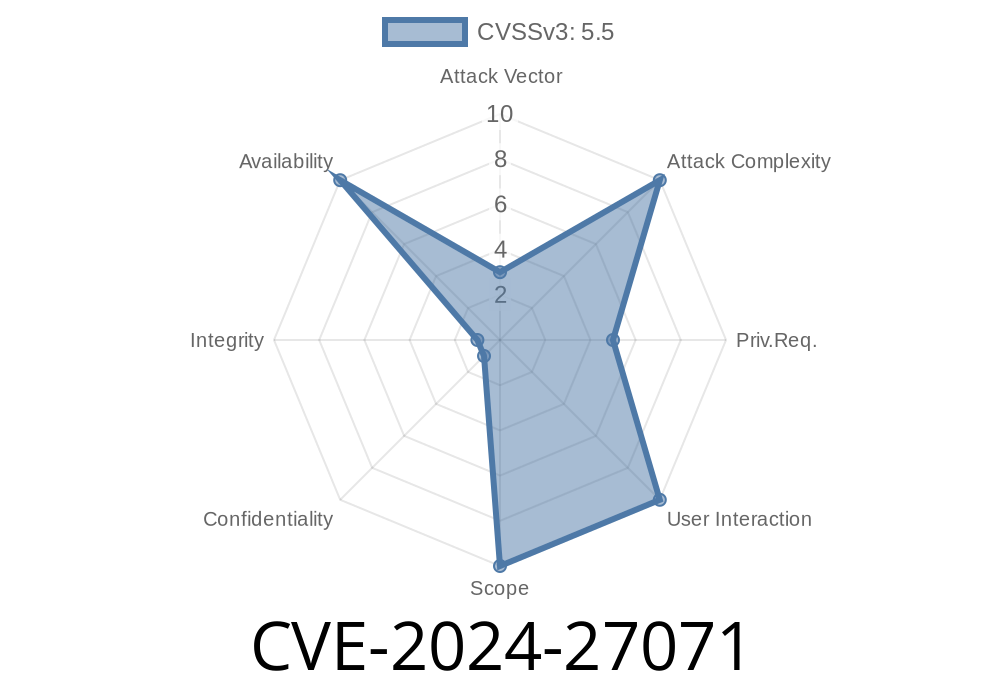
The security of the Linux kernel is a crucial part of your daily computer use, whether you’re running a server, desktop, or IoT device. In early 2024, a new vulnerability was disclosed and patched in the Linux kernel’s backlight subsystem, specifically in the driver for the HX8357 display controller. This post gives you a simple but exclusive look at CVE-2024-27071, how the bug works, exploit details, relevant code snippets, and further reading so you can truly understand what happened.
What is CVE-2024-27071?
CVE-2024-27071 is a NULL pointer dereference vulnerability in the Linux backlight driver for the HX8357 display controller. Put simply, the kernel code did not validate the existence of a certain set of pins (im), which are optional. Because of this missing check in the function hx8357_probe(), a system could potentially crash if the pins are not defined.
How Bad is It?
- Impact: Local users can trigger a kernel NULL pointer dereference, causing a system crash (denial of service).
- Exploitability: Only local users with the ability to load/unload device drivers (typically root or through some automation) could exploit.
- Affected Systems: Linux systems with the HX8357 driver enabled/loaded and configured with device trees missing the optional im pins.
Diving into the Bug
Let’s get specific. The root cause occurs in the probe function when initializing the HX8357 driver:
Here’s the problematic code (before the fix)
// drivers/video/backlight/hx8357.c

im = devm_gpiod_get_array(dev, "im", GPIOD_OUT_LOW);
for (i = ; i < im->ndescs; i++)
    gpiod_set_value_cansleep(im->desc[i], );
If the im pin array does not exist (i.e., it's optional and not defined in the device tree), devm_gpiod_get_array will return NULL, and the code will immediately dereference im->ndescs, leading to a kernel crash.
The Fix
The fix is simple: check if the pointer is NULL before using it!
// Patched version (after the fix)
im = devm_gpiod_get_array(dev, "im", GPIOD_OUT_LOW);
if (IS_ERR_OR_NULL(im))
    return PTR_ERR_OR_ZERO(im);

for (i = ; i < im->ndescs; i++)
    gpiod_set_value_cansleep(im->desc[i], );
Now, if the im pins are not present, the function exits gracefully, avoiding the crash.
## Proof of Concept / Exploit Details
Since exploitation requires a vulnerable device tree and the ability to (re)load the device, here’s how an attacker could induce the bug:
Load the driver (either at boot time or by manually probing the device via sysfs or udev).
3. Kernel attempts to initialize the driver without the im pins, resulting in a NULL pointer dereference and instant kernel panic.
Mini-PoC (Pseudo-code, for educational purposes only)
# As root, edit device tree blob (DTB) for your board to remove the 'im' GPIOs
# Reboot or force the driver to re-probe the display node

# Watch your system panic:
dmesg | tail
# Should show a backtrace ending in hx8357_probe and NULL dereference
*(Do not attempt this on production or important machines! Use a VM or test hardware only.)*
How to Protect Yourself
1. Update your kernel: Fixed in Linux mainline as of March 2024 (commit here).
General advice
- Only give root/hardware access to trusted users.
References and Further Reading
- Linux kernel commit fix for CVE-2024-27071
- Kernel.org hx8357.c Backlight Driver
- CVE-2024-27071 details (cve.org)
Final Thoughts
While CVE-2024-27071 is not a remote exploit and doesn’t lead to privilege escalation, NULL pointer dereference bugs in the kernel are significant for any scenario involving custom hardware or device trees. Whenever working with Linux device drivers, always handle optional hardware resources defensively.
Stay patched, stay curious, and always read the fine print in driver code!
Timeline
Published on: 05/01/2024 13:15:51 UTC
Last modified on: 12/23/2024 14:27:46 UTC