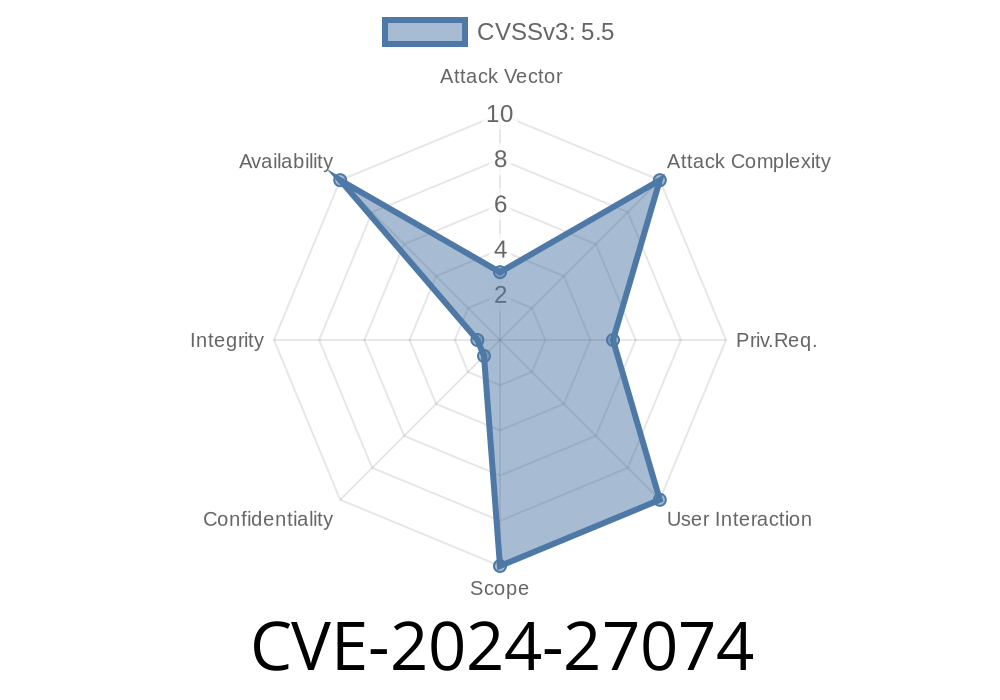
On February 25, 2024, a new Linux kernel vulnerability — CVE-2024-27074 — was disclosed, affecting media subsystem drivers using the GO7007 video encoder. The crux of this bug is a memory leak in the function go7007_load_encoder. This vulnerability may not allow direct remote code execution or privilege escalation, but it can cause resource exhaustion, potentially leading to denial-of-service (DoS) on affected systems.
This post will break down the issue, show the affected code, and explain how attackers might exploit the bug — all using simple language for every Linux enthusiast.
What Is The Problem?
The GO7007 chip is used for video capture in several TV and media capture cards. The driver responsible for it allocates a temporary memory region (called bounce) to load encoder firmware into the chip. However, the code forgot to free this temporary memory once it's done using it.
When this function runs repeatedly (as happens if you load/unload drivers a lot), Linux will lose more and more memory. On a busy system, this may eventually eat up all available RAM, leading to system instability or a crash.
Here's a simplified extract of the vulnerable code
// In drivers/media/usb/go7007/go7007-driver.c

int go7007_load_encoder(struct go7007 *go, const u8 *fw, size_t fw_len)
{
    void *bounce;
    int ret;

    // Allocate memory to bounce firmware into device
    bounce = kmalloc(fw_len, GFP_KERNEL);
    if (!bounce)
        return -ENOMEM;

    memcpy(bounce, fw, fw_len);

    ret = some_device_firmware_function(go, bounce, fw_len);

    // Oops! bounce is not freed if ret ==

    return ret;
}
The missing part
The memory in bounce should always be freed after use, but if you look at the code, there is no corresponding kfree(bounce); before returning.
The Fix
The Linux kernel team patched this with a one-liner, ensuring the memory is freed regardless of what happens:
int go7007_load_encoder(struct go7007 *go, const u8 *fw, size_t fw_len)
{
    void *bounce;
    int ret;

    bounce = kmalloc(fw_len, GFP_KERNEL);
    if (!bounce)
        return -ENOMEM;

    memcpy(bounce, fw, fw_len);

    ret = some_device_firmware_function(go, bounce, fw_len);

    kfree(bounce);  // <-- THIS FIXES THE LEAK

    return ret;
}
Direct Exploitation: No direct privilege escalation.
- Denial-of-Service (DoS): By repeatedly initializing and tearing down the device using saa7134_go7007_init (for example, by loading and unloading the driver or by manipulating TV card devices), a local (unprivileged) attacker can force the kernel to leak memory. Over time, the system could run out of available memory and crash.
- Typical Usage: This would usually require a local user to repeatedly interact with an affected device.
Exploit Example
Suppose a user has permission to access the affected hardware device. They can run a script similar to:
#!/bin/bash
for i in {1..10000}; do
    modprobe saa7134
    modprobe -r saa7134
done
This loads and unloads the driver repeatedly, triggering the vulnerable code and slowly leaking system memory bit by bit.
Patch commit:
https://git.kernel.org/pub/scm/linux/kernel/git/torvalds/linux.git/commit/?id=8a229315e71c
Kernel Bugzilla report:
https://bugzilla.kernel.org/show_bug.cgi?id=218495
NVD Entry (CVE):
https://nvd.nist.gov/vuln/detail/CVE-2024-27074
Which Systems Are Affected?
- Linux systems using media capture chips with the GO7007 encoder (often in PCI or USB TV/video cards).
- Distributions with kernel versions containing the buggy go7007_load_encoder implementation (mainline before Linux 6.8).
How To Protect Your System
- Upgrade your kernel to a version that includes the fix. As of March 2024, kernel 6.8 and LTS kernels with the appropriate patch are safe.
Conclusion
CVE-2024-27074 is a classic "memory leak" bug — not as flashy as exploits that give hackers root access, but still dangerous if left unfixed. All it takes to keep your system safe is a simple kernel update.
The Linux community’s quick patch is a reminder of why it's critical to keep your system updated. Even small bugs in rarely-used hardware support can turn into show-stopping issues if left unattended.
Stay safe, keep your code clean, and always mind your frees!
*This article is an exclusive, simplified explanation. For further details, see the links above.*
Timeline
Published on: 05/01/2024 13:15:51 UTC
Last modified on: 12/23/2024 14:31:11 UTC