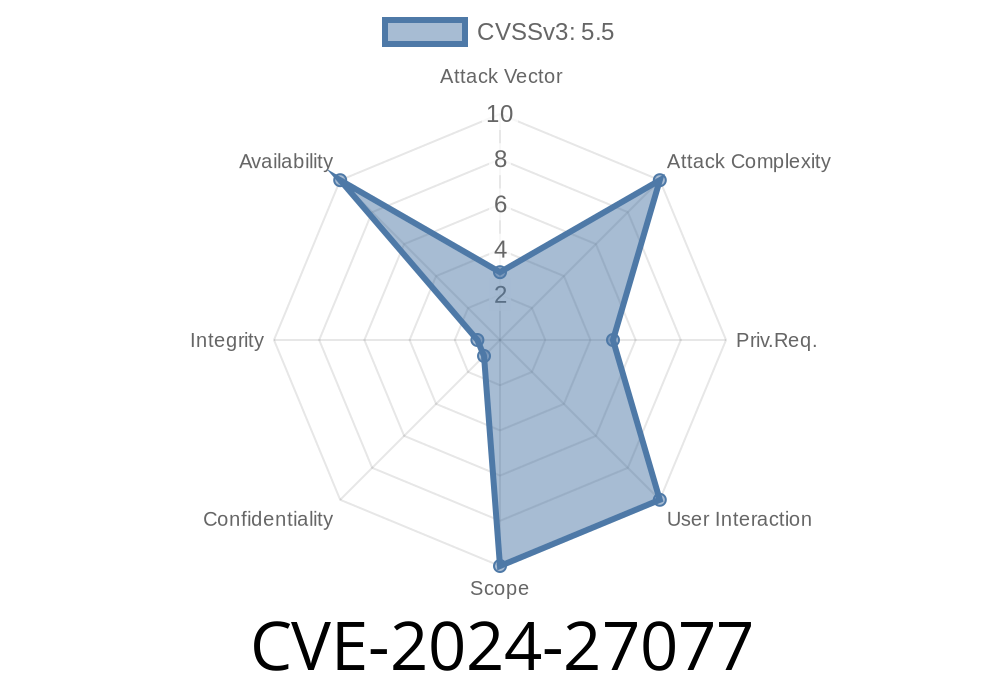
In early 2024, security researchers discovered a subtle but impactful vulnerability in the Linux kernel's media subsystem—specifically, the video4linux (V4L2) memory-to-memory (m2m) framework. This vulnerability, CVE-2024-27077, arises from a memory leak issue during the registration of media entities. It's another example of how minor mistakes in error handling—especially in allocation and deallocation of resources—can quietly affect system performance and security over time.
This post is tailored for developers, system administrators, and anyone interested in the internals of Linux security. Let's break down what the issue is, its root cause, how it can be exploited, and how the Linux community has fixed it.
What’s the V4L2 M2M Framework?
V4L2 is the Video4Linux2 kernel API, commonly used for handling video capture and output hardware. The V4L2 M2M (memory-to-memory) framework manages devices that process video streams by copying data from memory to memory, rather than directly capturing or displaying it.
Within this framework, media entities represent various functional blocks, such as video encoders or decoders.
The Vulnerability: How Did the Leak Occur?
In the v4l2_m2m_register_entity function, a dynamic allocation was made for entity->name. If some error occurred after this allocation—like a failed registration down the line—the clean-up code forgot to free this memory. As a result, every failed registration would leak just a bit of memory.
Over time, especially in error-rich environments or repeated device probing, these small leaks could accumulate, impacting system stability.
Here's a simplified version of the problematic code path (before the patch)
// Kernel code snippet (simplified)
int v4l2_m2m_register_entity(...) {
    entity->name = kstrdup("v4l2-m2m-entity", GFP_KERNEL);  // Allocate name
    if (!entity->name)
        return -ENOMEM;

    ret = media_entity_pads_init(entity, ...);
    if (ret < )
        return ret;  // Forgot to kfree(entity->name)
    ...
}
If media_entity_pads_init() fails, execution returns immediately, and the memory allocated for entity->name is never released.
What’s the Fix?
The patch simply adds a call to kfree(entity->name) in every error-handling path after the name has been allocated but before function returns with an error. This way, no memory leaks occur regardless of where the error happens.
Fixed code
int v4l2_m2m_register_entity(...) {
    entity->name = kstrdup("v4l2-m2m-entity", GFP_KERNEL);
    if (!entity->name)
        return -ENOMEM;

    ret = media_entity_pads_init(entity, ...);
    if (ret < ) {
        kfree(entity->name);  // New fix: free memory on error
        return ret;
    }
    ...
}
Is it Dangerous?
This vulnerability does not allow for code execution, privilege escalation, or direct compromise of system integrity. Rather, it’s a denial-of-service (DoS) class issue: by repeatedly forcing the vulnerable error path (e.g., via unprivileged device ioctl, or by probing and removing a broken video device), malicious users or buggy applications could slowly run the system out of kernel memory.
Possible Exploit (Proof-of-Concept)
A basic user-space exploit would require the ability to trigger the media device registration error path repeatedly—this could be done by, for example, creating and removing virtual V4L2 M2M devices with purposely-broken configurations (requires root or special privileges).
PoC outline
- Write a kernel module or script that keeps registering and unregistering a media entity with bad parameters.
Let it loop for a while.
- Monitor /proc/meminfo to see the slow memory growth.
Given the impact is limited (only leaks a small amount per failure), this is mostly a problem in automated or embedded environments where many devices may repeatedly fail to initialize.
How Was It Discovered?
The vulnerability was reported and fixed by routine code auditing and static analysis tools, which flagged that a dynamically-allocated string could be orphaned in certain error scenarios.
The fix landed in the official Linux kernel git repository:
Linux media: v4l2-mem2mem: fix a memleak in v4l2_m2m_register_entity (commit)
CVE record:
CVE-2024-27077 at MITRE (awaiting full details at publication time)
What Should You Do?
- Kernel Upgrades: Apply kernel patches released after the discovery date (March 2024). Most Linux distributions have already incorporated this patch.
- Monitoring: If you run workloads heavy on V4L2 M2M device registration (like video servers, test labs, or smart camera gateways), monitor for similar leaks using system tools like slabtop or /proc/meminfo.
- Verify Device Drivers: Encourage review of device drivers for similar allocation/deallocation balance issues.
References
- V4L2 M2M Framework Documentation
- Fixed commit in Linux kernel source
- CVE-2024-27077 at CVE Details
Summary
CVE-2024-27077 is a minor but non-trivial memory leak fixed in the Linux kernel’s media framework. While not a critical security hole, it highlights the importance of rigorous error-path resource management in all system code—especially the kernel. Make sure your systems are current, and keep an eye out for other “small” bugs that could have long-term effects.
If you have any questions, feel free to ask in the comments!
Timeline
Published on: 05/01/2024 13:15:51 UTC
Last modified on: 12/23/2024 14:38:37 UTC