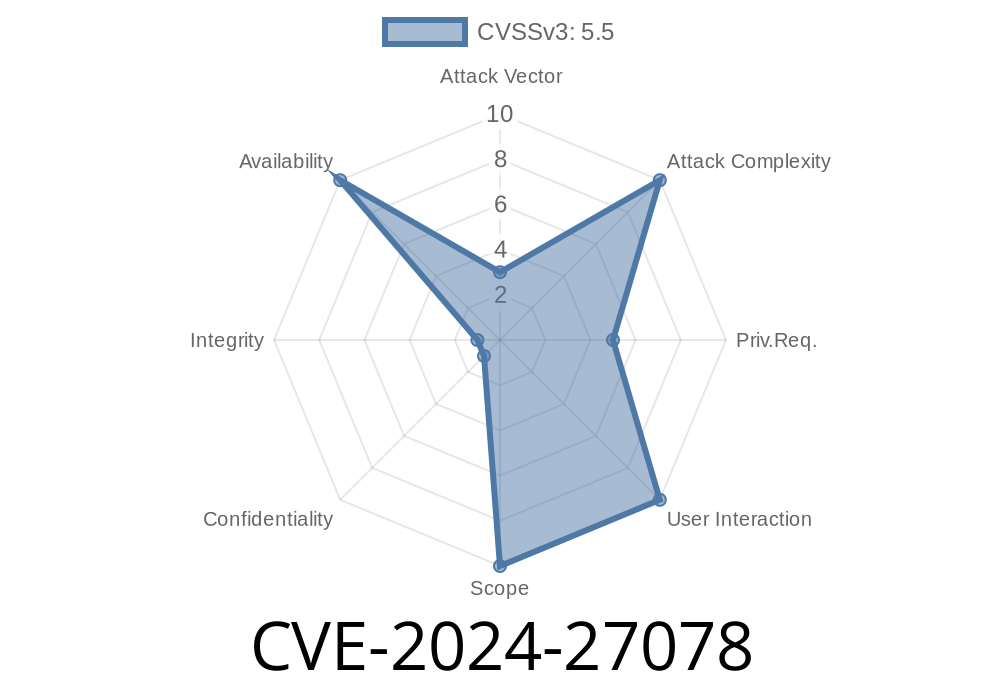
A new vulnerability, CVE-2024-27078, has surfaced in the Linux kernel’s media subsystem relating to “Test Pattern Generator” (TPG) code used by Video4Linux2 (V4L2). This bug — now fixed — was about memory leaks due to improper resource deallocation in error-handling paths of the function tpg_alloc in the file v4l2-tpg. If you run a Linux system that makes use of V4L2-based camera devices or similar hardware, this post will help you understand the issue, its impact, and what you should do about it.
What Is V4L2 TPG?
V4L2 (Video4Linux2) is the Linux kernel’s subsystem for handling all sorts of video capturing and output devices, like webcams, TV tuners, and other streaming video sources. The Test Pattern Generator (TPG) is a feature used mainly for testing video pipelines, letting you generate known image patterns for debugging and validation.
Description (From The Patch)
The bug is a classic: in the tpg_alloc function (which handles setting up resources for the TPG), resources (like memory blocks) are allocated in a loop. But, on error, the code only did a partial cleanup — or sometimes, not at all — leading to memory leaks.
In short: If something went wrong during setup (such as memory allocation failure), memory that was already allocated wasn’t always freed, which could pile up over time and waste system memory.
Here’s a simplified sketch of what was going wrong, based on the actual kernel patch
int tpg_alloc(struct tpg_data *tpg, ...) {
    for (i = ; i < tpg->planes; i++) {
        tpg->buffers[i] = kmalloc(buffer_size, GFP_KERNEL);
        if (!tpg->buffers[i]) {
            /* BUG: missing cleanup for already-allocated tpg->buffers[]...tpg->buffers[i-1] */
            return -ENOMEM;
        }
    }
    return ;
}
If kmalloc fails at any iteration, previously allocated buffers were sometimes not freed, resulting in a memory leak. The fix was to ensure that each error handling path cleans up previously allocated memory.
How Was It Fixed?
The kernel fix (merged as of Linux v6.8-rc1) updated all error paths in tpg_alloc to call a cleanup function, tpg_free, which properly deallocates all resources allocated so far. Here’s the corrected pattern:
int tpg_alloc(struct tpg_data *tpg, ...) {
    for (i = ; i < tpg->planes; i++) {
        tpg->buffers[i] = kmalloc(buffer_size, GFP_KERNEL);
        if (!tpg->buffers[i]) {
            tpg_free(tpg); // Proper cleanup now
            return -ENOMEM;
        }
    }
    return ;
}
Reference:
- Upstream Patch Commit
- CVE Record at NVD
- Linux v4l2-tpg Source Code
Who’s Affected?
- Linux systems (kernel 4.x, 5.x, pre-6.8) using V4L2 TPG for development/testing.
- Mainly kernel-space users (driver writers, distribution maintainers, or projects that leverage TPG through custom camera pipelines).
Note: Ordinary desktop/server users likely won’t be directly hit unless a local user triggers the TPG code repeatedly (say, via misbehaving test tools).
Exploitation Scenario
There is no remote code execution or privilege escalation. The root impact is resource exhaustion: an unprivileged local user or process with access to the V4L2 TPG interface could repeatedly trigger tpg_alloc errors (for example, forcing memory exhaustion intentionally), slowly leaking kernel memory. With enough attempts, this could eventually cause the system to run out of memory or at least degrade performance.
Example of a (Hypothetical) Exploit
A user program could, in a loop, create TPG test patterns with intentionally crafted dimensions or formats to trigger allocation failures, slowly leaking memory:
// User space pseudocode (not real exploit)
for (int i = ; i < 100000; i++) {
    open("/dev/video-tpg", ...); // Trigger TPG test pattern allocation
    ioctl(..., BAD_FORMAT);      // Pass format likely to fail and leak
    close(...);
}
On affected kernels, this loop could gradually eat up kernel memory, causing low-memory conditions.
How to Fix
Upgrade to a kernel with the patch applied (Linux 6.8-rc1+), or check with your Linux distribution vendor for availability of a backported fix if running earlier versions.
Conclusion
CVE-2024-27078 is a good example of why error-handling, even in internal kernel code, must clean up all resources. While not directly exploitable in most real-world setups, it could degrade system reliability. If you're affected, update your kernel or patch as soon as feasible. Kernel maintainers and developers: always audit your error paths!
Further Reading
- Linux Kernel changelog v6.8
- Video4Linux2 Documentation
*This post was written exclusively for our community, offering a simple and direct dive into a recent kernel vulnerability. Stay safe and keep your systems lean!*
Timeline
Published on: 05/01/2024 13:15:51 UTC
Last modified on: 12/23/2024 14:34:14 UTC