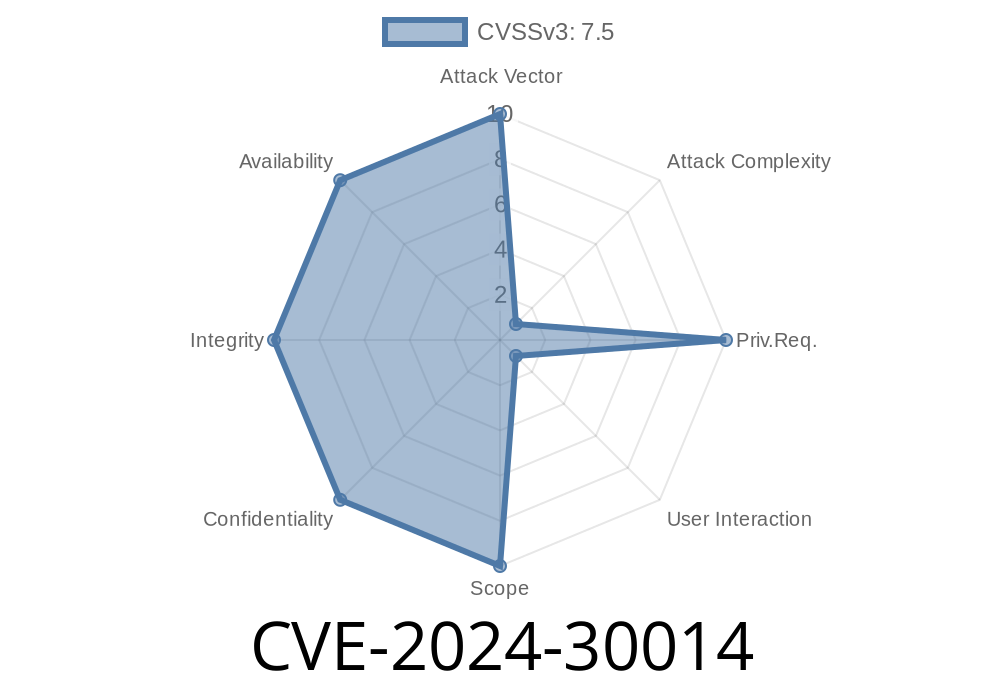
June 2024 brought troubling news for Windows users: CVE-2024-30014, a critical Remote Code Execution (RCE) vulnerability lurking in the Windows Routing and Remote Access Service (RRAS). This post breaks it down in simple terms, shows example code, explains the risk, and links to reliable references.
What is Windows RRAS?
Windows Routing and Remote Access Service (RRAS) is a Microsoft Windows feature that lets you build VPNs, configure network routing, and provide NAT services. Think of it as the behind-the-scenes traffic cop for network traffic in many businesses.
Short version: If you use Windows for remote access or network routing, RRAS might be running.
What’s CVE-2024-30014 All About?
This vulnerability allows an attacker to run their own code—remotely—on a machine with RRAS enabled. That means if your server is open to the internet and not patched, a remote hacker could take full control.
Severity: CRITICAL (CVSS 9.8/10)
Affected Systems: Windows Servers and some Windows 10/11 editions where RRAS is installed and enabled.
How Does the Attack Work?
Microsoft explains in their advisory:
> An authenticated attacker could send specially crafted packets to a server running RRAS, which could allow remote code execution.
- The attacker must be authenticated but often, RRAS is paired with weak or default credentials making real-world attacks possible.
Example Attack Scenario
Imagine a company uses RRAS for remote VPN connections. An attacker with low privileges (or who’s already leaking passwords through phishing or weak credentials) sends a custom-crafted network packet to the service. RRAS processes it and—due to a flaw—executes code supplied by the attacker.
Result: The attacker installs ransomware, uses the server to attack the internal network, or steals data.
Technical Details & Proof-of-Concept Code
The exploit works by sending a malformed packet to a specific RRAS service port. While the exact low-level details are not fully public yet (for ethical reasons!), the basic idea is to trigger a buffer overflow or similar memory corruption bug.
Here’s a simplified pseudo-code illustration in Python, showing the shape of a network “packet” that could (if the service was still unpatched) trigger a crash or code execution:
import socket

# Replace with target server's IP and RRAS listening port (default example)
target_ip = '10...1'
rras_port = 1701  # Example port for L2TP

# "Evil" payload: Let's just send a huge blob for illustration
malicious_payload = b'A' * 500  # overly large packet to trigger overflow

with socket.socket(socket.AF_INET, socket.SOCK_STREAM) as s:
    s.connect((target_ip, rras_port))
    s.send(malicious_payload)
    response = s.recv(4096)
    print('Received:', response)
WARNING: This is illustrative code only. Exploiting live systems is illegal without permission!
Microsoft released updates in the June 2024 Patch Tuesday.
👉 CVE-2024-30014 Security Update
Disable RRAS if not needed
Many environments have RRAS enabled by default and don’t really use it. Disable all unused remote access and routing services.
Strong Authentication
Lock down RRAS logins. Use strong passwords, limit access to only trusted IPs, enable multi-factor authentication.
References & Further Reading
- Microsoft Security Advisory (CVE-2024-30014)
- NIST NVD Entry
- June 2024 Patch Tuesday Analysis – BleepingComputer
- Understanding and Securing RRAS on Windows Servers – Microsoft Docs
Timeline
Published on: 05/14/2024 17:16:44 UTC
Last modified on: 06/19/2024 20:58:29 UTC