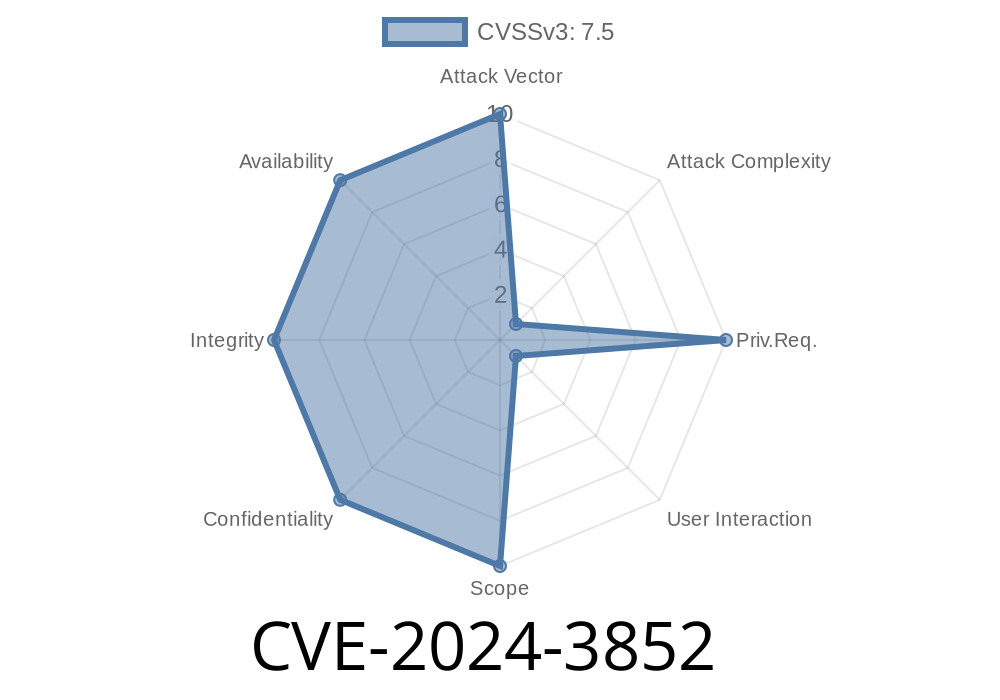
In April 2024, Mozilla fixed a security flaw tracked as CVE-2024-3852 that affected multiple popular products, including Firefox, Thunderbird, and Firefox ESR. Let’s break down what happened, how it can go wrong, and why it matters.
What is CVE-2024-3852?
CVE-2024-3852 is a vulnerability in the JavaScript engine used by Firefox browsers and Thunderbird email client. Specifically, it deals with the JavaScript function GetBoundName, which can return the *wrong version* of an object if certain Just-In-Time (JIT) compiler optimizations are triggered.
This means that under specific conditions, JavaScript code could get access to an outdated or unexpected object, potentially leaking sensitive information or breaking security boundaries.
References
- Mozilla Security Advisory 2024-16
- NVD entry for CVE-2024-3852
Behind the Scenes: What’s GetBoundName?
GetBoundName is an internal function used by SpiderMonkey—the JavaScript engine behind Firefox. It helps JavaScript code figure out which object a variable name refers to (think of scope and closures).
Normally, this should always return the latest, most accurate binding (variable reference). But when the JIT engine gets involved for performance, some optimizations forgot to keep track of all possible changes. If the code changed a variable in a way the JIT wasn’t expecting, GetBoundName could give back a *previous* or *different* version of the object.
Code Example: How Could This Go Wrong?
Let’s visualize it with a simple (simplified) code snippet.
function makeFunc() {
  let obj1 = {secret: "password"};   // Initial object
  let obj2 = {secret: "not-secret"}; // Another object

  function innerFunc() {
    // Under normal operation, this should always see the latest binding
    return obj1.secret;
  }

  // Change obj1 to point elsewhere before returning
  obj1 = obj2;
  return innerFunc;
}

let fn = makeFunc();
console.log(fn()); // Should print "not-secret"
With the vulnerability, when the JIT compiler "optimized" the code, the function innerFunc *might* still reference the old obj1 even after it has been updated to point to obj2. That could allow a clever attacker to read or manipulate objects they shouldn’t have access to.
Imagine that in place of our trivial example, obj1 could be a privileged object, like browser credentials or other sensitive data.
Proof of Concept Exploit
Below is an *illustrative* proof-of-concept that tries to access a stale object by exploiting scoping confusion, similar to what an attacker might try with CVE-2024-3852:
function leakObject() {
    let privilegedObject = {token: "super-secret-token"};
    let normalObject = {token: "public-data"};

    function getToken() {
        // JIT may incorrectly bind to privilegedObject
        return privilegedObject.token;
    }

    // Switch binding (simulates a context swap)
    privilegedObject = normalObject;

    // Should return 'public-data', but may leak 'super-secret-token'
    return getToken();
}

console.log(leakObject());
With this bug, a malicious script running in the browser might be able to grab sensitive data *after* a supposed privilege reduction, just because JIT didn’t update the binding correctly!
Why Does This Matter?
- Cross-boundary Data Leak: Attackers could grab or manipulate variables that should be out of their reach.
- Breaking Security Contexts: Could be used alongside other vulnerabilities for privilege escalation or sandbox escapes.
Mozilla patched CVE-2024-3852 in
- Firefox 125
- Firefox ESR 115.10
- Thunderbird 115.10
Update now! If you haven’t already, get the latest versions to stay secure.
Learn More
- Mozilla Security Advisory 2024-16
- Detailed Discussion on Bugzilla (Bug 1884457)
- CVE-2024-3852 on NIST NVD
In Summary:
CVE-2024-3852 is a subtle yet dangerous bug fixed by Mozilla in April 2024. It could let malicious code slip past important security checks due to incorrect object binding when JIT optimizations are enabled. If you’re using Firefox, Thunderbird, or ESR, update immediately to avoid potential attacks.
Timeline
Published on: 04/16/2024 16:15:08 UTC
Last modified on: 07/03/2024 02:06:44 UTC