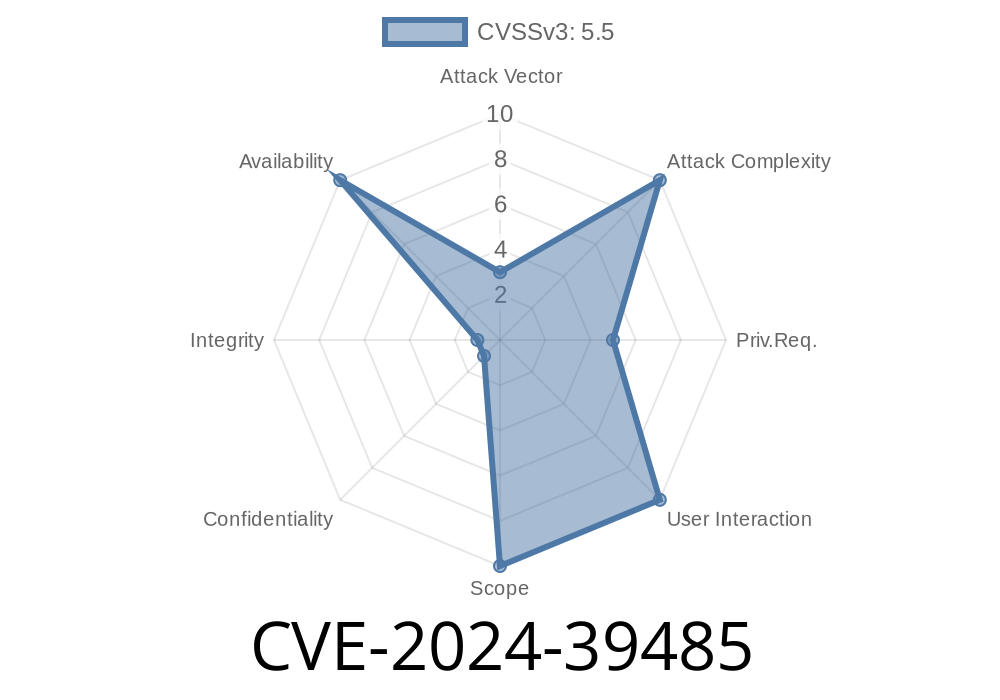
A critical vulnerability has recently been patched in the Linux kernel relating to the V4L (Video for Linux) async notifier system. Catalogued as CVE-2024-39485, this flaw involves improper cleanup of linked list entries, leading to dangling pointers which could be used in denial of service or potentially more serious kernel exploits. If you’re a kernel developer, systems administrator, or just a Linux enthusiast, it’s important to understand how this bug worked and how it was fixed. Let’s break it down in clear, simple terms.
What is Vulnerable?
At the heart of this bug is the media/v4l2 async notifier subsystem – part of the Linux kernel that helps devices inform other subsystems about their presence and capabilities asynchronously.
When de-registering, the associated notifier_entry was not re-initialized.
- This led to a classic dangling pointer: the kernel thought the entry was gone, but it still referenced freed memory.
- Attackers could leverage this to cause memory corruption, use-after-free conditions, or panic the kernel.
The Problem: Dangling List Pointer
Linux kernel code often relies on doubly-linked lists for tracking resources. Here, each notifier has an entry field (notifier_entry) that links it to other notifiers. When the notifier gets deregistered, the code was doing this:
// Before the patch (VULNERABLE VERSION)
list_del(¬ifier->notifier_entry); // Removes from list, but doesn't re-init
// 'notifier_entry' now points to garbage!
The problem: notifier_entry still points to where it used to be in the list; it isn’t “reset,” leaving a pointer to freed memory (potential use-after-free) or an invalid address.
The Fix
The kernel patch fixes this by calling list_del_init() instead of just list_del(). This means the list is not only unlinked, but the entry is set back to an empty state, eliminating the dangling pointer:
// After the patch (SAFE VERSION)
list_del_init(¬ifier->notifier_entry); // Unlinks and re-initializes entry
list_del_init() safely removes the entry from the list and then resets its pointers, so even if the structure were re-used or inspected again, it would no longer point to any stale memory.
Reference to the patch:
Linux Kernel Patch Commit
CVE Details: CVE-2024-39485 on CVE.org
Example: Minimal Exploit Scenario
Let’s see how you could (in theory) exploit the vulnerable code.
Attacker reallocates the freed memory (occupying the old spot of notifier_entry).
3. Kernel, thinking the notifier is still valid, follows the pointer, accessing now-attacker-controlled memory.
Here’s a (simplified) C code snippet showing how a dangling pointer arises
struct notifier my_notifier;
register_notifier(&my_notifier);
// ... do stuff ...
unregister_notifier(&my_notifier);
// 'my_notifier.notifier_entry' still points to where it was!
With the patch, notifier_entry is re-initialized, so after unregistering, it isn’t possible to use it to reference freed or attacker-controlled memory.
Who Is Affected?
- All Linux kernel versions before the patch are vulnerable if they use the V4L async notifier subsystem.
- Various desktop and embedded Linux devices (smart cameras, video capture cards, media centers) are potentially affected.
How to Fix
- Upgrade your kernel: Make sure you’re running a version with the fix (commits from early June 2024 or later).
Check vendor advisories: Your distro may backport the patch to older maintained kernels.
- Disable unneeded video drivers: As a last resort, blacklist affected drivers if you cannot patch immediately.
Final Words
CVE-2024-39485 reminds us how even small mistakes with linked lists and pointer management can lead to serious security problems in kernel-space. Always re-init your pointers after deletion, especially in code that runs at high privileges!
References:
- Linux Kernel Patch Commit
- CVE-2024-39485 details on CVE.org
Timeline
Published on: 07/05/2024 07:15:10 UTC
Last modified on: 08/02/2024 04:26:15 UTC