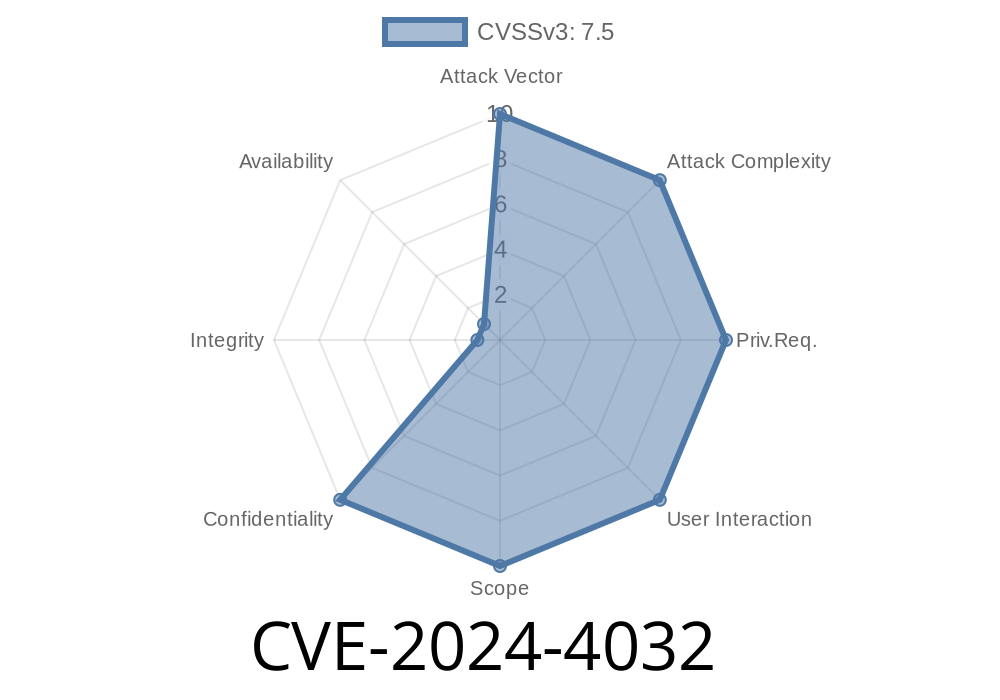
The recent bug identified as CVE-2024-4032 exposes a subtle yet significant issue in Python’s standard ipaddress module. This vulnerability affects how certain IPv4 and IPv6 addresses are classified as "private" or "globally reachable," leading to incorrect results when using the is_private and is_global properties. The bug arises because the module had outdated information about address designations, not matching the current IANA Special-Purpose Address Registries.
In this post, we’ll break down what went wrong, show you how to spot it in your code, and explain how Python 3.12.4 and 3.13.a6 fix the problem.
What Went Wrong in CVE-2024-4032
The root of the issue lies in how the Python ipaddress module defined ranges of "private" and "global" IP addresses. For tasks like validating user inputs, filtering network traffic, or authenticating connections, you often need to check if an IP is, for example, a reserved or a public address.
is_global: True if the address is considered ‘globally reachable’ (public Internet).
However, until Python 3.12.4 and 3.13.a6, the module used stale definitions. Some special-purpose ranges (recently updated by IANA) were misclassified:
Some addresses marked as “private” were actually not private anymore (or vice versa).
Practically, this means your code could make dangerous security or routing decisions, thinking an address is private (safe) when it’s actually globally reachable (risky or public).
Example: Exploiting the Confusion
Let’s see how the bug shows up in real code. Suppose you want to accept API requests only from private IP addresses, rejecting all "global" users.
Vulnerable Python Example (pre-3.12.4)
import ipaddress

ip_input = "100.64..1"  # Carrier-grade NAT

ip = ipaddress.IPv4Address(ip_input)
print(f"Is {ip} private? {ip.is_private}")  # Expected True or False?
print(f"Is {ip} global? {ip.is_global}")    # Expected True or False?
Output (pre-fix)
Is 100.64..1 private? False
Is 100.64..1 global? True
What’s wrong?
According to IANA Special-Purpose Address Registry, the block 100.64../10 is reserved for Carrier-Grade NAT—not "globally reachable." But the old ipaddress would have set is_global to True and is_private to False—a misclassification that could allow traffic you didn’t intend.
Let’s take a simple web app that allows access only from private network addresses
from flask import request, abort
import ipaddress

@app.before_request
def only_allow_private():
    ip = ipaddress.ip_address(request.remote_addr)
    if not ip.is_private:
        abort(403)
If an attacker makes a request from 100.64..1, and your app is running on a vulnerable Python version, the request is allowed—even though it’s not a private network by IANA’s current rules. In other cases, real private addresses could be blocked by mistake.
The Fix and the Future
CPython 3.12.4 and 3.13.a6 update the ipaddress definitions to match the latest from IANA. Check out the upstream Python bug report and patch:
- Python security advisory: CVE-2024-4032
- Python bug tracker: issue11885
- Relevant code change: GH-11885: update is_private, is_global, and friends
IANA Special-Purpose Address Registries:
How to Protect Your Python Apps
1. Upgrade Immediately: If you use the ipaddress module (directly or through dependencies!), upgrade to Python 3.12.4 or newer ASAP.
2. Double-Check Assumptions: If your code relies on “private” or “global” IP checks, re-audit it.
3. Pin Dependency Versions: If you use third-party libraries that wrap or depend on ipaddress (like Django, FastAPI, Flask middlewares), confirm their Python version support.
4. Manual Patch (for old Pythons): If you cannot upgrade yet, consider temporarily maintaining your own address-checking functions reflecting the latest IANA data.
Conclusion
CVE-2024-4032 is a prime example of how even “boring standard library code” carries real-world security risks. Mismatches between code and evolving standards (like IANA registries) can expose your applications to subtle privilege escalation, information leaks, or outright policy bypass.
Don’t underestimate the risk: Audit, upgrade, and stay synced with trusted standards in your codebase.
*Stay safe, and always check twice when trusting IP addresses in your Python apps.*
Timeline
Published on: 06/17/2024 15:15:52 UTC
Last modified on: 08/29/2024 21:35:11 UTC