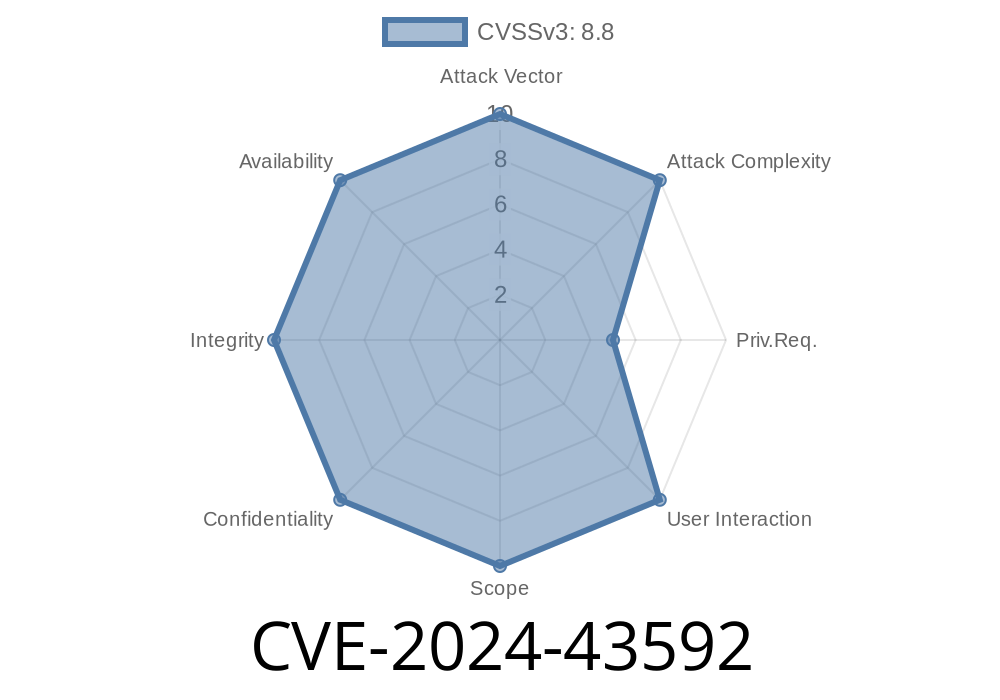
In May 2024, Microsoft patched a high-severity flaw in the Windows Routing and Remote Access Service (RRAS), officially tagged as CVE-2024-43592. This critical Remote Code Execution (RCE) bug affects numerous Windows Server versions running RRAS — a feature often used to provide VPN, NAT, and routing for networks. In this long read, we'll walk through what CVE-2024-43592 is, see how exploitation is possible, inspect a code snippet representing the vulnerability, link key references, and offer some mitigation tips. Everything is written in easy-to-understand language for security professionals and sysadmins alike.
What is RRAS?
Windows Routing and Remote Access Service (RRAS) is a Windows component that lets administrators configure routing, network address translation, and virtual private networking. In many organizations, RRAS is a critical component that sits at the network edge, making any security flaw in it particularly dangerous.
CVE-2024-43592: The Vulnerability Explained
CVE-2024-43592 enables a remote attacker to execute code on the underlying Windows Server — potentially giving them the same privilege as the RRAS process itself (which often runs as SYSTEM). The flaw exists in the way RRAS processes specially crafted network packets. Attackers don’t need valid credentials or user interaction to exploit this bug — making it “wormable” if abused properly.
How the Exploit Works
The vulnerability exists in RRAS’s packet parsing logic, specifically when handling certain VPN or routing requests. If an attacker sends a malformed packet, they can corrupt memory via a buffer overflow or similar vulnerability. This lets them run arbitrary code on the server.
While Microsoft hasn’t published a proof-of-concept, security researchers like ZDI analyzed the bug for exploitability.
Simplified Exploit Flow
1. Find an RRAS server exposed to the network/internet.
2. Send a specially crafted packet that triggers the bug. (This might involve a buffer overflow, use-after-free, or similar condition.)
Code Snippet: Simulated Vulnerable Handler (C-like Pseudocode)
While the precise vulnerability details aren’t public, below is a simplified example showing how a buffer overflow in packet processing could arise:
#define MAX_PACKET_SIZE 2048

void HandleRRASPacket(char *packet, int length) {
    char buffer[MAX_PACKET_SIZE];
    // Unsafe: No validation on the length
    memcpy(buffer, packet, length); // Potential overflow if 'length' > MAX_PACKET_SIZE

    // ...process packet
}
If an attacker sends a packet larger than MAX_PACKET_SIZE (2048 bytes), memcpy will overflow buffer, overwriting memory and potentially hijacking execution.
Scan for public-facing RRAS servers on common ports (like 1723 for PPTP).
2. Send a malicious packet — matching the protocol but containing data specifically crafted to exploit the vulnerable handler.
3. Once remote code is running, deploy malware, ransomware, or pivot further into the internal network.
Example with Python’s socket library (conceptual, for educational purposes only)
import socket

# Replace with target's IP, port 1723 is common for PPTP
target_ip = '192.168.1.100'
target_port = 1723

# Create an oversized payload - adjust as needed for real exploit
payload = b'A' * 4096

with socket.socket(socket.AF_INET, socket.SOCK_STREAM) as s:
    s.connect((target_ip, target_port))
    s.send(payload)
*Note: This is a simplified example to illustrate the concept, not a real exploit.*
References & Further Reading
- Microsoft Advisory: CVE-2024-43592
- Zero Day Initiative: ZDI-24-654
- NIST NVD entry: CVE-2024-43592
- Microsoft RRAS documentation
- Microsoft Patch Tuesday for May 2024
Conclusion
CVE-2024-43592 is a dangerous RCE flaw in Windows RRAS. Exploiting it is trivial for attackers in the right context, and it could allow full system compromise. Patch now, audit your RRAS deployments, and limit exposure to the public internet to stay safe.
*Stay tuned to security bulletins, and always apply updates promptly!*
Timeline
Published on: 10/08/2024 18:15:27 UTC
Last modified on: 10/12/2024 00:00:11 UTC