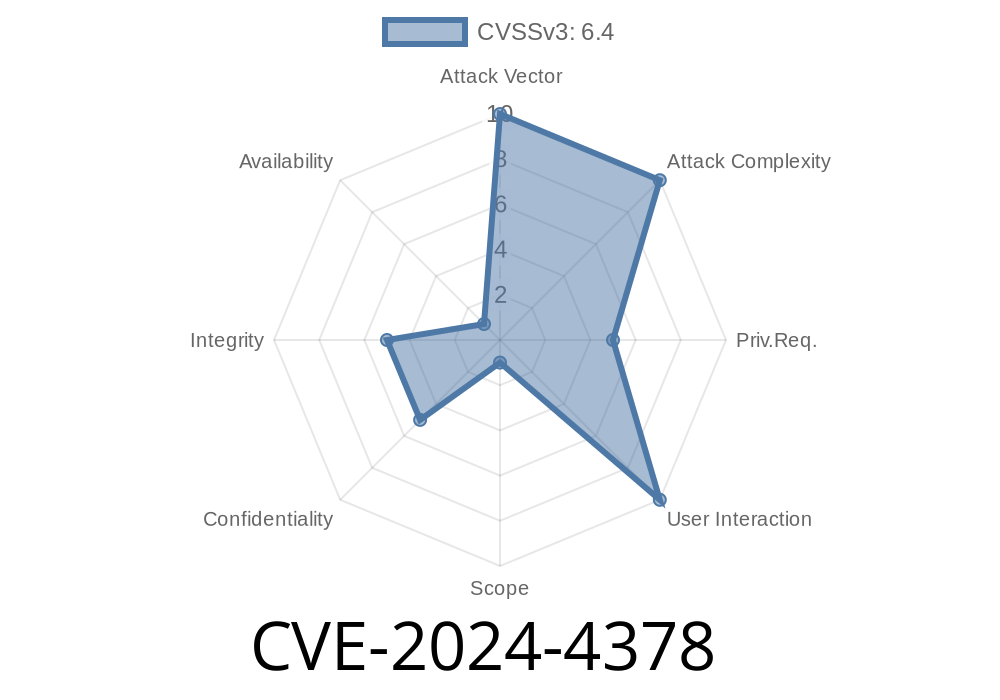
Date: June 2024
Severity: Medium–High
Affected Plugin: Premium Addons for Elementor
Vulnerable Versions: up to and including 4.10.30
Exploit Type: Stored Cross-Site Scripting (XSS)
Privilege Required: Contributor or higher
Overview
A critical vulnerability — CVE-2024-4378 — was recently discovered in the Premium Addons for Elementor WordPress plugin. This plugin, with over 600,000 active installations, is a popular tool for enhancing Elementor-powered sites. The flaw allows authenticated users to insert malicious scripts within the plugin's menu and shape widgets. If exploited, these scripts execute when any site visitor loads a compromised page, potentially leading to session hijacking, site redirection, or data theft.
This post dives deep into how this XSS vulnerability happens, who can exploit it, and what you should do to stay protected.
What is Stored XSS?
Stored XSS (Cross-Site Scripting) occurs when malicious scripts are injected into a web application and saved (persisted) on the server. Whenever any user visits the affected page, the script runs in their browser. In WordPress, stored XSS can let attackers steal logins, deface content, or infect visitors — all without them knowing.
Details of the Vulnerability
In all Premium Addons for Elementor versions up to 4.10.30, certain input fields in the “Menu” and “Shape” widgets did not sanitize or escape user-supplied data properly. This means users with at least contributor-level permissions could add JavaScript code to website pages via these widgets.
The plugin failed to verify or “clean” user input before displaying it in the browser. Normally, WordPress developers should use functions like esc_html() or esc_attr() to prevent this kind of attack, but here, user input was output almost *as-is*.
What can a contributor do?
Contributors can create and edit posts/pages, but cannot publish. Still, their submissions may get reviewed and published by editors or admins, making this a dangerous bug.
Exploit Example
Here’s a simple code snippet showing how a malicious user might exploit this bug.
Suppose a contributor creates or edits a page using Elementor and inserts a Menu or Shape widget. They then add the following payload in a widget field (for example, a label or title):
<script>alert('XSS by CVE-2024-4378!');</script>
If the site admin or any visitor views the page, the injected JavaScript will execute, popping up the alert — or doing something worse!
Example:
1. Edit a page/post with Elementor as a contributor.
Save and submit the post for review.
5. When an admin/editor or site visitor views the page, JavaScript runs.
This can be used for:
Vulnerable Widgets: Menu and Shape
Check your plugin version in Plugins → Installed Plugins.
If you’re on 4.10.30 or earlier, you are at risk.
References & Timeline
- Wordfence Advisory
- CVE Record
- WPScan Entry
- Plugin Homepage
Fix & Mitigation
Update Immediately!
The plugin authors fixed this bug in version 4.10.31. You should update from your WordPress dashboard, or download the latest plugin version here.
Temporary workaround:
Downgrade user roles: Only trust users with contributor or above with full access.
- Use a security plugin (like Wordfence) to block untrusted editors.
Vulnerable code (hypothetical)
// BAD: Directly echoing user input without sanitization
echo $_POST['widget_label'];
Better (fix)
echo esc_html($_POST['widget_label']); // Escapes special chars, blocks scripts
Always validate, sanitize, and escape data *before* rendering it in browsers!
Conclusion
CVE-2024-4378 is a powerful reminder that even trusted, widely used WordPress plugins can harbor dangerous flaws. If you use Premium Addons for Elementor, update now and audit roles on your site.
Stay safe, keep your plugins updated, and encourage your teams to understand security basics!
Share this post to help your fellow WordPress site owners stay protected.
Feel free to ask questions or comment if you want more technical deep dives or remediation tips!
Timeline
Published on: 05/23/2024 11:15:24 UTC
Last modified on: 06/04/2024 17:55:10 UTC