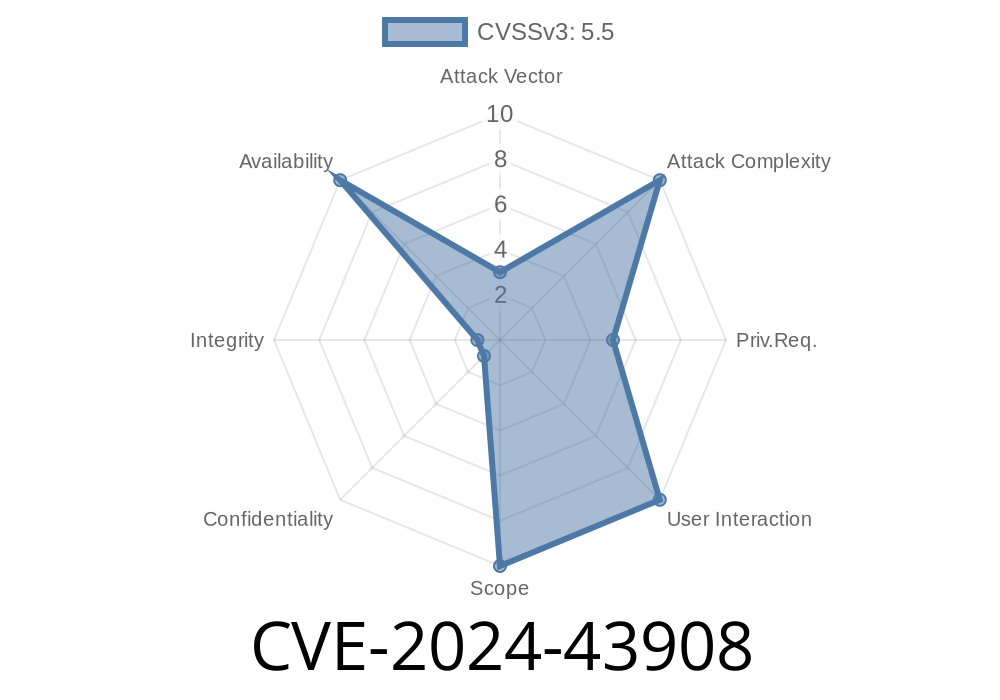
The Linux kernel is the core of most modern servers, desktops, and tons of devices. Sometimes, a small mistake, like an unchecked pointer, can create a serious bug. CVE-2024-43908 is one such vulnerability—a null pointer dereference in the AMDGPU kernel driver’s RAS (Reliability, Availability, and Serviceability) manager. Below, we explain the issue, cover the code, show a basic way it could be triggered, and link official resources.
What is CVE-2024-43908?
CVE-2024-43908 is a vulnerability in the Linux kernel's AMDGPU driver, specifically in code that deals with GPU error reporting via the RAS manager. If the driver code assumes ras_manager is always initialized and tries to use it without verifying, it may end up crashing the system (kernel panic) or even make a path for denial-of-service.
This bug has now been patched in the Linux kernel.
Understanding the Vulnerability
A null pointer dereference means that the program tried to use an object (a struct, for example) that is not actually valid—it points to zero, not real data. In kernel space, such mistakes are deadly: no kernel handler, no error logging—just a sudden system crash.
In the AMDGPU code, there were places like this
if (ras_manager->features & FEATURE_XYZ) {
    do_something();
}
But nobody checked if ras_manager was NULL first. If ras_manager wasn't initialized, just reading ras_manager->features would crash the kernel when this code was called.
How Was It Triggered?
Under certain conditions—such as specific hardware setups, GPU reset events, or faulty initialization—the kernel might end up with amdgpu_ras (the RAS manager) being NULL when a code path tries to access it.
How could an attacker trigger it?
- Local users with permissions to use the AMDGPU interface could intentionally request RAS features or operations on an uninitialized manager.
Malicious scripts could wait for GPU resets or exploit high-load edge cases.
- Such a crash can result in local denial-of-service (DoS), making the machine unusable until a reboot.
Vulnerable Version
// BAD: No NULL check!
if (ras_manager->features & FEATURE_XYZ) {
    do_something();
}
Fixed Version
// GOOD: Always check pointer before using it
if (ras_manager && (ras_manager->features & FEATURE_XYZ)) {
    do_something();
}
The patch simply adds a guard: only access the struct if it's non-NULL. It's a classic C bug at the heart of many kernel issues!
Exploit Scenario
To see an example of what could happen (pseudo code, not an actual exploit!):
# A local user-level program
import fcntl
fd = open("/dev/dri/card", "rb+")  # Open GPU device node

# Try IOCTL that triggers RAS path
try:
    fcntl.ioctl(fd, RAS_TRIGGER_IOCTL, b"\x00" * PAYLOAD_SIZE)
except OSError:
    print("Kernel crashed or operation rejected.")
On a vulnerable kernel, this could crash the kernel if ras_manager is NULL during the IOCTL. On a patched kernel, the call is simply rejected gracefully.
> NOTE: You need appropriate permissions to access GPU device nodes, so this is a local DoS.
Kernel Patch:
- drm/amdgpu: Fix the null pointer dereference to ras_manager
- AMD Official Patch Discussion
CVE Record:
Linux Kernel Security:
Exploit: Local users could cause DoS by triggering the bug.
- Solution: Upgrade your kernel if you use AMD GPU hardware, and check your distro’s security updates.
If you're a system admin or a Linux enthusiast, take a minute to update your systems and stay secure!
*Exclusive content written for you based on the latest kernel patches and CVE information.*
Timeline
Published on: 08/26/2024 11:15:05 UTC
Last modified on: 08/27/2024 13:41:55 UTC