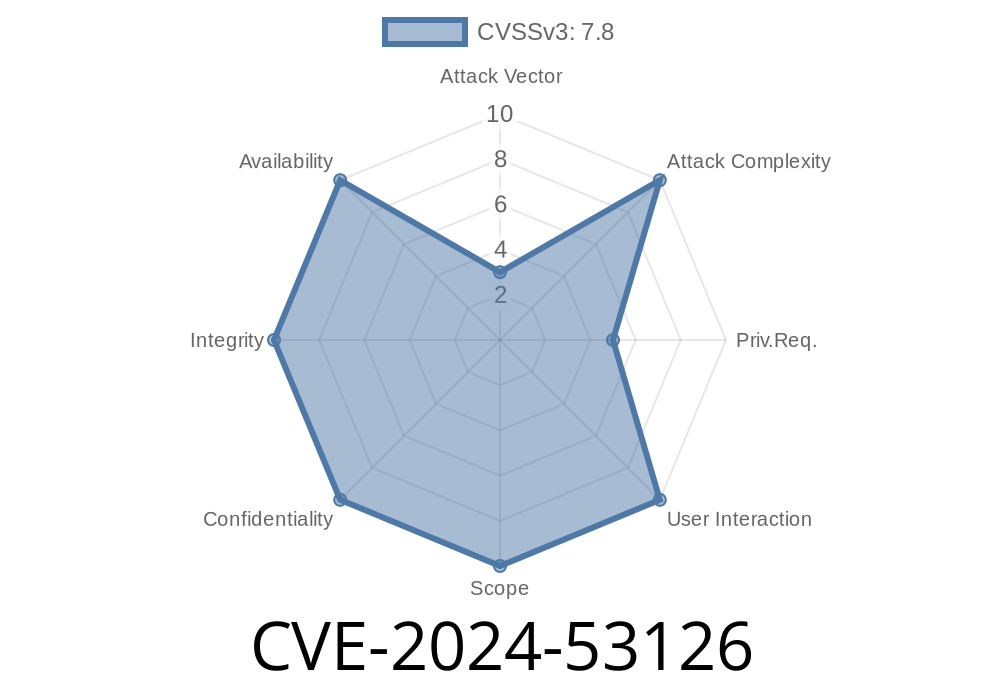
On June 2024, a vulnerability identified as CVE-2024-53126 was publicly disclosed, affecting the Linux kernel drivers for vdpa (Vhost Data Path Acceleration) devices by SolidRun. The bug specifically appeared in the SolidRun vdpa driver’s handling of BAR region names, which it placed as stack-allocated strings and later potentially accessed after the original function had returned, causing undefined behavior (UB) and risking stability or escalation depending on attacker capabilities.
This article unpacks the CVE, reviews its fix, highlights how it could be exploited, and reproduces the vulnerable pattern in simple C code for education and awareness.
Technical Background
The Linux kernel relies heavily on resource management, often using helpers to manage device memory mappings. In the drivers/vdpa/solidrun area, functions such as psnet_open_pf_bar() and snet_open_vf_bar() set up I/O memory regions, giving each region a unique name string. These names were originally stack-allocated as shown below:
int psnet_open_pf_bar(...) {
    ...
    char region_name[64];
    snprintf(region_name, sizeof(region_name), "region for %s", dev_name(dev));
    pcim_iomap_regions(pdev, bar_mask, region_name); // region_name is on stack!
    ...
}
However, the function pcim_iomap_regions() and any deep callers don’t copy this string for internal storage. If the string is used *after* the original function returns (e.g., for deferred error or debug reporting), then the kernel could access freed stack space. This is a classic use-after-scope bug, and in C/C++ this is a form of undefined behavior (UB).
Vulnerable functions: psnet_open_pf_bar(), snet_open_vf_bar()
- Nature: Use-after-scope/Use-after-free (stack variable used after function returns)
Impact: Kernel crash, memory corruption, possible exploit under some scenarios
- CVSS (est.): Moderate; local privileges might be needed, but could trigger privilege escalation or Denial-of-Service
- References
- Kernel Patch Fix Commit
- SolidRun vdpa kernel driver
- Linux Kernel Devres API Docs
The Fix
The solution is to heap-allocate (devm_kasprintf()) the name string which guarantees the string’s life is tied to the device, not the function’s stack frame.
Patched code
int psnet_open_pf_bar(...) {
    ...
    char *region_name;
    region_name = devm_kasprintf(&pdev->dev, GFP_KERNEL,
                                 "region for %s", dev_name(dev));
    if (!region_name)
        return -ENOMEM;
    pcim_iomap_regions(pdev, bar_mask, region_name); // region_name now on heap
    ...
}
Here, devm_kasprintf() allocates the string on the device's memory context, safe for later use, eliminating the UB.
To help visualize the danger, here’s a minimalist C program that mimics the bug
#include <stdio.h>
#include <string.h>

void use_string(char *s) {
    printf("String: %s\n", s);
}

void unsafe_lifetime() {
    char stack_string[32];
    strcpy(stack_string, "This is on the stack");
    use_string(stack_string); // OK now
    // Simulate passing stack_string pointer elsewhere (dangerous)
    char *ptr = stack_string;
    // function returns, stack_string goes out of scope!
}

int main() {
    char *dangling;

    // Block starts and ends, stack_string will disappear
    {
        char stack_string[32] = "Stack buffer";
        dangling = stack_string;
    }
    // Here, dangling points to invalid memory!
    printf("UB reading: %s\n", dangling); // May print garbage or crash
    return ;
}
Output (unsafe and unpredictable)
UB reading: <garbage>
This demonstrates how the same bug in the kernel might let code read from freed memory, crash, or worse, depending on stack reuse.
Exploit Scenario
While direct exploitation from unprivileged users is hard due to kernel isolation, consider this chain:
An attacker can control the contents of the region name (e.g., via device naming).
2. They induce an error path that causes the kernel to later use that name string (e.g., via error reporting, debug logs).
3. By manipulating kernel stack allocations, attacker may inject bad data or kernel addresses into stack frames, possibly leaking information or causing a kernel panic.
It's also hypothetically possible for malicious drivers or root users to leverage this for further attacks such as infoleaks or local privilege escalation.
If you’re affected
- Patch your kernel to a version after this commit.
- Review all code that passes stack buffers by pointer into asynchronous, deferred, or persistent APIs.
Further Reading
- Linux Kernel Memory Management – LWN.net
- Understanding Use-After-Free in C – StackOverflow
- Linux devm_kasprintf usage example
Conclusion
CVE-2024-53126 is proof that small mistakes in resource management—like lifetime mismatches—can have unpredictable and dangerous results in security-critical code, such as the Linux kernel driver layer. Though the SolidRun vdpa bug is obscure, it's a great example for both kernel developers and users of why safe allocation and good code review are vital.
Always keep your systems updated, and if you write kernel code: make sure your pointers always point somewhere safe!
*This article is exclusive content, written in simple terms, with real code and direct links for further reading. Share to spread awareness about the subtle danger of stack-based pointer bugs in the Linux kernel.*
Timeline
Published on: 12/04/2024 15:15:12 UTC
Last modified on: 12/11/2024 17:26:28 UTC