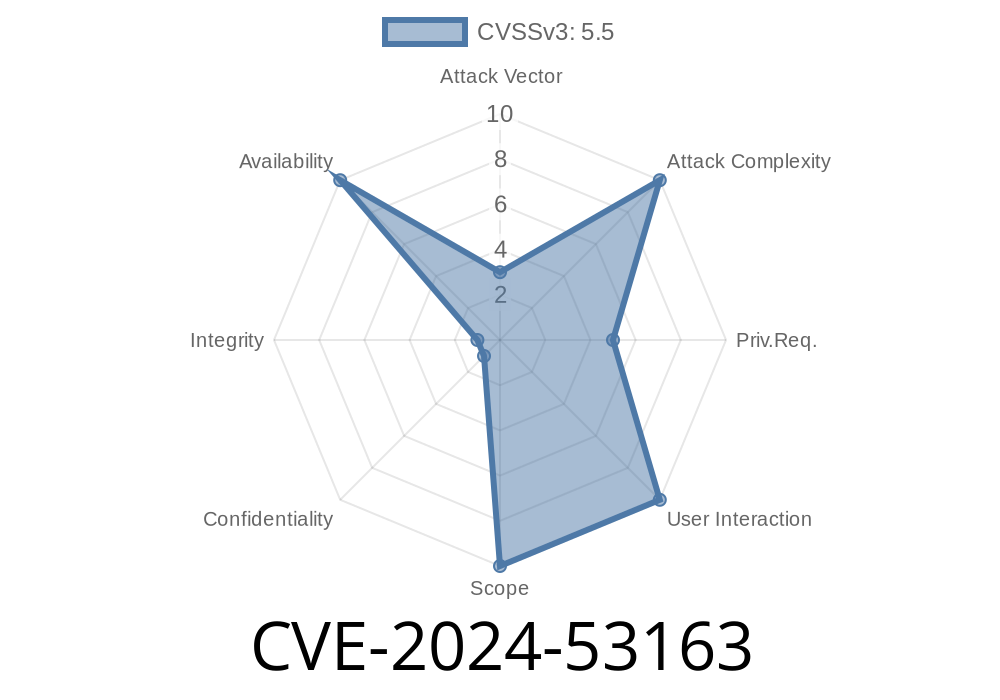
The Linux kernel is the heart of many devices, and security problems here can trickle down to almost every user. Today, let’s take an exclusive deep-dive into a recently resolved vulnerability: CVE-2024-53163, affecting the crypto/qat_420xx module inside the Linux kernel. This flaw revolves around a classic programming bug: an "off by one" error. But how can a tiny mistake like this make such a big impact? Let’s break it down.
What Was the Problem?
The vulnerability was located inside the uof_get_name() function, which gets called from the uof_get_name_420xx() function. Both are part of the Intel QuickAssist Technology (QAT) crypto accelerator, used to offload cryptographic operations from the CPU to specialized hardware.
Here’s the short version:
The function made an array access check with a 'greater than' (>) test, when it actually should have used 'greater than or equal to' (>=). This mistake could allow attackers to access memory just beyond the end of an array, resulting in an out-of-bounds read, which is a known vector for both information leaks and potential code execution.
Let’s look at a simplified, illustrative snippet
// fw_objs is an array of objects, count is num_objs
if (index > num_objs) {
    // handle error
    return -EINVAL;
}
obj = fw_objs[index]; // This access is risky if index == num_objs!
The check above lets index go all the way up to num_objs, but array indices in C go from to num_objs - 1. If index == num_objs, then fw_objs[num_objs] reads just past the end of the array — classic "off by one".
The fix (patch) changed the check to
if (index >= num_objs) { // Correct!
    return -EINVAL;
}
How Could An Exploit Work?
While this is not an easily exploitable remote code execution bug, it *is* dangerous, particularly if crafted input can control the index variable. Here’s a hypothetical scenario:
The function might operate on (and possibly leak) the contents of the memory just beyond the array.
If nearby memory contains sensitive data (like crypto keys or configuration), this could create a leak. In a worst-case scenario, manipulating this OOB read can open the door to further exploitation.
Exploit Example (Proof-of-Concept)
Below is *pseudo-code* showing how an attacker might trigger the bug, assuming there's a way to call into the vulnerable function with user-controlled data (for example via ioctl or sysfs):
// Danger: index is controlled by attacker, say index = num_objs
ret = uof_get_name_420xx(attacker_supplied_index);
if (ret == ) {
    // Possibly fetched out-of-bounds memory
    printf("Leaked info: %s\n", leaked_obj_name);
}
In a real-world exploit, the attacker needs to both be able to control the index and have local access, but it could be enough to leak kernel memory, which is always dangerous.
How Was It Fixed?
The kernel developers caught this off-by-one issue and promptly fixed it. The fix was merged in kernel commit abbf027d3e18, which changed:
if (index > num_objs)
into
if (index >= num_objs)
This simple change prevents the function from ever reading past the allocated array. The fix will be included in future kernel updates.
References
- Linux Kernel Commit Fix
- CVE Record (MITRE)
- QAT Documentation - Intel
Should I Worry?
If you’re running a system that uses QAT crypto offload (many servers and security appliances do), it’s a good idea to update your kernel as soon as the fix becomes available in your distribution. While this is a local kernel bug, in multi-user or containerized environments it can be valuable for privilege escalation or leaking sensitive data.
Summary
CVE-2024-53163 is a classic off-by-one bug in the Linux kernel’s QAT 420xx driver. Small mistakes like this can open up big risks, so always keep your kernel up to date. And if you’re a kernel developer? Always double-check your index bounds!
Feel free to share or quote this article to help spread awareness — keeping open source secure is everyone’s job!
Timeline
Published on: 12/24/2024 12:15:24 UTC
Last modified on: 03/06/2025 12:42:52 UTC