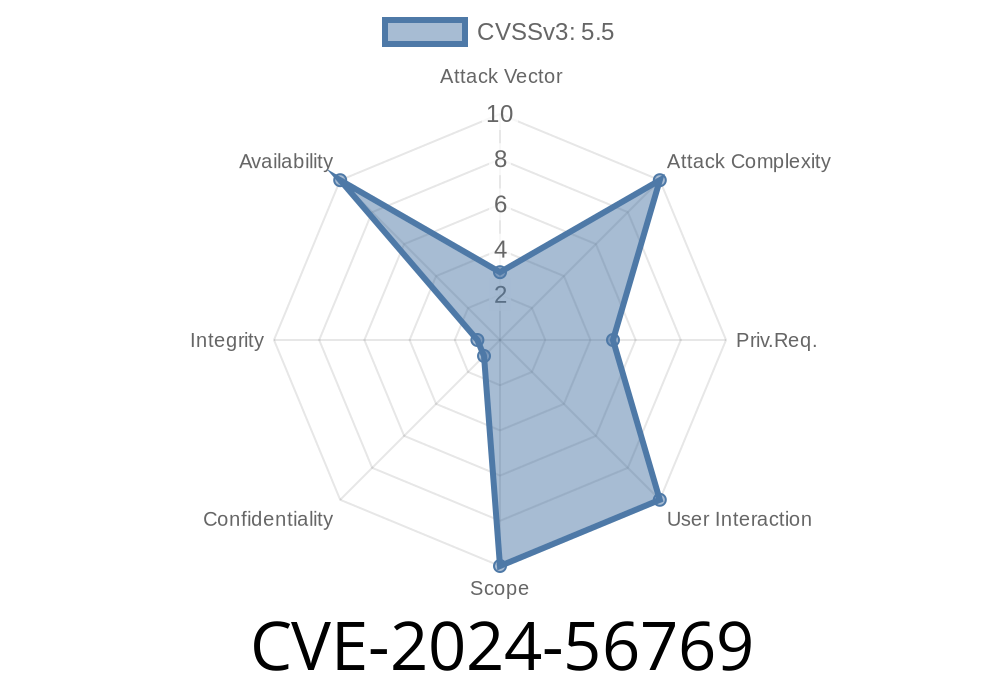
The Linux kernel is the beating heart of millions of devices—everything from web servers to digital television receivers. When bugs slip in, they can have wide-reaching effects. One recently patched issue is tracked as CVE-2024-56769, and it centers on a rather subtle but critical problem: the use of an uninitialized buffer in the dib300mb DVB frontend driver.
This article will explain what went wrong, how it was fixed, and what this means for Linux users and developers.
What Is CVE-2024-56769?
CVE-2024-56769 is a vulnerability in the dib300mb Digital Video Broadcast (DVB) frontend driver, specifically within the Linux kernel’s media framework. The bug is about using data from a buffer before making sure it actually contains good values—called using an “uninitialized value.”
In more concrete terms: When the driver talks to certain DVB hardware over I2C (a common communication bus), it sometimes reads into a memory buffer named rb. If the read doesn’t work correctly, rb is not filled with real data and still holds whatever happened to be in memory. Using such unpredictable values can lead to strange behaviors and even security problems.
Who can be affected?
- Anyone running a Linux system with this DVB hardware and driver (especially if device access is available to untrusted users).
How Was the Problem Found?
Like many modern bugs, this one was first uncovered in automated testing. Syzkaller is a fuzzing tool from Google that throws random inputs at the kernel to see what breaks. With help from KMSAN (Kernel Memory Sanitizer), Syzkaller caught the kernel reading uninitialized data in the following function: dib300_read_reg().
Here’s an excerpt from the report
BUG: KMSAN: uninit-value in dib300mb_attach+x2d8/x3c drivers/media/dvb-frontends/dib300mb.c:758
Local variable rb created at:
 dib300_read_reg+x86/x4e drivers/media/dvb-frontends/dib300mb.c:54
Let’s take a look at the problematic part of the code (shortened for clarity)
static int dib300_read_reg(struct i2c_adapter *adap, u8 reg)
{
    u8 rb[2];
    struct i2c_msg msg[] = {
        { /* ... setup message ... */ },
        { /* ... setup read ...  .buf = rb, .len = 2 ... */ }
    };

    /* ... send I2C messages ... */
    ret = i2c_transfer(adap, msg, 2);

    if (ret != 2) {
        /* Error handling? */
        return -EIO;
    }

    return (rb[] << 8) | rb[1];  // <-- THIS READS FROM rb EVEN ON ERROR
}
If i2c_transfer(...) fails, .buf (which points to rb) could contain *garbage values*—and the code still uses those values! If those garbage values leak or are used in further computations, it can lead to wrong results or even security holes.
The Fix
The fix is, thankfully, straightforward: Initialize the buffer to zero before using it. That way, even if the read fails, rb contains predictable, safe values.
The patched code looks like this
static int dib300_read_reg(struct i2c_adapter *adap, u8 reg)
{
    u8 rb[2] = {, };  // Zero the buffer
    struct i2c_msg msg[] = {
        // ... same as before ...
    };

    ret = i2c_transfer(adap, msg, 2);

    if (ret != 2) {
        // No uninitialized read—safe to return error
        return -EIO;
    }

    return (rb[] << 8) | rb[1];
}
You can see the official commit here
- media: dvb-frontends: dib300mb: fix uninit-value in dib300_write_reg (kernel.org commit)
Privilege Needed: Local access to the device (or process) that uses the DVB frontend driver.
- What Could Happen: An attacker could trigger code paths that use the broken register read, then leverage the garbage data in rb for further exploitation (crashing the device, info leaks, or undefined behavior).
Typical attack vector: An untrusted process with DVB device access could use this bug to make the driver hand back memory content it shouldn’t, depending on what's left in the buffer.
PoC (Proof of Concept)
While this bug does not immediately allow for code execution, consider a simple exploit scenario (pseudocode):
// This user-space program triggers the vulnerability by repeatedly forcing
// failures in i2c_transfer and then capturing results.

// NOT a real attack — but shows how an info leak could work:
while (1) {
    int result = ioctl(dvb_fd, DIB300_READ_REG, bad_reg_addr);
    if (result != -EIO) {
        printf("Leaked data: x%x\n", result);
    }
}
Again, this can only leak whatever junk data happened to be in kernel memory at that moment, but in some situations (especially if kernel memory is sensitive or shared), this might reveal system info or help in chaining further exploits.
References
- Linux kernel commit (official fix): media: dvb-frontends: dib300mb: fix uninit-value in dib300_write_reg
- Syzkaller automated bug report
- About KMSAN (Kernel Memory Sanitizer)
Conclusion
CVE-2024-56769 might look simple, but it shows why memory safety matters deeply in kernel code—especially around device drivers and hardware communication. It’s unlikely to be remotely exploitable or allow immediate privilege escalation, but info leaks and unpredictable kernel behavior are always serious risks. This bug is now fixed, and the solution is easy—so be sure your Linux kernel is up-to-date, especially if you use DVB hardware.
Takeaway: Always initialize your memory—and, if in doubt, return a clear error without touching unknown data!
*If you want to learn more about this class of bugs or how to use fuzzers like Syzkaller and sanitizers like KMSAN, check out the resources above.*
Timeline
Published on: 01/06/2025 17:15:44 UTC
Last modified on: 01/07/2025 22:49:54 UTC