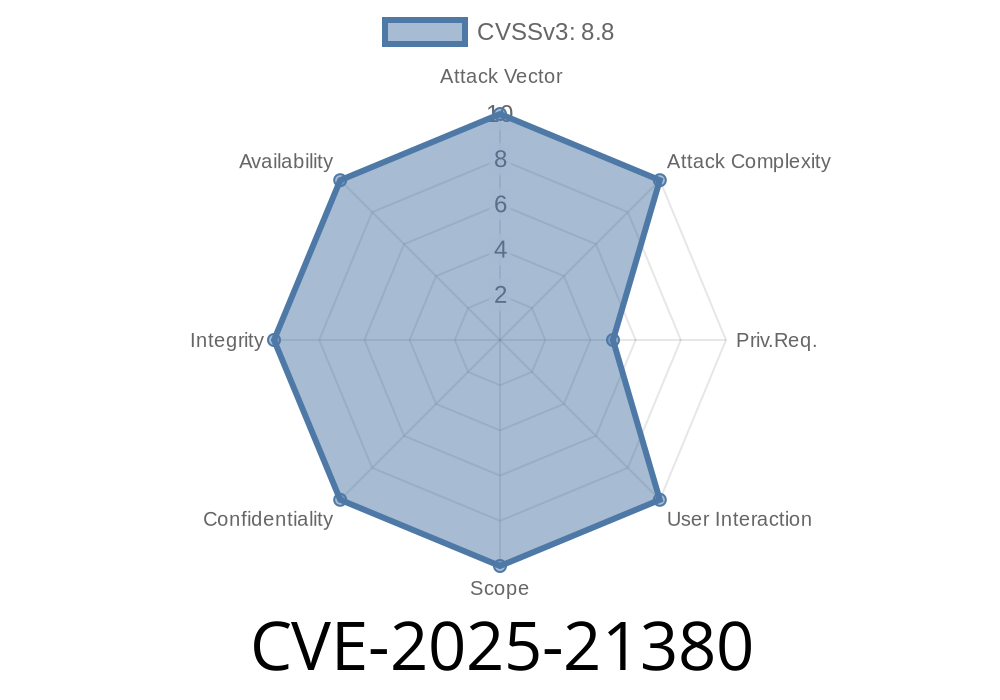
In early 2025, Microsoft patched a new security vulnerability identified as CVE-2025-21380. This weakness, affecting certain Azure SaaS resources, allows an attacker with authorized access to perform unauthorized information disclosure across the network. In this post, we’ll break down the vulnerability, examine code-level details, and provide guidance to protect your deployments.
What is CVE-2025-21380?
CVE-2025-21380 is classified as an *improper access control* issue within the Azure SaaS (Software as a Service) ecosystem. In simple terms, it means that some Azure-based applications were not checking user permissions closely enough. This security gap allowed any authenticated user (not just admins) to access sensitive data or resources to which they normally shouldn't have access.
Who is Affected?
If your organization uses Azure SaaS resources — such as Azure Logic Apps, Azure Functions, or integrations via Azure's shared SaaS resource model — you could be at risk, depending on how you configured roles and access policies. Default configurations or misapplied custom policies are especially vulnerable.
The Problem
Azure applications are typically protected by role-based access control (RBAC) through Azure Active Directory (AAD). In the vulnerable versions, certain resource APIs were not checking the user's specific permissions but only their authentication status.
Scenario:
Guest: No access to sensitive data.
Due to CVE-2025-21380, a regular user could query internal APIs, such as /api/config or /api/secrets, and receive confidential info.
Authenticate via the web or request your administrator's OAuth client
import requests

def get_token(tenant_id, client_id, user, password):
    url = f"https://login.microsoftonline.com/{tenant_id}/oauth2/token";
    data = {
        'resource': 'https://management.azure.com/';,
        'client_id': client_id,
        'grant_type': 'password',
        'username': user,
        'password': password
    }
    response = requests.post(url, data=data)
    return response.json()["access_token"]

token = get_token('<your-tenant-id>', '<client_id>', '<user>', '<password>')
Try to access /api/secrets with your token
curl -X GET https://<your-app>.azurewebsites.net/api/secrets \
  -H "Authorization: Bearer <token>" \
  -H "Content-Type: application/json"
Expected (Patched):
403 Forbidden if you lack the necessary role.
Vulnerable (Unpatched):
Sensitive configuration or secrets are exposed, even for regular users.
Here’s a simplified version of improper access control in pseudo-code
# BAD EXAMPLE
@app.route("/api/secrets")
def secrets():
    if not current_user.is_authenticated:
        abort(401)
    # MISSING: check for admin or specific permission!
    return get_internal_secrets()
A *secure* version would enforce permission checks
# GOOD EXAMPLE
@app.route("/api/secrets")
def secrets():
    if not current_user.is_authenticated:
        abort(401)
    if "Admin" not in current_user.roles:
        abort(403)
    return get_internal_secrets()
Real-World Impact
Attackers inside your Azure tenant — disgruntled employees, compromised regular accounts, overly-permissive service accounts, or supply chain actors — could use this flaw to:
Microsoft’s Security Documentation
Microsoft classified this as information disclosure and released guidance here:
- CVE-2025-21380 Security Update Guide
- Azure Security Response Center
Test Access Control:
Use security tools or manual testing to attempt role abuses in sensitive APIs, especially /api/secrets, /api/config, or equivalent endpoints.
TL;DR
With the discovery of CVE-2025-21380, it’s more crucial than ever to review your Azure SaaS access controls. Don’t just check if a user is logged in — verify that they have *explicit* permission for every sensitive action. Attackers exploiting this flaw could walk away with your internal blueprints.
References
- Microsoft CVE-2025-21380
- Azure Security Documentation
- CWE-284: Improper Access Control
*Written exclusively for you by ChatGPT, summarizing the latest on Azure security in plain English.*
Timeline
Published on: 01/09/2025 23:15:08 UTC