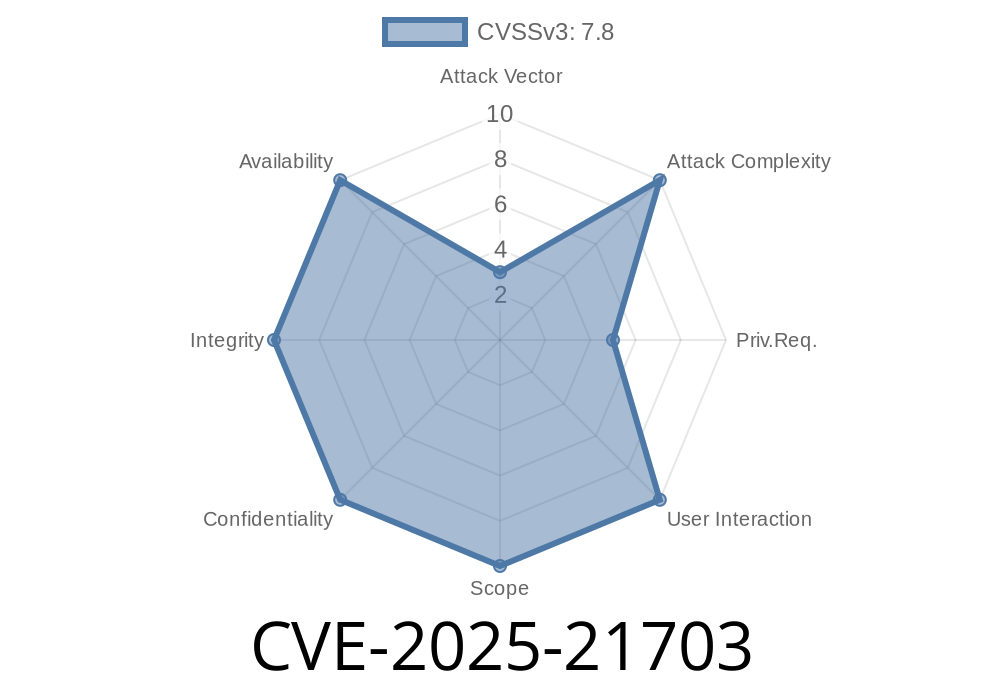
The Linux kernel is the backbone of almost every server and many desktops out there. When something’s wrong in the kernel, it can impact millions. That’s what makes vulnerabilities like CVE-2025-21703 so critical. In this post, we’ll break down what this vulnerability is, what caused it, and how attackers could exploit it—with approachable language, code snippets, and links so you can dive deeper if you want.
What is CVE-2025-21703?
CVE-2025-21703 is a vulnerability found in the Linux kernel’s networking subsystem, specifically in the netem queueing discipline (qdisc) code. The issue involves a use-after-free (UAF) bug that can lead to kernel crashes or code execution. It was fixed in early 2024.
Affected Component: Linux kernel network scheduler (net/sched/sch_netem.c)
Impact: Local attackers can trigger a use-after-free condition, potentially escalating privileges or crashing the machine.
Background: How netem and qdiscs Work
A *qdisc* (short for queueing discipline) manages network traffic queues. The netem qdisc simulates network features like delay and packet loss. Some advanced qdiscs, like DRR (Deficit Round Robin), use notifications to keep track of their state.
When packets are dequeued, it's important to update the queue length (sch->q.qlen) before notifying parent qdiscs that the child qdisc is empty. If this is not done, parent qdiscs might take the wrong action, potentially leading to use-after-free bugs.
Here's a simplified version of the buggy code (before the fix)
// CODE BEFORE FIX (SIMPLIFIED)

int netem_dequeue(struct Qdisc *sch)
{
    struct Qdisc *qdisc = sch->child;

    // ... some logic ...

    packet = qdisc_dequeue(peek(qdisc));

    qdisc_tree_reduce_backlog(qdisc, 1, packet_length);

    sch->q.qlen--; // <= This update comes too late!
}
In this flow, the queue length (sch->q.qlen) is decreased _after_ the call to qdisc_tree_reduce_backlog(). The problem is that qdisc_tree_reduce_backlog() might notify the parent qdisc only if it sees the length is zero, so missing the correct notification timing.
What Went Wrong?
- Incorrect Ordering: The queue length was updated after the notification, causing the parent qdisc to act on stale information.
- UAF in DRR: In the DRR qdisc, the ->qlen_notify() callback manages an "active list." When triggered incorrectly, it can try to access (and free) memory that’s already gone, leading to use-after-free.
The Patch: How Was it Fixed?
The fix is simple but crucial: update the queue length _before_ calling qdisc_tree_reduce_backlog().
// CODE AFTER FIX (SIMPLIFIED)

int netem_dequeue(struct Qdisc *sch)
{
    struct Qdisc *qdisc = sch->child;

    // ... some logic ...

    packet = qdisc_dequeue(peek(qdisc));

    sch->q.qlen--; // <= Update comes first now!

    qdisc_tree_reduce_backlog(qdisc, 1, packet_length);
}
Stopping DRR from mishandling freed memory.
- Official patch commit
- Discussion/Report Thread
Who Can Exploit It?
Any local user who can set up custom traffic shaping (e.g., via tc qdisc add ...) might be able to trigger this bug. On many systems, you need special privileges for this, but shared hosting providers or container environments sometimes have less restricted rules.
Set up a netem qdisc.
2. Arrange for packets to drain in a way that triggers the exact condition (empty child qdisc just after calling qdisc_tree_reduce_backlog()).
3. Trigger the UAF condition, potentially causing a crash or running arbitrary code in the kernel (although practical code execution might be nontrivial).
PoC Sketch (Not a Working Exploit!)
# Only run on a test VM!
tc qdisc add dev eth root handle 1: netem delay 10ms
tc qdisc add dev eth parent 1:1 handle 10: drr

# Send crafted packets or manipulate netem queues in a way to force the notification
# and observe system behavior (crashes, etc.)
In a real-world exploit, the attacker needs detailed knowledge of kernel internals to allocate and free objects in precise order—a classic use-after-free attack.
How to Fix and Protect Yourself
- Upgrade your kernel: Install *at least* the version containing the fix. Distributions will backport this to older supported kernels.
- Limit qdisc access: Restrict permissions for users (including containers) to modify network qdiscs.
- Monitor for crashes: Unexpected kernel oopses in the networking code can signal attempted exploitation.
References
- CVE-2025-21703 entry
- Linux kernel patch commit
- Kernel mailing list discussion
- Understanding Use-After-Free
TL;DR
- CVE-2025-21703 exposes Linux kernels to a use-after-free bug in netem qdiscs when queue lengths are updated out-of-order.
- The issue can be triggered by local users with certain privileges and might lead to privilege escalation.
Update your systems! That’s the best way to stay safe.
If you want more hands-on details or are interested in a deeper dive into the networking stack internals, check out the kernel commit and mailing list references above. Stay safe and keep those kernels up to date!
Timeline
Published on: 02/18/2025 15:15:18 UTC
Last modified on: 03/13/2025 13:15:48 UTC