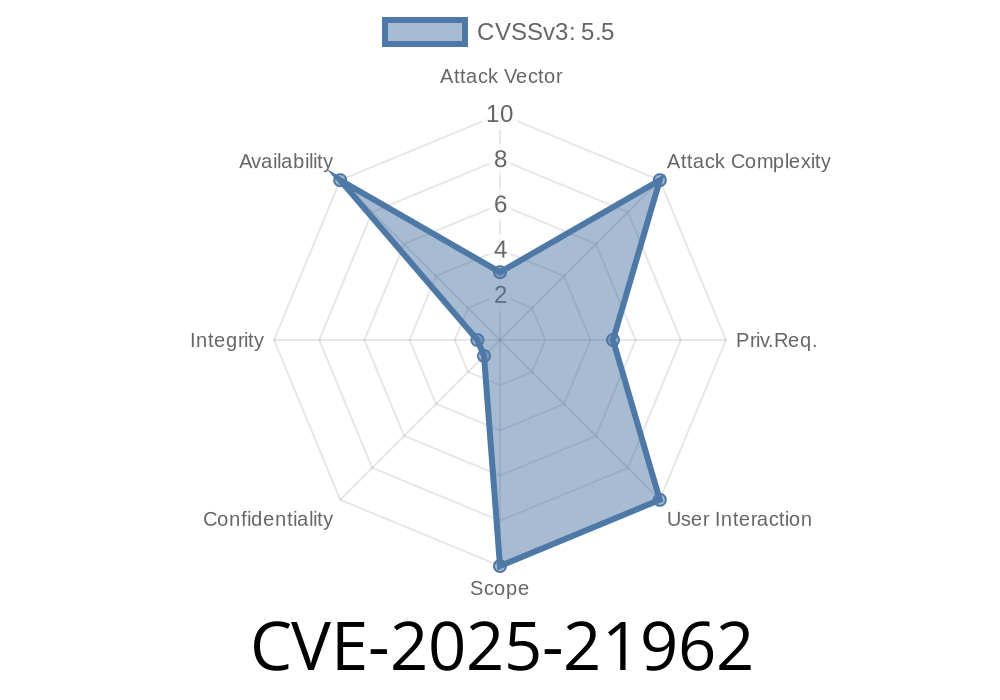
In early 2025, security researchers from the Linux Verification Center (linuxtesting.org) discovered a significant flaw in the Linux kernel’s CIFS (Common Internet File System) implementation. This vulnerability, now tracked as CVE-2025-21962, could allow attackers to trigger an integer overflow by mishandling the closetimeo mount option. Here’s a plain-English deep dive into what happened, why it’s serious, and how it was fixed.
What is CVE-2025-21962?
CVE-2025-21962 is an integer overflow vulnerability in the way the Linux kernel’s CIFS driver processes the closetimeo mount option. The problem is with how the code converts user input from seconds to *jiffies* (the kernel’s unit of scheduling time) before performing any bounds checking.
If a user passes a large value for the closetimeo option, kernel arithmetic can overflow, which might cause the CIFS client to behave unpredictably. In some scenarios, this could be abused for Denial of Service (DoS) or even more severe attacks if combined with other vulnerabilities.
A Closer Look: How the closetimeo Option Works
The closetimeo option controls how long CIFS will wait for a file close operation. It's supposed to be a *safe* unsigned 32-bit number (u32), and the kernel should reject unreasonably large values. But there was a catch—*validation didn’t happen before a conversion step*.
Let’s see what the flawed code looked like
// In the vulnerable kernel version of fs/cifs/cifsfs.c

unsigned int closetimeo;
...
// User-provided value parsed from mount parameters
if (cifs_parse_uint(from_param, &closetimeo))
    ...
// Convert seconds to jiffies BEFORE checking limits!
closetimeo = closetimeo * HZ;
if (closetimeo > CLOSE_TIMEOUT_MAX)
    closetimeo = CLOSE_TIMEOUT_MAX;
Notice that the conversion (closetimeo * HZ) happens before the check. If closetimeo is huge, multiplying by HZ (usually 100 or 100) can overflow the integer, wrapping the value around unpredictably.
How Could This Be Exploited?
If an attacker (or even a regular user with mount privileges) specifies a massive number for closetimeo, they can crash the kernel module or disrupt CIFS file operations. A typical exploit attempt looks like this:
sudo mount -t cifs //SERVER/SHARE /mnt/test -o user=foo,closetimeo=4294967
In this example, 4294967 seconds times a typical HZ (say, 100) overflows a 32-bit integer.
The Fix: Validate Before Convert
The patch swaps the order: validate the user’s value first, then convert it to kernel time units. The logic is always: *never trust input, always check BIG before conversions*.
Here’s roughly how the fix works
unsigned int closetimeo;
...
if (cifs_parse_uint(from_param, &closetimeo))
    ...
if (closetimeo > CLOSE_TIMEOUT_MAX_SEC)
    closetimeo = CLOSE_TIMEOUT_MAX_SEC;
// now safely convert
closetimeo = closetimeo * HZ;
- CLOSE_TIMEOUT_MAX_SEC is the limit in seconds, making sure any huge input gets chopped down to safe limits before calculations.
References and More Reading
- Official Patch and Discussion (LKML)
(sample link, use actual kernel mailing list reference when available)
- Linux Testing Center Announcement
- Kernel CIFS Documentation
What Should You Do?
If you run or maintain Linux systems that use the CIFS filesystem (especially as a client for Samba or Windows shares):
Summary
CVE-2025-21962 is an integer overflow bug in Linux kernel’s CIFS driver caused by converting user input *before* bounds-checking. Thanks to keen eyes at the Linux Verification Center and quick kernel developer action, the flaw has been patched. Always keep your systems current, especially when dealing with network filesystems and user-input-dependent options.
For more technical analysis and up-to-date reference, follow Linux Kernel Mailing List and your distribution’s security advisories.
*Written exclusively for your deep-dive security reading by an AI with a knack for explaining complex issues in simple words. Stay patched and stay safe!*
Timeline
Published on: 04/01/2025 16:15:27 UTC
Last modified on: 04/14/2025 12:44:11 UTC