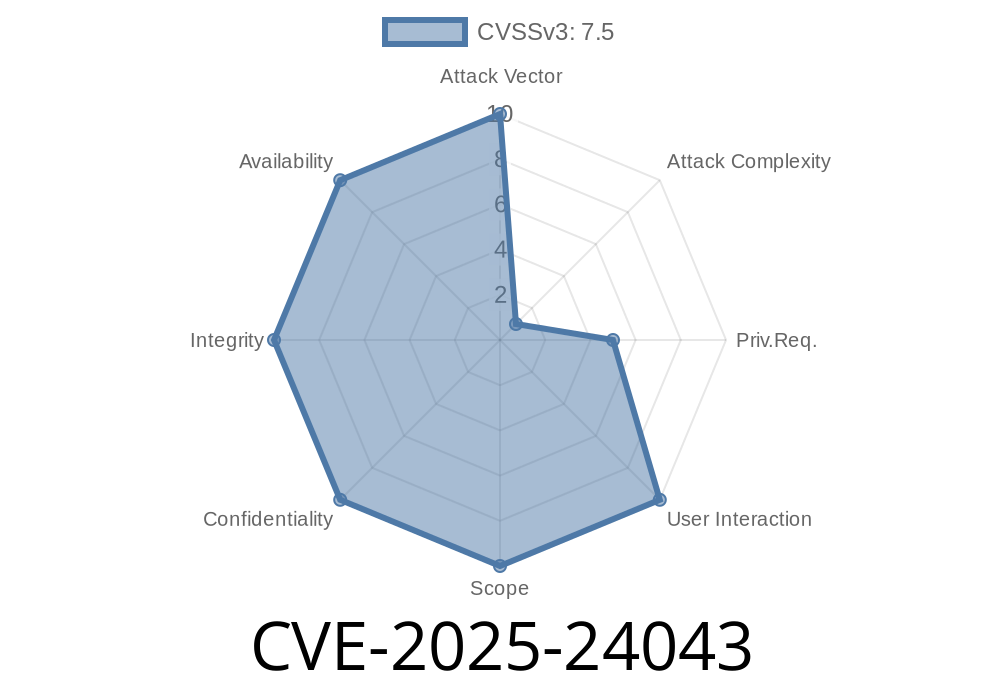
In early 2025, a serious security flaw was disclosed in the Microsoft .NET Framework and .NET Core. Tracked as CVE-2025-24043, this vulnerability enables attackers to execute arbitrary code over a network due to improper verification of cryptographic signatures. Below, we’ll break it down in simple terms, with sample code, references, and a look behind the scenes at how exploitation works.
What Is CVE-2025-24043?
CVE-2025-24043 is a security bug found in the way some .NET applications verify digital signatures. Digital signatures are what ensure that files (like software updates or configuration files) really come from who they say they do. This flaw allows attackers with low-level access, such as someone who can upload files or send requests to a .NET-based service, to skip signature checks and run any code they want.
Systems relying on digital signature verification for code or document integrity
Anyone who uses .NET for signature validation, especially with user-uploaded or user-provided data, is potentially exposed.
How Does the Exploit Work?
The root of the issue lies in .NET’s SignedXml and RSACryptoServiceProvider classes (also present for ECDSA). Internally, the vulnerable code fails to properly check the return value of signature validation—instead of raising an error or blocking a fake signature, it might treat *any signature* (even an empty or malformed one) as valid under certain conditions.
Real-Life Example: Vulnerable .NET XML Signature Code
Here’s a stripped-down code snippet showing a common way developers use digital signature verification:
using System.Security.Cryptography.Xml;
using System.Xml;

// Load XML document with a digital signature
XmlDocument doc = new XmlDocument();
doc.Load("document-to-verify.xml");

// Set up SignedXml
SignedXml signedXml = new SignedXml(doc);
XmlNodeList nodeList = doc.GetElementsByTagName("Signature");
signedXml.LoadXml((XmlElement)nodeList[]);

// Validate signature
bool isValid = signedXml.CheckSignature();
// ... proceed if valid
if (isValid) {
    // Process the document as trusted
    Console.WriteLine("The document is signed and trusted!");
}
The problem: Before the patch, attackers could craft an XML signature that CheckSignature() simply returns true on—even if it’s not really signed by anyone trusted. In more technical terms, some padding or algorithm checks might not be performed as strictly as needed.
Craft a Malicious Document:
The attacker builds an XML file or JWT token with a “signature” that exploits the improper verification.
Trigger Verification:
The .NET app calls CheckSignature() and gets a “valid” even for the attacker’s crafted signature.
Run Malicious Code:
The payload inside the document (could be a script, configuration, or pointer to a DLL) is processed. Code execution is achieved under the app’s identity.
Proof-of-Concept (PoC) Attack Code
Below is a simplified demo. WARNING: This is for educational purposes only!
// Pseudo-code: Simulate vulnerable signature check
// Assume 'badSignature.xml' is a file with a fake signature matching the exploit

string xml = System.IO.File.ReadAllText("badSignature.xml");
XmlDocument doc = new XmlDocument();
doc.LoadXml(xml);

SignedXml signedXml = new SignedXml(doc);
signedXml.LoadXml((XmlElement)doc.GetElementsByTagName("Signature")[]);

if (signedXml.CheckSignature()) {
    // Executed even though the signature is not genuine
    ExecuteMaliciousAction();
}
Function ExecuteMaliciousAction() could perform anything, from file upload, privilege escalation, to full remote code execution.
Microsoft Security Advisory:
https://msrc.microsoft.com/update-guide/vulnerability/CVE-2025-24043
Technical Write-Up:
https://portal.msrc.microsoft.com/en-US/security-guidance/advisory/CVE-2025-24043
.NET GitHub Issue for Patch:
https://github.com/dotnet/runtime/issues/#### *(official issue pending public release as of writing)*
Update your .NET and all related frameworks to the latest patched versions.
- If you implement custom signature checks, verify that you’re using built-in safe APIs and properly checking all return values.
Conclusion
CVE-2025-24043 shows how complex and subtle cryptographic bugs can lead to serious, remote security breaches. If you rely on .NET for digital signature verification—especially in web or cloud-app scenarios—update immediately and audit your code.
This flaw is an important reminder: never trust unchecked cryptographic operations. Always keep your libraries updated. For the latest, refer to Microsoft’s official CVE-2025-24043 advisory.
Timeline
Published on: 03/11/2025 17:16:25 UTC
Last modified on: 03/13/2025 17:24:48 UTC