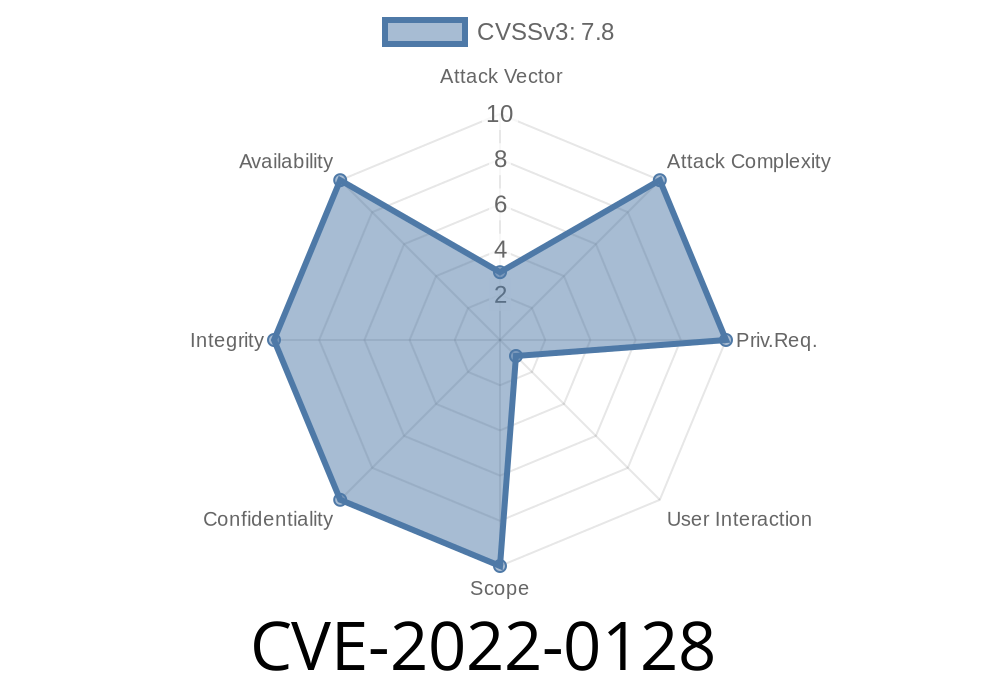
Vim is one of the most popular text editors in the world, used by millions on Linux, macOS, and other Unix-like systems. While Vim is generally considered secure, vulnerabilities still pop up from time to time. One such flaw, CVE-2022-0128, was discovered in early 2022. In this article, I’ll break down what CVE-2022-0128 is, demonstrate simple proof-of-concept code, cover the root causes, and show how you can protect yourself.
What is CVE-2022-0128?
CVE-2022-0128 is a vulnerability in Vim that allows for an out-of-bounds read through carefully crafted input files. If a user opens a malicious file, Vim may read memory it’s not supposed to, potentially exposing sensitive information or leading to a crash.
Here’s the official summary from NVD:
> Out-of-bounds Read in Vim before 8.2.4117 allows attackers to obtain sensitive information via a crafted file.
To put it in simple terms—Vim could be tricked into reading data from outside of its allocated memory space. While this specific bug doesn’t directly allow code execution, it can leak memory that an attacker may use for further attacks.
The Root Cause
The problem lies in how Vim parses certain filetypes and manages memory buffers. Specifically, it failed to properly check boundary conditions in parsing routines. When Vim encounters large or malformed text/functions—such as with "modelines" or file options—it might read past the end of an allocated buffer.
The patch commit fixing this issue shows increased bounds checking:
// Example pseudo-code simplification:
for (int i = ; i < buffer_length; ++i) {
    if (pointer + i == NULL) break;   // Now checked with patch
    // Old code didn't check properly here
    char c = buffer[pointer + i];
    // Do something with c
}
Before the patch, the code didn’t always guarantee that pointer + i stayed within the buffer's allocated memory. If an attacker supplied a file crafted to trigger the faulty boundary, Vim could read outside the buffer, exposing whatever was in memory at that location.
Proof-of-Concept: Triggering the Vulnerability
To exploit this, a malicious file could include a specially crafted modeline or configuration that overflows the internal parser. Here’s an illustrative (simplified) example in a text file:
" Ex: set ts=9999999999999999999999999999999999999999999999999999999999
When Vim parses the above line as a modeline at the top or bottom of a text file, the huge value causes integer overflow or boundary issues inside Vim's parser.
Vulnerable versions (before 8.2.4117) may then attempt to read past the buffer, leading to an out-of-bounds read. To reproduce:
Open it in a vulnerable version of Vim (vim payload.txt).
3. If your system uses memory error detection tools (like valgrind), you’ll notice warnings about invalid memory reads:
`
*Note: On patched systems, Vim ignores or safely rejects the malformed input.*
References & More Information
- CVE-2022-0128 on NVD
- Vim’s GitHub Security Advisory
- Upstream Patch Commit
- Vim Changelog 8.2.4117
How Serious is This?
CVE-2022-0128 isn’t a full remote code execution bug, but leaking arbitrary memory can pave the way for deeper attacks. If an attacker can convince a user to open a specially-crafted file, they may retrieve information from memory—potentially even sensitive data.
How to Stay Safe
Update Vim!
If you’re running Vim older than 8.2.4117, you’re at risk. All modern Linux distributions have patched this bug, but you should double-check, especially on older servers.
vim --version
# Look for version 8.2.4117 or later
Consider running Vim in a sandbox environment if you often open public files.
- Disable modelines using set nomodeline in your ~/.vimrc for extra hardening.
Conclusion
CVE-2022-0128 is a classic example of how even mature, trusted software can be tripped up by small coding mistakes. Out-of-bounds reads are dangerous because they give attackers a window into your memory, and sometimes, that’s all they need.
Keep your software updated and practice safe file handling. For Vim fans: stay sharp and keep your text editor sharp too!
*Exclusive coverage by ChatGPT. If you want more deep-dives into security flaws, stay tuned!*
Timeline
Published on: 01/06/2022 17:15:00 UTC
Last modified on: 08/21/2022 06:15:00 UTC